TYPE: Short Communication
Shahid Nawaz Khwaja Bhai Landge¹* , Tanveer A. Khan², Mujaffar Shaikh³
¹The Blatter Herbarium, St. Xavier College (Empowered Autonomous Institute), Mumbai, India – 400001
²Department of Botany, H. J. Thim College of Arts and Science, Mehrun. Jalgaon, Maharashtra state, India – 425001
³Department of Botany, S. N. Govt. P.G. College, Khandwa District, Madhya Pradesh, India –450001

The genus Parahyparrhenia A.Camus, a rare, relatively small Afro-Eurasian genus (Landge & Shinde, 2021), is classified within the tribe Andropogoneae Dumortier. Globally, this genus is represented by seven species distributed across Africa, India, and Thailand (Soreng et al., 2017; Landge & Shinde, 2021, 2022). In India, only two species are known, viz., P. bellariensis (Hack.) Clayton and P. khannae A.P. Tiwari & Chorghe, both of which are considered endemic to the country (Landge & Shinde, 2021). Taxonomically, the genus is generally considered polyphyletic. Morphologically, it is notably characterised by the presence of a protruding, pungent callus on the sessile spikelet; a detailed description of its distinguishing characters is provided in Landge & Shinde (2022).
During a phylogenomic study focused on Asian Andropogoneae, correspondence with the second and third authors (TAK and MS) brought attention to an important collection of an interesting grass specimen. This specimen originated from the northern drier regions of Maharashtra, specifically the Jalgaon district. The specimens were subsequently sent to the Blatter Herbarium (BLAT) and identified by the first author (SNL) as Parahyparrhenia khannae using the key provided by Landge & Shinde (2021, 2022) (Figures 1 & 2).
Prior to this finding, Parahyparrhenia khannae was known only from a few isolated localities in the Indian states of Madhya Pradesh and Gujarat (Tiwari et al., 2020; Landge & Shinde, 2022). In this publication, we report the occurrence of P. khannae from Charmali village, Jalgaon District, establishing not only a new distributional record but also a new genus record for the grass flora of the state of Maharashtra (Figure 3).
Recent field studies conducted from 2024 to 2026 in the Marathwada and Vidarbha regions of Maharashtra revealed habitat similarities—specifically regarding aridity—to Asirgarh, Sailana, and Ratlam, where P. khannae is known to occur (pers. obs.). Based on these ecological parallels, we hypothesise that the species may also be present in the semi-arid districts of Aurangabad and Nagpur. Furthermore, targeted field surveys in Rajasthan, Haryana, and Chhattisgarh are recommended to further delineate the distribution of P. khannae.
Morphological description
Caespitose, ephemeral grass, ca. 350 mm high, with shallow roots and geniculately-ascending culms. Culms slender, unbranched, distinctly bicoloured (internodes pale yellow and sheaths green) with definite brown or purplish nodes, glabrous. A single tuft comprising up to 25 culms. Basal sheaths glabrous, somewhat reddish in colour, ca. 8.0 mm long, middle and upper sheaths 35–75 mm long. Internodes are longer than the sheaths, ribbed, prominently nerved, distinctly granulated between the nerves, and glabrous. The sheath mouth is constricted, leading to leaf blade abscission. Ligule membranous 0.9 mm, hairy on the dorsal surface, and the apex is ciliate. Blades linear, long-acuminate, apex acuminate; lamina initially flat, later convoluted; dorsal surface densely hairy, striated, slightly granulated between the nerves, glaucous; ventral surface of the blade is green, striated, prominently granulated with a distinct mid rib. The lowest blade is 8.0×0.5 mm, and the upper is 70×1.0 mm. Inflorescence terminal in a pedunculate fascicle (1–3 racemes each on a separate peduncle per fascicle) of racemes. Racemes 4.0 cm long (without awns) and 9.0 cm long (with awns), solitary, slender, possessing large awns. Spikelets disposed in a heteromorphic pair, lowest pair(s) homomorphic and sterile. Terminal spikelet pair constitutes a triad of one sessile and two pedicelled spikelets. Sessile spikelets, two flowered; lower floret epaleate, sterile; upper floret hermaphrodite, well-developed, and awned. Callus acicular, dorsally channelled, curved in the lower one-fourth, distinctly protruding, oblique at the base, profusely bearded, 2.0×0.2 mm, and honey-coloured. Sessile spikelet 7.0×0.7–1.0 mm, often farinaceous; lower glume coriaceous, dorsally convex, linear-elliptic, 5.0×0.8–1.0 mm, straw, green or greyish to leaden black in colour, setose in the upper half either side of the longitudinal median slit, 6–8-nerved, obscure, apex deeply notched (1.0 mm deep) with hyaline disintegrating membrane, both the margins rounded (except near the apex margins keeled, minutely winged and scabrid), evenly inflexed throughout the length, tightly and evenly clasping the edges of the upper glume. The ventral surface of the lower glume exhibits a median ridge throughout the length responsible for casting a longitudinal scar (channel) on the developed caryopsis. Upper glume coriaceous-membranous, linear-oblong, 4.8×1.0 mm (unopened), 3-nerved (mid nerve scabrid on the keel), apex tridentate (mid nerve excurrent as an arista); dorsally convex and upper portion flattened, margins evenly inflexed, upper margins slightly broader, glabrous, sometimes granulated. Lower floret, sterile and epaleate;
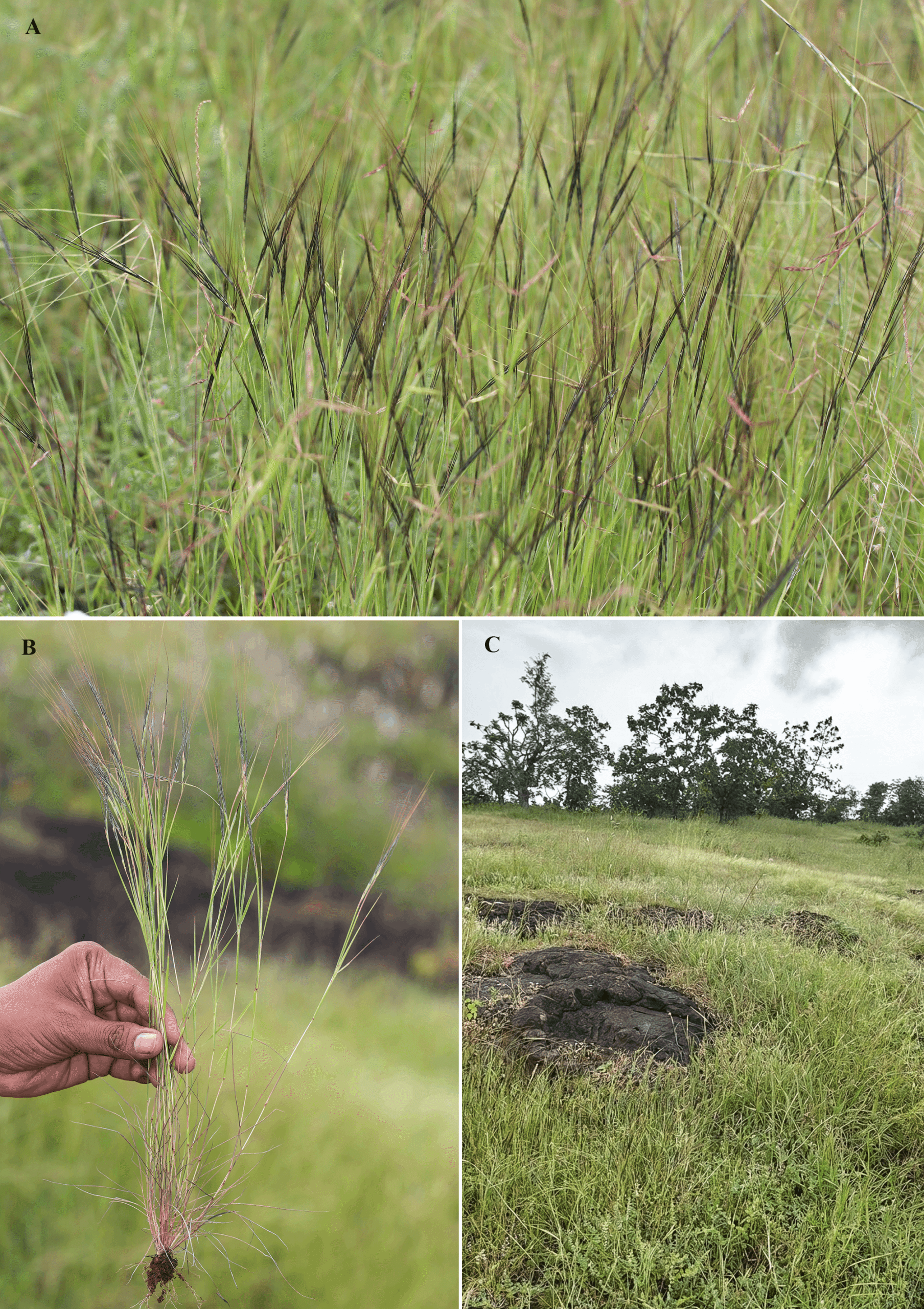
Figure 1. Habit and habitats of Parahyparrhenia khannae near Charmalli, Jalgaon, Maharashtra, India. A. Closeup of the grass in the habitat. B. Tuft of a single specimen. C. Slope with intermittent basalt rocks. (Based on TAK 3168 at the Blatter Herbarium (BLAT)) (© Dr. Tanveer A. Khan)
lower lemma elliptic-lanceolate, 2.8×0.5–0.6 mm, hyaline-membranous, extremely fragile, nerves barely visible, apex obtuse or erose, puberulous or glabrescent, margins close to the apex puberulous, dorsally longitudinally depressed, closely appressed to the caryopses (in the mature fruiting specimens). Upper floret: hermaphrodite, epaleate: upper lemma with a geniculate awn, lemma body linear-stipitate, 4.0×0.3 mm, lower half hyaline-membranous, rupturable, prominently 3-nerved, glabrous, upper half tough, coriaceous, nerves not visible, husky-brown, bifid, lobes minute, linear (not persistent in fruiting specimens), caducous after anthesis; awn bigeniculate, first column 1.6 cm, second column 1.1 cm, bristle 3.6–4.0 cm; column hirtellus, hair 0.5–1.2 mm long, biseriately disposed on each margin of the twisted column. Stamens three, anthers ca. 0.8 mm, whitish. Lodicules two, scarious-membranous (in fruiting), subclavate-oblong, ciliate (only two on each lodicule), 0.8×0.3 mm, with two prominent cilia, 0.1–0.2 mm. Caryopsis deep purplish, linear-elliptic, 2.8–3.4×0.7–0.8 mm, longitudinally sulcate on the front side and bulged on the lower back because of the embryo; embryo more than half, almost two-thirds of the length, of the caryopsis. Rhachis internode yellowish, 2.1 mm long (before merging in the callus), laterally compressed, densely ciliate (hair white) on the margins, lower hair short ca. 0.5 mm and upper hair 1.1 mm long, apex sharply oblique. Pedicel yellowish, shorter than the rhachis internode, 1.8 mm (before merging in the callus), laterally compressed except being angular towards the apex, densely ciliate on the margins, joint between pedicelled spikelet and pedicel scarcely visible. Pedicelled
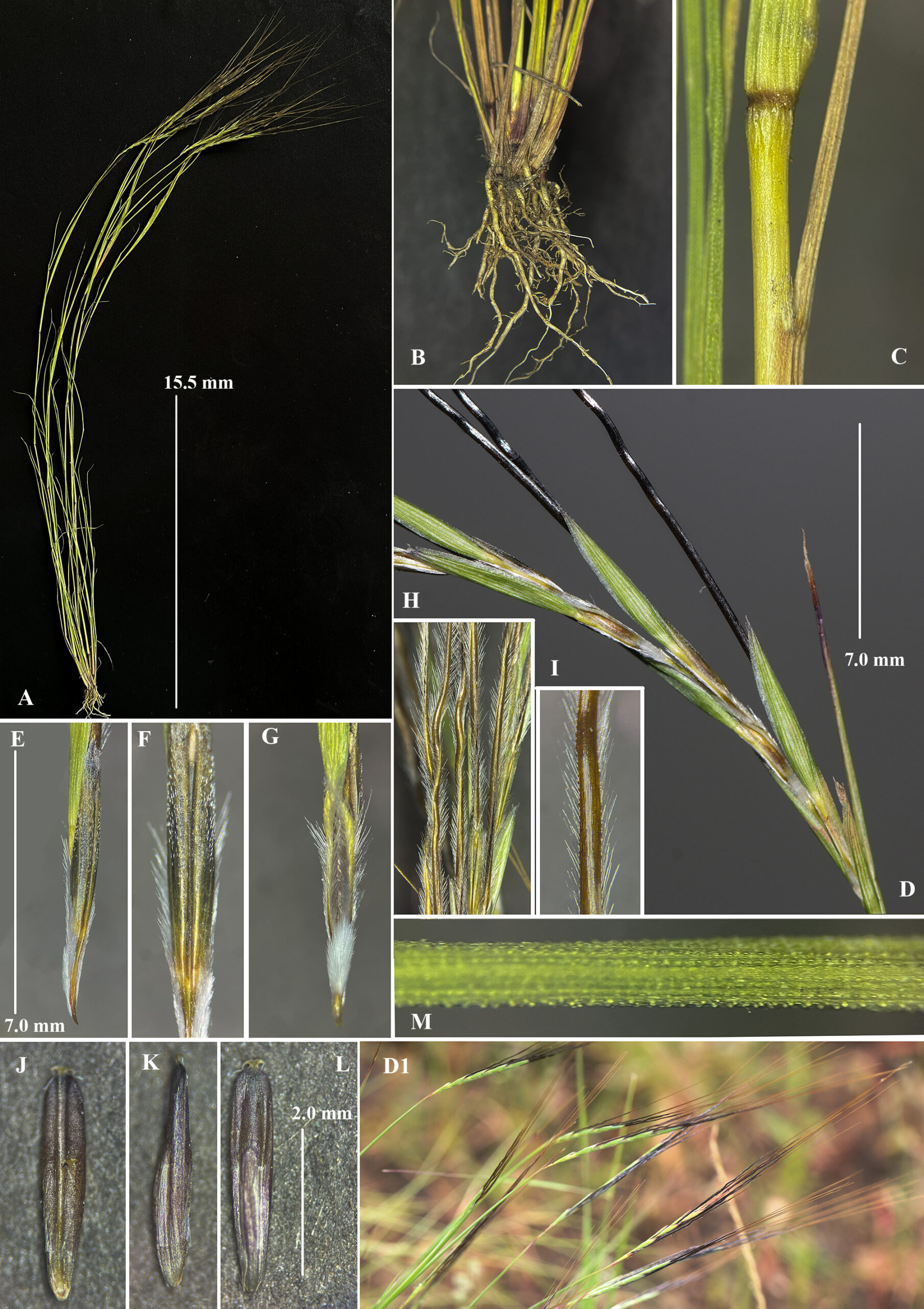
Figure 2. Morphological characteristics of Parahyparrhenia khannae from Jalgaon, Maharashtra. A. Habit. B. Basal portion of the grass specimen. C. Leaf base, culm, and glabrous node. D–D1: Inflorescence. D. Raceme closeup. D1. Racemes in field showing all geniculate awns on one side. E–G: Sessile spikelet. E. Lateral view. F. Front view. G. Back side view. H & I: Geniculate awn closeup. J–L: Caryopsis. J. Front view (showing a median longitudinal groove/slit). K. Lateral view. L. Back side view. M. Leaf blade surface granulated. (Based on TAK 3168 at the Blatter Herbarium (BLAT)) (© Shahid Nawaz Landge).
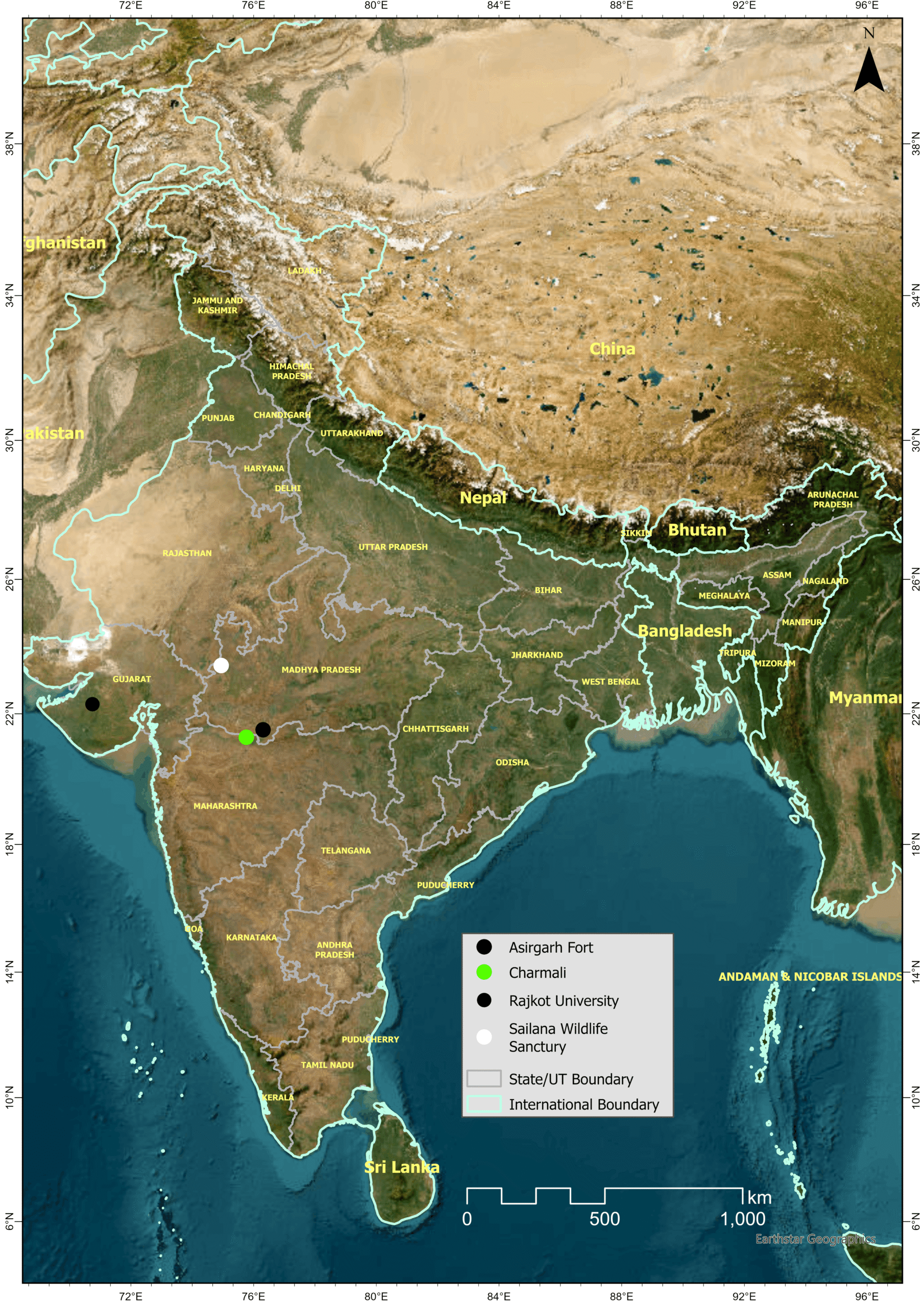
Figure 3. Distribution map of Parahyparrhenia khannae A.P. Tiwari & Chorghe in India, prepared using ArcGIS PRO 3.6.1 (Legends: White dot=Type locality; Black dots=Already known localities; Green dot=recent collection locality).
spikelet sterile without florets, equal or subequal to the sessile spikelet, often farinaceous, callus long, indistinct, 0.8–1.0 mm; lower glume elliptic-lanceolate, 7.0×1.0 mm, 7–8-nerved (of unequal lengths, four nerves reach to the apex and are somewhat excurrent), apex broadly bifid, submarginal nerves somewhat keeled and moderately winged all along the length except lower 2.0 mm, wings tend to curl inward, edges of the wing scabridulous, especially towards the apex becoming scabrid bearing processes; dorsal surface granulated on and between the nerves. Upper glume elliptic, 5.5×0.8 mm, subhyaline-membranous, 5-nerved, apex acute, margins hyaline, hairy in the lower two-thirds.
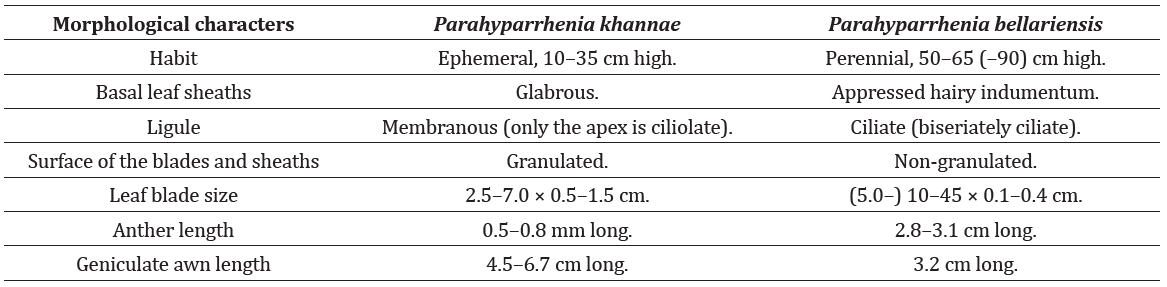
Parahyparrhenia khannae can be distinguished from another species of Parahyparrhenia found in India, P. bellariensis, based on morphological differences such as ligule, leaf blade size, anther length, etc. (Table 1).
Table 1. Morphological comparison of the key characters of two species of Parahyparrhenia from India.
Distribution: Gujarat state (Rajkot University Campus), Madhya Pradesh (Sailana Bird Sanctuary (also known as Sailana Lesser Florican Sanctuary) and Asirgarh fort hill) and Maharashtra (Jalgaon district) (Figure 3). Endemic to Peninsular India (Tiwari et al. 2020; Landge & Shinde, 2021, 2022).
Habitats: In Maharashtra, the species was observed growing on a slope among intermittent basalt rocks adjacent to a freshwater stream (Figure 1).
Specimens Examined: INDIA. Maharashtra state, Jalgaon District, 3 km away from Charmali village, 21.2993744, 75.8049824, 14 Sept. 2025, TAK 3168 (BLAT) 8 Preparations.
Acknowledgement
We extend our sincere gratitude to the Director of the Maharashtra Gene Bank Project (Special Cell), Maharashtra State Biodiversity Board, Nagpur, for providing the financial support essential to this fieldwork. We are also grateful to the management of St. Xavier’s College (Empowered Autonomous Institute), Mumbai, and the Director of the Blatter Herbarium (BLAT) for providing the necessary infrastructure and laboratory facilities. Lastly, the first author (SNL) wishes to thank Mr. Ishteyaque Ahmad Patel (Field Biologist and Remote Sensing & GIS Analyst) for his valuable assistance in preparing the map for this study.
CONFLICT OF INTEREST
The authors declare no conflict of interest.
DATA AVAILABILITY
All the information available to authors, have been provided.
AUTHORS’ CONTRIBUTION
The first author (SNL) conceptualised, designed, and prepared the manuscript; second (TAK) and third (MS) collected the specimens and provided the material for research work, reviewed the manuscript, and arranged the funding for the research work.
Edited By
Amit Kumar
Wildlife Institute of India, Dehradun, India.
*CORRESPONDENCE
Shahid Nawaz Khwaja Bhai Landge
✉ shahidnawaz.landge@xaviers.edu
CITATION
Landge, S. N. K. B., Khan, T. A. & Shaikh, M. (2026). Note on the distribution of Parahyparrhenia khannae (Poaceae: Andropogoneae): a rare and endemic taxon from India. Journal of Wildlife Science, 3(1), 26-29. https://doi.org/10.63033/JWLS.INTG4185
FUNDING
The field work was funded by the Director of Maharashtra Gene Bank Project (Special Cell), Maharashtra State Biodiversity Board, Nagpur.
COPYRIGHT
© 2026 Landge, Khan & Shaikh. This is an open-access article, immediately and freely available to read, download, and share. The information contained in this article is distributed under the terms of the Creative Commons Attribution License (CC BY 4.0
 ), allowing for unrestricted use, distribution, and reproduction in any medium, provided the original work is properly cited in accordance with accepted academic practice. Copyright is retained by the author(s).
PUBLISHED BY
Wildlife Institute of India, Dehradun, 248 001 INDIA
PUBLISHER'S NOTE
The Publisher, Journal of Wildlife Science or Editors cannot be held responsible for any errors or consequences arising from the use of the information contained in this article. All claims expressed in this article are solely those of the author(s) and do not necessarily represent those of their affiliated organisations or those of the publisher, the editors and the reviewers. Any product that may be evaluated or used in this article or claim made by its manufacturer is not guaranteed or endorsed by the publisher.
Landge S. N. & Shinde R. D. (2021). Rediscovery of Parahyparrhenia bellariensis (Poaceae: Andropogoneae): A presumed extinct grass from Andhra Pradesh, India. Phytotaxa, 497(2), 147–156. https://doi.org/10.11646/phytotaxa.497.2.7
Landge S. N. & Shinde R. D. (2022). A taxonomic revision of the genus Parahyparrhenia (Poaceae: Andropogoneae) in India and review of African and Thai species. Phytotaxa, 541(3), 247–260. https://doi.org/10.11646/phytotaxa.541.3.4
Soreng R. J., Peterson P. M., Romaschenko K., Davidse G., Teisher J. K., Clar L. G., Barberá, P., Gillespie L. J. & Zuloaga, F. O. (2017). A worldwide phylogenetic classification of the Poaceae (Gramineae) II: An update and a comparison of two 2015 classifications. Journal of Systematics and Evolution. 55(4), 259–290. https://doi.org/10.1111/jse.12262
Tiwari A. P., Chorghe A. R., Landge S. N. & Shaikh M. (2020). A new species of Parahyparrhenia (Poaceae: Andropogoneae) from India. Phytotaxa, 446(1), 55–60. https://doi.org/10.11646/phytotaxa.446.1.7
Edited By
Amit Kumar
Wildlife Institute of India, Dehradun, India.
*CORRESPONDENCE
Shahid Nawaz Khwaja Bhai Landge
✉ shahidnawaz.landge@xaviers.edu
CITATION
Landge, S. N. K. B., Khan, T. A. & Shaikh, M. (2026). Note on the distribution of Parahyparrhenia khannae (Poaceae: Andropogoneae): a rare and endemic taxon from India. Journal of Wildlife Science, 3(1), 26-29. https://doi.org/10.63033/JWLS.INTG4185
FUNDING
The field work was funded by the Director of Maharashtra Gene Bank Project (Special Cell), Maharashtra State Biodiversity Board, Nagpur.
COPYRIGHT
© 2026 Landge, Khan & Shaikh. This is an open-access article, immediately and freely available to read, download, and share. The information contained in this article is distributed under the terms of the Creative Commons Attribution License (CC BY 4.0), allowing for unrestricted use, distribution, and reproduction in any medium, provided the original work is properly cited in accordance with accepted academic practice. Copyright is retained by the author(s).
PUBLISHED BY
Wildlife Institute of India, Dehradun, 248 001 INDIA
PUBLISHER'S NOTE
The Publisher, Journal of Wildlife Science or Editors cannot be held responsible for any errors or consequences arising from the use of the information contained in this article. All claims expressed in this article are solely those of the author(s) and do not necessarily represent those of their affiliated organisations or those of the publisher, the editors and the reviewers. Any product that may be evaluated or used in this article or claim made by its manufacturer is not guaranteed or endorsed by the publisher.
Landge S. N. & Shinde R. D. (2021). Rediscovery of Parahyparrhenia bellariensis (Poaceae: Andropogoneae): A presumed extinct grass from Andhra Pradesh, India. Phytotaxa, 497(2), 147–156. https://doi.org/10.11646/phytotaxa.497.2.7
Landge S. N. & Shinde R. D. (2022). A taxonomic revision of the genus Parahyparrhenia (Poaceae: Andropogoneae) in India and review of African and Thai species. Phytotaxa, 541(3), 247–260. https://doi.org/10.11646/phytotaxa.541.3.4
Soreng R. J., Peterson P. M., Romaschenko K., Davidse G., Teisher J. K., Clar L. G., Barberá, P., Gillespie L. J. & Zuloaga, F. O. (2017). A worldwide phylogenetic classification of the Poaceae (Gramineae) II: An update and a comparison of two 2015 classifications. Journal of Systematics and Evolution. 55(4), 259–290. https://doi.org/10.1111/jse.12262
Tiwari A. P., Chorghe A. R., Landge S. N. & Shaikh M. (2020). A new species of Parahyparrhenia (Poaceae: Andropogoneae) from India. Phytotaxa, 446(1), 55–60. https://doi.org/10.11646/phytotaxa.446.1.7


