TYPE: Review Article
Arjun Viswa Santhasivam² , Babu Santhanakrishnan¹*, Arun P. Ramachandran¹, Moorthi Mahaly²
¹Sálim Ali Centre for Ornithology and Natural History, Anaikatty, Coimbatore – 641108, Tamil Nadu. (South India Centre of Wildlife Institute of India).
²PG & Research Department of Zoology and Wildlife Biology, AVC College (Autonomous), Mayiladuthurai - 609305, Tamil Nadu.

Introduction
Globally, road networks spanning 64 million kilometres have been established (CIA, 2024), facilitating human obility and the transportation of goods (van der Ree et al., 2015). A recent meta-analysis reveals a concerning trend: nearly 80% of the world’s roadless areas are highly fragmented, consisting of almost 6,00,000 distinct patches, half of which are smaller than 1 km2 (Ibisch et al., 2016). Projections indicate road and rail networks will expand over 60% between 2010 and 2050 (Dulac, 2013; Laurance et al., 2014), with significant growth expected in biodiversity-rich developing countries. Roads often lead to contagious development, i.e., the establishment of new settlements and habitat conversion for agriculture. The environmental impacts of roads are profound, encompassing both direct and indirect effects, immediate and long-term. These include habitat loss and fragmentation, changes in microclimate, increased windthrow, heightened wildfire risks, animal injuries and mortality, changes in animal behaviour, population isolation, increased pressures from tourism and hunting, and elevated levels of pollution (Spellerberg, 2002; see examples in van der Ree et al., 2015). Among these, road mortality remains the most detrimental and severe threat to wildlife (Trombulak & Frissell, 2000). Therefore, understanding vulnerable species and road mortality rates across sites and species is crucial for informing road policies, and management practices, and mitigating adverse effects on biodiversity.
Wildlife-vehicle collisions, or road mortality or roadkill, refer to any case where animals are killed or injured to death by vehicles (ranging from motorcycles to heavy trucks). The estimated/actual roadkill values globally reveal alarming figures:annual bird mortality is 340 million in the USA, 194 million in Europe, and 138 million in Canada (Calvert et al., 2013; Loss et al., 2014; Grilo et al., 2020); mammal mortality in Europe is 29 million (Grilo et al., 2020), and vertebrate deaths in China average 6.35 individuals per 100 km per day. A recent consortium on Global Roadkill Data (Grilo et al., 2025) compiled nearly 2,00,000 observations across 54 countries, revealing that mammals account for the highest road kills (61%), followed by amphibians (21%) and reptiles (10%). Although some species may experience low road mortality rates, species already threatened by other factors and with slow reproductive rates may find it challenging to recover from the losses, increasing the risk of local extinctions (Quintana et al., 2022; Grilo et al., 2025).
India has the second longest road network in the world, spanning approximately 63,45,403 km, which includes over 1,46,145 km of National Highways (NH), about 1,79,535 km of State Highways (SH), and about 60,19,723 km of other roads (MoRTH, 2024). In the Western Ghats region, around 26,482 km of roads have already been constructed, including 7,182 km of NH, 8,122 km of SH, and the remaining being other roads. The Western Ghats is one of the biodiversity hotspots in the world (Myers et al., 2000; Mittermeier et al., 2011), and it is globally recognised for its rich biodiversity and high degree of vertebrate endemism (Myers et al., 2000; Gunawardene et al., 2007). For instance, 91% of the amphibian species found here are endemic (Dahanukar & Molur, 2020), and 73% of reptile species found in the region are endemic to India (9% are endemic to the Western Ghats; Srinivasulu et al., 2021). Despite this rich biodiversity and endemism, large stretches of natural forests in the Western Ghats have seen conversion for monoculture and economically-important/cash crops (e.g., tea, coffee) over different time periods (Menon & Bawa, 1998; Jha et al., 2000). To support these plantations, human settlements were established in various parts of the Ghats (Gadgil, 1979). In later years, these high-elevation regions were exploited for tourism-related activities, including pilgrimages (Seshadri & Ganesh, 2015), following the implementation of land transformation policies. This increased the necessity for several roads along the Western Ghats to facilitate the movement of people and goods. Many of these roads connect important tourist destinations, major cities or pilgrimage sites in the Western Ghats (Baskaran & Boominathan, 2010; Bhupathy et al., 2011; Seshadri & Ganesh, 2011; Seshadri & Ganesh, 2015; Jeganathan et al., 2018a), carrying heavy vehicular traffic through ecologically fragile landscapes, including tiger reserves and wildlife sanctuaries, leading to enormous wildlife road mortalities (e.g. Mudumalai Tiger Reserve – Baskaran & Boominathan, 2010; Kalakkad-Mundanthurai Tiger Reserve – Seshadri & Ganesh, 2011).
While several studies have documented road mortality in the Western Ghats, few have evaluated the effectiveness of mitigation strategies, with a few initiatives where mitigation measures were implemented for reducing roadkill (e.g., the canopy bridge for arboreal mammals in Valparai – Jeganathan et al., 2018b). However, such measures rarely address the mortality of smaller vertebrates or invertebrates. To initiate effective mitigation measures for these taxa, it is important to identify vulnerable species and mortality rates across taxa and sites for the Western Ghats. The existing literature on road mortality studies in the Western Ghats is fragmented, impeding an understanding of the overall picture of this understudied yet critically important conservation issue. In this context, we attempted to collate published works on road mortality of wild animals in the Western Ghats to identify vulnerable species, mortality rates of various taxa, and bias in road mortality studies.
Methods
To investigate the patterns of road mortality among wildlife (both invertebrates and vertebrates) in the Western Ghats, we conducted a systematic literature survey of all published articles (including short communications and research articles) using three academic search engines: Google Scholar, ResearchGate, and Web of Science. The search employed the following combinations of keywords: Roadkill+Western+Ghats”; “Road+mortality+Western+Ghats”; “Road-kill+Western+Ghats”; “Vehicle+traffic+mortality+Western+Ghats”. From this search, we collated 42 publications addressing road mortality studies in the Western Ghats, encompassing a wide array of taxonomic groups from invertebrates to higher vertebrates. In the first level of filtering, we omitted articles published in predatory journals (n=8) as well as theses, dissertations, and reports, to include only peer-reviewed articles. Such literature was also excluded because of its limited accessibility and uncertain availability. Data presented in predatory journal publications were excluded due to the lack of a peer-review process (journals listed at https://www.predatoryjournals.org/the-list/journals) and the lack of DOI numbers. In the second level of screening, we excluded duplicate publications that contained the same data appearing in multiple sources, and retained only one version for our analysis (n=2). Thus, this review focused exclusively on articles published in peer-reviewed journals, with non-repetitive information (Supplementary 1).
From the selected articles, we extracted all available data to create a comprehensive database of roadkill information. This database includes critical information such as locations (GPS coordinates, state, and district-level information), year and month of data collection, habitat types examined (as specified in the article), lengths of the road surveyed (in km), number of replications, species and number of individuals killed (including unidentified species), and publication details (author, year and journal). In addition to this data, we compiled species-wise conservation status (based on the IUCN Red List category (www.iucnredlist.org/)), classifications under the Schedule of the Indian’s Wild Life (Protection) Act, 1972, as amended in 2022, habit, venomous/non-venomous (in the case of snakes), taxonomic classifications (order, family, and scientific and common names) and endemicity status pertaining to all recorded instances of road mortality (Dahanukar, 2020; Srinivasulu et al., 2021; Nameer, 2020). We plotted study locations and checked for geographical patterns among the publications using QGIS version 3.14 (QGIS Development Team, 2020). We calculated the mean road mortality rate for species (hereafter “mortality rate”) by dividing the number of recorded kills by the total survey effort (i.e., kilometres surveyed multiplied by the number of replicates) from studies that reported this information.
Result
As a result of the filtering process, we retained 32 publications – including 26 research articles and six short communications – covering four states for this study (Figure 1 and Supplementary 1). The total surveyed road length across the 32 studies was 511.81 km.
Spatial distribution of road mortality studies:
The spatial analysis of the locations of road mortality studies across the Western Ghats revealed that a large proportion of studies were conducted in the southern Western Ghats (n=27), particularly within the Nilgiris (n=17) and Anamalai (n=6) landscapes. In contrast, fewer studies were conducted in the central (n=3) and northern (n=2) Western Ghats (Figure 1). Most studies focused on selected taxa or multiple vertebrates (n=23), with a few studies collecting information on invertebrates as well (n= 8). The studies spanned across various seasons – dry, i.e., March to June (n=2), wet, i.e., June to December (n=15), dry and wet seasons (n=12) – and habitats – from dry thorn forests to high-elevation evergreen forests and plantations. A majority of the studies were conducted during the wet season and in dry forests (n=9), and agricultural areas and plantations (n=10).
Diversity of fauna in road mortality studies
Species inventory:
Altogether, 6,507 individuals of various taxa (1,547 individuals of invertebrates and 4,960 individuals of vertebrates), including
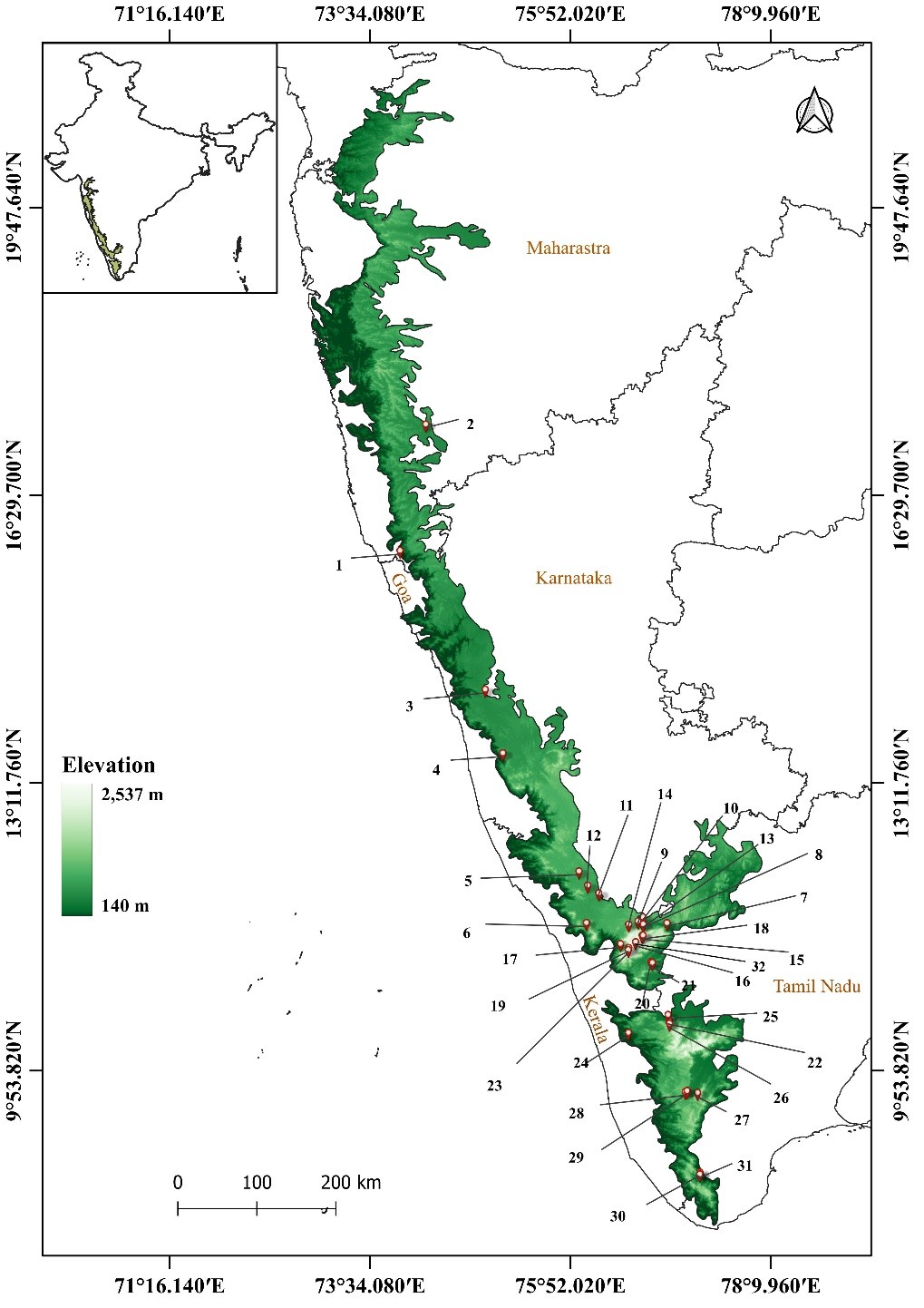
Figure 1. Spatial distribution of road mortality studies across the Western Ghats.
Note: 1 – Gaitonde et al., (2016); 2 – Kumbar & Lad, (2017); 3 – Seshadri et al., (2009); 4 – Correa et al., (2023); 5 – Bansal, (2020); 6 – Roshnath & Cyriac, (2013); 7 – Deb & Sengupta, (2020); 8 – Samson et al., (2020); 9 – Samson et al., (2016); 10 – Khanduri et al., (2022); 11 – Rao & Girish, (2007); 12 – Selvan et al., (2012); 13 – Gokula, (1997); 14 – Baskaran & Boominathan, (2010); 15 – Santhoshkumar & Kannan, (2017); 16 – Santhoshkumar et al., (2016); 17 – Kannan, (2007); 18 – Santhoshkumar et al., (2017); 19 – Vadivalagan et al., (2012); 20 – Prakash & Karthik, (2021); 21 – Sony & Arun, (2015); 22 – Kumara et al., (2000); 23 – Balakrishnan, (2007); 24 – Yadav et al., (2022); 25 – Jeganathan et al., (2018a); 26 – Vijayakumar et al., (2001); 27 – Ganesh & Chandramouli, (2020); 28 – Bhupathy et al., (2011); 29 – Selvan, (2011); 30 – Narayanan, (2015); 31 – Seshadri & Ganesh, (2011); 32 – Samson & Princy, (2023).
Unidentified species, were killed. Out of 6,507 individuals, only 2,820 (43%) individuals of 235 species were identified up to species level, i.e., nearly 57% of the mortalities were unidentified (Figure 2). Among higher vertebrates, species-level identification was available for only 47% of the mortalities, while the remaining 53% could not be identified up to species level.
Between 1997 and 2023, studies reported 239 species of invertebrates and vertebrates belonging to 70 families as road kill along the sampled roads of the Western Ghats. Of these, 73 species were invertebrates belonging to eight families (one wasp, three dragonflies, and four butterfly families). The remaining 166 species, which accounted for 14% of the total vertebrate diversity of the Western Ghats, consisted of 74 reptiles (18 families), 40 birds (22 families), 31 mammals (16 families) and 21 amphibians (six families) (Supplementaries 2–6). Excluding unidentified species, road mortality affected 28% of reptiles (15 lizard species, 42 snake species, 14 worm snake and shieldtail species, three turtle and tortoise species),25.6% of mammals (four primate species, nine rodent species, eight carnivore species, six ungulate species, one hare species, one shrew species, one bat species, domestic dog), 8%
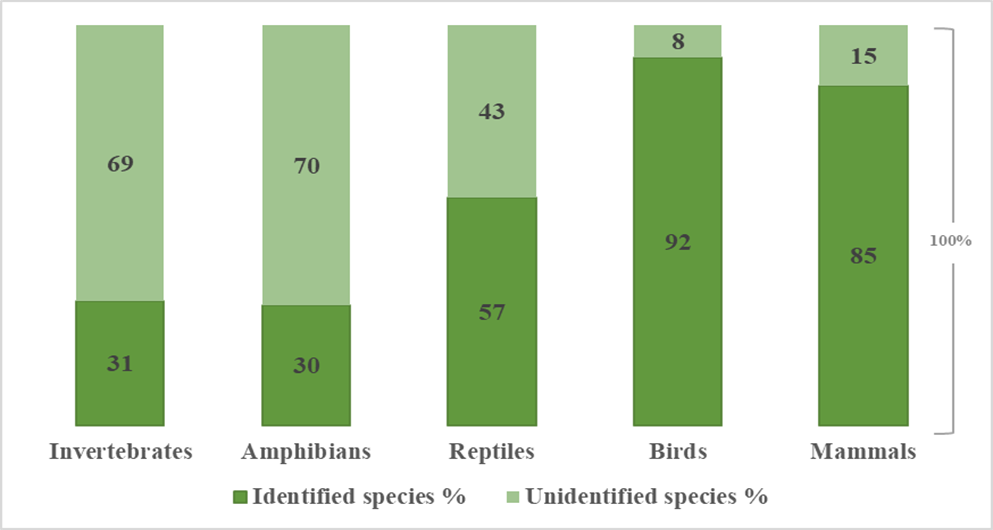
Figure 2. Percentage of kills identified up to species level across taxa in the Western Ghats.
Table 1. Number of higher vertebrate species affected due to vehicular movement in the Western Ghats
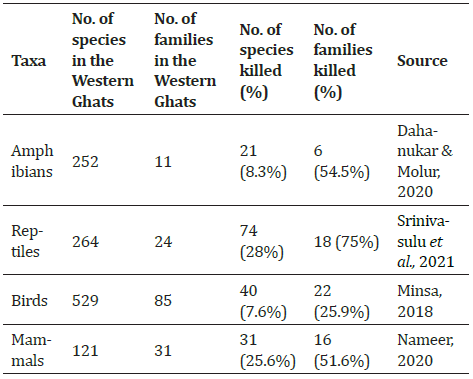
of amphibians (two toad species, 18 frog species, one caecilian species), and 7.6% of bird species found in the Western Ghats (Table 1 and Supplementaries 2-6).
Endemicity:
Out of 446 endemic vertebrates (excluding fishes) in the Western Ghats, nearly 51 (n = 682; 13.79%) endemic vertebrates were reported as road fatalities, including 31 reptile species, 14 amphibian species and six mammal species. Endemic vertebrates that were recorded as road kills included Uropeltis ocellatus, Uropeltis ceylanica, Minervarya nilagirica, Uperodon triangularis, Salea horsfieldii, Xylophis perroteti, Plectrurus perroteti, Beduka amboli, and Hylarana spp. (Supplementaries 2-6).
Conservation status of roadkilled species:
Of the 166 vertebrate species, 18 (n = 122; 2.47%) species were listed under one of the IUCN threatened categories (CR, EN, and VU). This included seven mammal species (five Vulnerable and two Endangered), eight reptile species (six Vulnerable and two Endangered), and three amphibian species (all Endangered; Supplementaries 2–6). Among Endangered vertebrates, lion-tailed macaque Macaca silenus, Nilgiri tahr Nilgiritragus hylocrius, red-spotted earth snake Uropeltis rubromaculata, Travancore shieldtail Rhinophis travancoricus, Boulenger’s bubble-nest frog Raorchestes signatus, spotted bush frog Raorchestes tinniens, and Amboli rock toad Xanthophryne tigerina were reported in the studies. Some of the Vulnerable species reported were bonnet macaque Macaca radiata, leopard Panthera pardus, spiny tree mouse Platacanthomys lasiurus, nilgiri langur Semnopithecus johnii, sambar Deer Rusa unicolor, Indian star tortoise Geochelone elegans, Indian flap-shell turtle Lissemys punctata, Western Ghats king cobra Ophiophagus kaalinga, Phipson’s shieldtail Uropeltis phipsonii, two-lined black earth snake Melanophidium bilineatum and shorthead kukri snake Oligodon brevicauda. Out of the 239 species, 103 were listed under different schedules of India’s Wild Life (Protection) Act, 1972, as amended in 2022. Twenty-three species were under Schedule I, which included two birds, 13 mammals, and eight reptiles; 43 species were under Schedule II, which included 31 birds, eight mammals, and four reptiles; one species of mammal under Schedule III, and 36 species under Schedule IV, which included two mammalian and 34 reptilian species (Supplementary 2-6). In addition, 682 individuals (13.79%) of endemic vertebrates and 122 individuals (2.47%) of globally threatened vertebrates were reported in road mortalities.
Most frequently killed species:
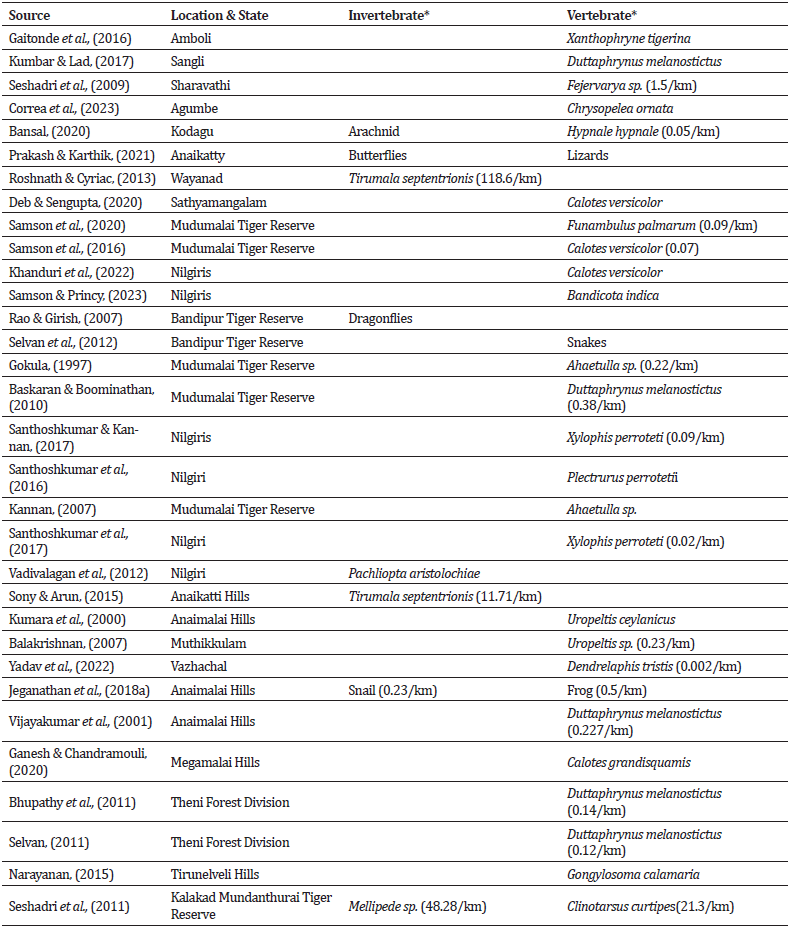
The species most affected by road mortality in terms of the number of road-killed individuals found varied between sites and studies. However, common Asian toad Duttaphrynus melanostictus, Oriental garden lizard Calotes versicolor, Uropeltis spp., and Ahaetulla spp. were reported to be killed most frequently across the study locations (Table 2).
Road mortality rate
Among vertebrate road kills, amphibians (52.16%) were more abundant than reptiles (30.15%), mammals (15.96%), and birds (1.73%).
We calculated mortality rates using information from the 18 studies that mentioned survey effort and total mortalities. The overall mortality rate for animals across these study sites ranged from 0.006 to 137.3 kills/km. Mortality rates for invertebrates and vertebrates varied widely between the studies, ranging from 0.72 to 137.3 kills/km for invertebrates and 0.006 to 40 kills/km for vertebrates. Wayanad had the highest mortality rates for invertebrates, while Sharavati had the highest rates for vertebrates (Figure 3). The mortality rate for amphibians across the studies ranged from 0.02 to 2.0 kills/km, except in Sharavati (40 kills/km) and Kalakad Mundanthurai Tiger Reserve (KMTR) (31.7 kills/km), where the highest road mortality was reported. Amphibian road mortality rates were relatively lower in Mudumalai and Bandipur Tiger Reserves, compared to Mukthikulam and Sharavati. Reptile mortality rates were also relatively higher in KMTR and Anamalai Tiger Reserve (Figure 3). In contrast, birds and mammals exhibited relatively lower mortality rates across most sites, except in KMTR, where a maximum of 0.79 kills/km was reported for mammals. In terms of species’ habit, terrestrial and semi-aquatic amphibian species were more vulnerable to roadkill (Figure 4), whereas arboreal and fossorial species showed greater vulnerability among reptiles (Figure 5).
Discussion
Our review of wildlife road mortality studies in the Western Ghats biodiversity hotspot revealed that invertebrates, amphibians, and reptiles are more vulnerable to vehicle-induced mortality, both in terms of the number of species and individuals killed. We found that mortality rates for these taxa were relatively higher in sites such as Mukthikulam and Shravati, which are high-rainfall (wet) zones of the Western Ghats, which can be attributed to prolonged breeding and hydroperiod-mediated migration. Furthermore, our results suggest that current roadkill assessments across the Western Ghats have not been adequately covered in terms of taxa (e.g., invertebrates), spatial and temporal scope, and that several methodological artefacts exist.
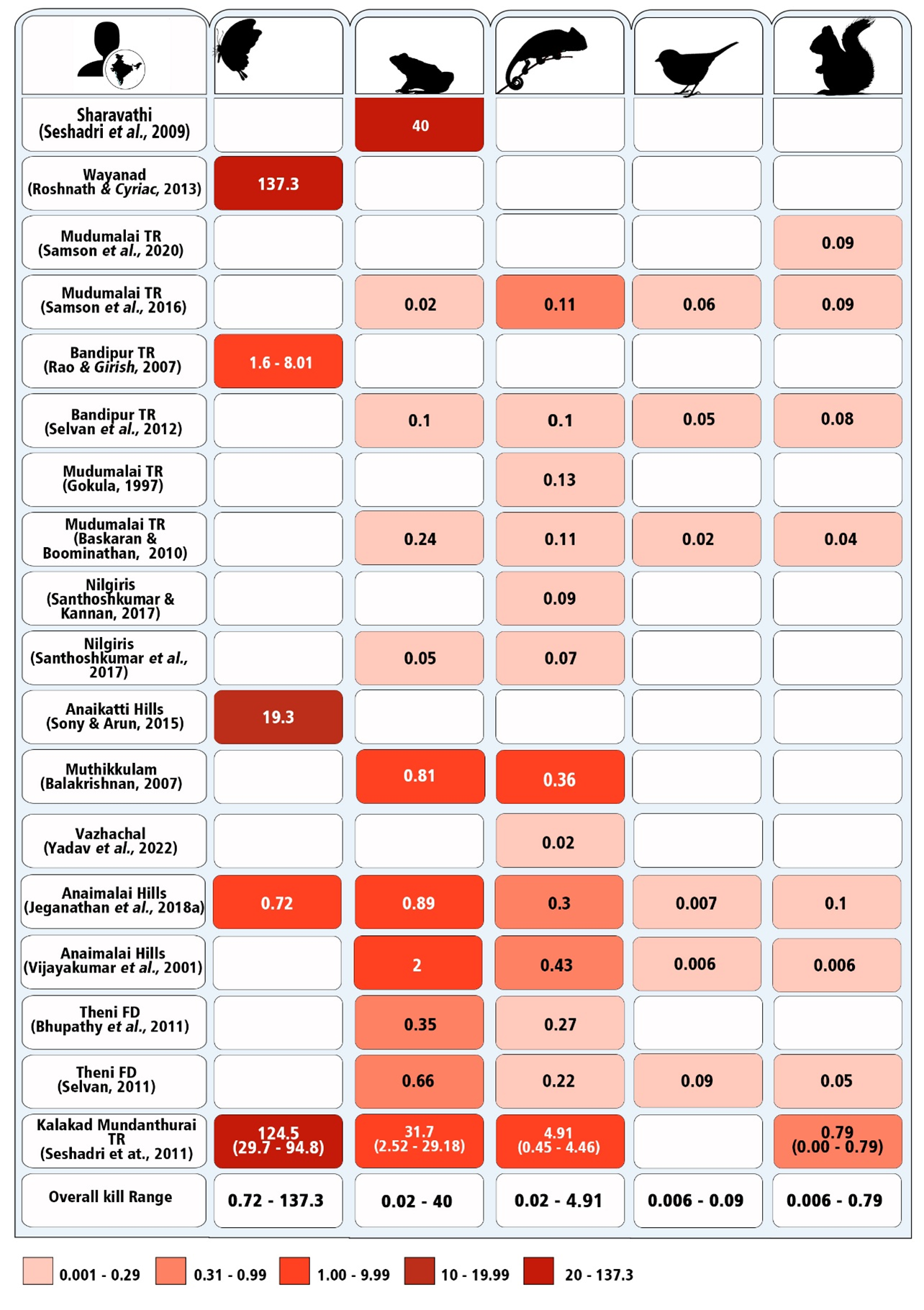
Figure 3. Road mortality rate (Number of kills/km/visit) of invertebrates and vertebrates (including unidentified species) in various studies along the Western Ghats between 1997 and 2023 (Kalakad Mundanthurai TR (Seshadri et al., 2011) – Overall mortality rate/km/visit (Before and During religious tourism season).
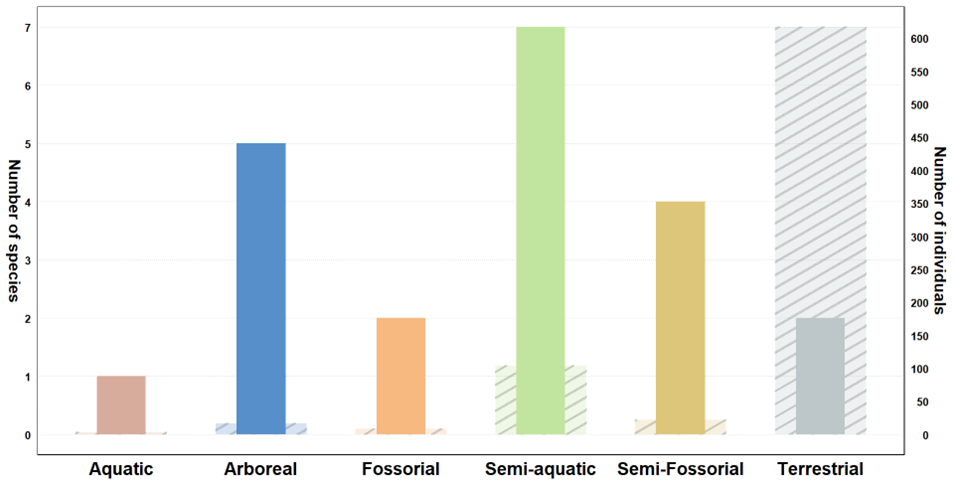
Figure 4. Number of amphibian species and individuals killed across different habits in the Western Ghats. Dark colour was number of species and light shade was number of individuals.
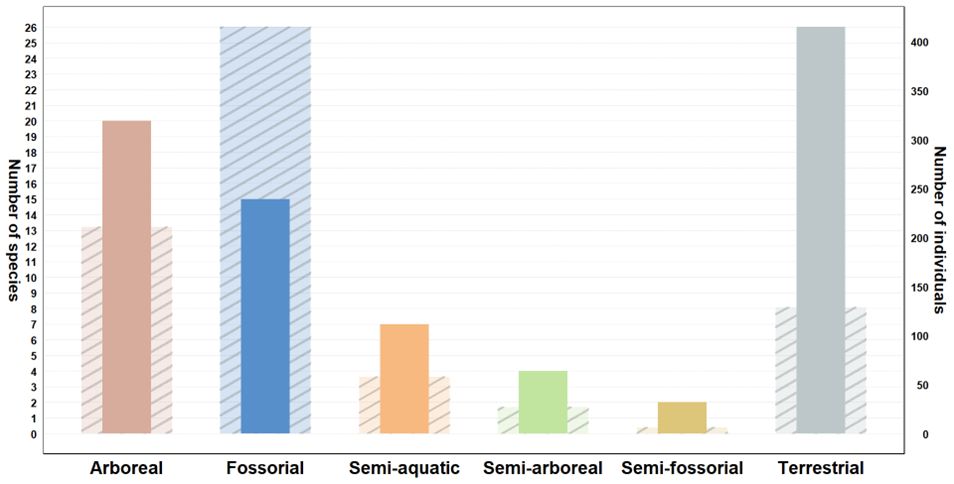
Figure 5. Number of reptile species and individuals killed across different habits in the Western Ghats. Dark colour was number of species and light shade was number of individuals.
Table 2. Site-specific vulnerable invertebrate and vertebrate species affected by vehicular traffic in the Western Ghats (*values in parentheses indicate the mortality rate of the species)
Comparisons of mortality rates across the reviewed articles in the Western Ghats were not possible due to substantial methodological variations between the studies: (1) differential sampling effort (season covered, mode of survey-walk or vehicle, number of observers); (2) variations in topography and habitat matrix along the surveyed roads (habitat and elevation gradients) and (3) variations in species reporting (order, family, genus and species levels). Therefore, we only identified vulnerable species and high mortality-prone zones based on the available information in select articles to prioritise the conservation interventions.
Spatial distribution of road mortality studies:
Compared to the southern Western Ghats, road mortality studies in the northern and central regions of the Western Ghats are limited, despite the presence of extensive road networks and ongoing development. Even within the southern Western Ghats, there is a notable lack of studies on the western slopes (the rain-fed areas of the southern Western Ghats), as compared to the eastern slopes (the rain-shadow regions). The western slopes receive relatively higher rainfall during the southwest monsoon and have one of the longest road networks with a high human density. Therefore, it is expected that road mortality rates for invertebrates and lesser vertebrates would be higher in these areas.
Taxa- specific road mortality
Amphibians:
Among the amphibians, widespread terrestrial Duttaphrynus melanostictus and other semi-aquatic and semi-fossorial species such as Hylarana spp., Uperodon triangularis, Microhyla ornata, and Minervarya nilagirica are more vulnerable to road kills. Due to their slow movement, most of the terrestrial toads (e.g., Duttaphrynus melanostictus) were killed when they tried to cross the road. In the Western Ghats, the highest road mortality was reported for amphibians, particularly during the wet seasons (e.g., Vijayakumar et al., 2001 & Bhupathy et al., 2011). During this time, amphibians move in large numbers to congregate in pools and streams for breeding, becoming vulnerable to road kills. It is evident that roads near waterbodies or parallel to streams have higher mortality rates, as reported in Baskaran & Boominathan, (2010), and Rajvanshi et al., (2013). Furthermore, factors such as traffic intensity, road structural characteristics, and road density significantly increase the likelihood of road kills (van der Ree et al., 2015). The higher mortality rates of herpetofauna in the rainfed areas of the Western Ghats are likely due to extended rainy days, which prolong breeding-related movements in amphibians and lead to relatively enhanced road kills compared to rain-shadow regions.
Reptiles:
The second most affected vertebrate group was reptiles, with 74 species, including 31 species endemic to the Western Ghats. The overall mortality rate ranged from 0.07 to 0.43 individuals/km, except in the KMTR, where the highest road mortality of reptiles (4.91 kills/km) was reported. Other than the widespread Oriental garden lizard, uncommon and rare species like common skink Eutropis carinata, Indian chameleon Chamaeleo zeylanicus, brahminy blind snake Indotyphlops braminus, Indian rock python Python molurus, common kukri snake Oligodon arnensis, common wolf snake Lycodon aulicus, common bronzeback tree snake Dendrelaphis tristis, Oriental rat snake Ptyas mucosa, slender-nosed vine snake Ahaetulla oxyrhyncha, green keelback Rhabdophis plumbicolor, checkered keelback Fowlea unicolor, common krait Bungarus caeruleus and Russell’s viper Daboia russelii were also recorded as road kills (Figure 6). Among reptiles, nearly 56 snake species (i.e., 46% of the snake species known from Western Ghats) were recorded as roadkill, including individuals from Uropeltidae and Typhlopidae families. The frequency of occurrence of snakes roadkill was notably high in all parts of the Western Ghats. The higher snake mortality rates have been attributed to thermoregulation behaviour (Vijayakumar et al., 2001; Bhupathy et al., 2011) as tarred roads retain daytime heat and provide an optimal environment for thermoregulation during the night. This explanation may be appropriate in temperate regions, where temperature fluctuations are significant during night hours. However, in tropical areas like the Western Ghats, temperature fluctuations are not extreme. So, animals may not require a hot surface like roads for thermoregulation. This is also partially supported by the studies on the Indian rock python in Sathyamangalam Tiger Reserve in the Western Ghats, and water python in Australia, which state that pythons are active throughout the year (Vishnu et al., 2023; Shine & Madsen, 1996). Rajvanshi et al., (2013) suggested a design to reduce road mortality of snakes by creating artificial thermoregulation structures on both sides of the road to facilitate snake thermoregulation, reducing roadkill in the vicinity. This approach needs to be evaluated through experimental field studies on snakes in the Western Ghats. Potential reasons for the higher frequency of snake road mortality in the Western Ghats could be: 1) Body shape- Snakes have long and slender bodies when compared to other lesser vertebrates and reptiles, which enhances their chances of being struck by moving vehicles (Hughes, 2025), regardless of tyre width and weight of the vehicle. 2) Scavenging behaviour- Observations indicate that Indian snakes, including banded krait Bungarus caeruleus (Dabholkar & Sagar, 2024), spectacled cobra Naja naja (Patel et al., 2018), and checkered keelback Fowlea unicolor (Wewhare & Pandey, 2021) scavenge on crushed animal carcasses. 3) Dilution of vehicle- induced vibrations- Snake road mortality rates are relatively higher during the monsoon season (Pragatheesh & Rajvanshi, 2013; Santhoshkumar & Kannan, 2017). We believe that this might be due to rain induced vibration on tarred road, which could hinder the ability of snakes to recognise the vibration of a speeding vehicle (e.g. Hartline, 1971). 4) Road as barrier- The obstruction of water courses, soil, and vegetation forces various species like water snakes (e.g., Natricidae), fossorial snakes (e.g., Typhlopidae & Boidae), and arboreal snakes (e.g., Ahetulla spp.) to cross roads, which are not adept at moving on tarred surfaces (Figure 5); and 5) Predator vigilance- Although species like rat snakes are fast movers, they are also being killed at several locations. This may be due to predator vigilance and smoother surfaces (e.g., Bhupathy et al., 2011). When they enter open places like roads, they move slowly, looking for predators (Waring et al., 1991). Further research should focus on these aspects to elucidate the possible reasons for high snake mortality rates in the Western Ghats. Such studies would also assist managers and the public works department in designing roads in the region to mitigate road mortality in the future.
Birds & Mammals:
Higher bird mortalities among the reviewed studies involved shrub-dwelling, low-flight, and open habitat preferring families such as Columbidae (5 species of doves and pigeons), Cuculidae (5 species of cuckoos), Pycnonotidae (3 species of bulbuls), and Corvidae (2 species of crows). Foraging and scavenging for food grains or insects on or near the road surface could increase the probability of birds like doves, mynas, crows, and bulbuls being hit by vehicles (e.g., Husby, 2016). Further, the species reported frequently as roadkill were most abundant along the roads (Santos et al., 2016). During our endemic bird survey in Nilgiris, we also observed the road mortalities of endemic birds of the Western Ghats, such as Nilgiri sholakili Sholicola major and Nilgiri laughingthrush Montecincla cachinnans (unpublished data, S.Babu), although existing literature has not reported road fatalities of these bird species.
The mortality rates of birds were lower than those of other vertebrates in the Western Ghats. This can be attributed to road structural characteristics (narrow width, sharp curvature, and elevation), and slow vehicle speeds that reduce collisions with flying birds owing to quick evasive responses of birds. However, the nfluence of breeding and moulting seasonality on roadkill susceptibility of birds remains understudied and warrants further examination.
Mammals:
Among mammals, arboreal and commensal species, such as bonnet macaque, grey langur, three-striped palm squirrel Funambulus palmarum, and herbivores such as sambar deer and Indian chevrotain Moschiola indica were frequently killed on roads. One of the major reasons for the road mortality of arboreal mammals was anthropogenic food supplies or garbage dumped along the tourism/pilgrimage-dominated roads (e.g., Nilgiris), and lack of canopy contiguity. In some cases, over-speeding vehicles hit large-bodied mammals like sambar deer and Nilgiri tahr (Jeganathan et al., 2018a), contributing to their deaths. Most rodent (rats and shrews) kills could not be identified to the species level.
From our review, we conclude that the survey efforts to monitor bird and mammal road mortality require broader spatial coverage, rather than intensive searches limited to a few kilometres. A broad spatial coverage would likely capture a greater variety of species, including endemic and range-restricted bird species, than what is currently documented.
Mortality vs vehicle intensity:
A few studies were conducted to illustrate the relationship between vehicular traffic and road mortality rates for vertebrates and invertebrates, revealing differential patterns: some showed linear relationships (Rajvanshi et al., 2013; Sheshadri & Ganesh, 2011), while others indicated non-linear relationships (Sheshadri & Ganesh, 2011) and no relationship (Bhupathy et al., 2011; Santhoshkumar & Kannan, 2017). A non-linear relationship suggests that while road mortality for wild animals increases with higher vehicle density, it may decline after reaching a certain threshold (particularly for nocturnal and vertebrate species; Sheshadri & Ganesh, 2011).
Mortality rate of wildlife
The length of the road network in the Western Ghats is 26,482 km, which includes national highways, state highways, and rural roads. Based on the published road mortality rates, we calculated a conservative estimate of daily roadkill of wild animal individuals (kills/visit) for the entire road network in the Western Ghats: 19,067 – 36,35,979 (invertebrates); 530 – 10,59,280 (amphibians); 530 – 1,30,026 (reptiles), 159 – 2383 (birds), and 159 to 20,920 (mammals). Even when considering the lowest mortality rates (kills) for each taxon, the annual estimates of the roadkill (for 365 days) for vertebrates (amphibians: 1,93,450; reptiles: 1,93,450; birds: 58,035; and mammals: 58,035) in the Western Ghats is alarmingly high. This estimate raises significant concerns as it appears to be a primary anthropogenic reason for the amphibian and reptile population decline in the Western Ghats. This review underscores the need for collaborative efforts among researchers, policymakers, and conservationists to develop wildlife-friendly road infrastructure in this ecologically sensitive region.
Survey bias in road mortality studies
Though only about 14% of total Western Ghats vertebrate diversity (166 vertebrate species)have been reported as dying due to vehicular collisions, the actual number of species affected and individuals killed would be much higher than that reported. Roadkills often go undetected due to several reasons, such as- 1) Carcasses are often consumed by scavenging birds (crows and kites), mammals (mongooses and civets), and free-ranging animals such as dogs and cats (Santos et al., 2011; Teixeira et al., 2013). 2) Animals with injuries may retreat to nearby forest patches and may subsequently die there. Such kills are unreported or undocumented (Raman, 2011). 3) Roadkill of smooth-skinned, and soft, small-bodied (e.g., caecilians, anurans, shieldtail, geckos, and rodents) animals can become unidentifiable after being run over repeatedly by vehicles, and washed off the roads during peak monsoon. Because of these reasons, more than 70% of road mortalities of amphibians, and several species of Uropeltidae and Typhlopidae families reported from the Western Ghats were not identified to the species level. In contrast, despite their slow movement, species of the genus Bufo (with their rough skin) could remain identifiable for longer periods (for more than 7 days; personal observation in Anaikatty hills) despite heavy vehicle traffic and less abundance in forest floors (e.g., Vijayakumar et al., 2001). This species is frequently reported across multiple studies in the Western Ghats. 4) Observer’s expertise in identifying road mortalities up to species level. Although these factors have been addressed in several studies across the globe (Santos et al., 2011; Santos et al., 2016), we find that these aspects have not been included as part of studies in the Indian context.
Mitigative measures
Given the higher road mortality rates of vertebrates, characterised by both the number of kills and species affected, it is essential to implement mitigative measures targeting these taxa. For this, data on the spatial and temporal distribution of road kills across the country would be required (Saxena et al., 2019).
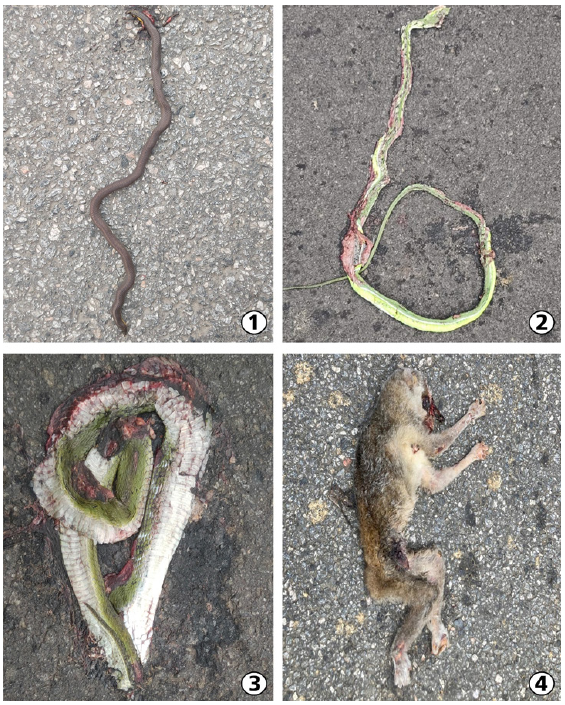
Figure 6. Road kills of some uncommon species in the Western Ghats. 1. Uropeltis bhupathyi – Fossorial ©Arjun Viswa S; 2. Ahaetulla sp. – Arboreal © S. Babu; 3. Rhabdophis plumbicolor – Semi-aquatic ©Arjun Viswa S; 4. Loris lydekkerianus malabaricus – Arboreal © Kishore Muthu.
However, it is impractical to collect such voluminous data through a single study. A solution to this issue is to use citizen science data through established mobile applications (e.g., roadkillmonitoring.in), combined with an intensive outreach programme to collect roadkill data across the country (Pawgi et al., 2024). Hotspots of roadkill generated from citizen science data would further help prioritise sites requiring conservation interventions. Site-and species-specific mitigative measures should be developed to reduce wildlife mortality. Our review strongly indicates that amphibians and reptiles are more vulnerable to roadkill in the Western Ghats. Although limited attention has been given to herpetofauna conservation in the country, a few conservation measures, such as the construction of herpetofaunal passages, and the use of drift fences near canals, streams and rivers can be attempted (Ward et al., 2015). However, the effectiveness of such measures should be tested frequently.
Way Ahead
To address and control road mortality of wild animals in the Western Ghats and other key biodiversity-rich regions of the country, we suggest that further studies are required in the following areas: (1) Since 57% of roadkill remains unidentified, it is important to apply cost-effective molecular-based species identification for small, soft-bodied vertebrates (e.g., caecilians, bush frogs, shieldtail); (2) Standardisation of survey protocols for road mortality studies and the correction of mortality rates for carcass persistence is essential; (3) An assessment of the impact of road characteristics, vegetation structure, species-specific traits and hydrological parameters on vertebrate mortality patterns is needed, and (4) Research and development focusing on drift fences and culverts (both dry and wet), amphibian tunnels, underpasses and overpasses in the Indian context should be conducted.
TO DOWNLOAD SUPPLEMENTARY MATERIAL CLICK HERE.
Acknowledgement
The first author sincerely thank to the Principle and Management of A.V.C. College (Autonomous), Mayiladuthurai for all the support throughout the dissertation and degree. Authors also thank the Director, Dean, Registrar and Research Coordinator of WII-SACON for the necessary permission to carry out this review work.
CONFLICT OF INTEREST
Dr P. R. Arun is an academic editor at the Journal of Wildlife Science. However, he did not participate in the peer review process of this article except as an author. The authors declare no other conflict of interest.
DATA AVAILABILITY
Data is available from the corresponding author on request.
AUTHORS’ CONTRIBUTION
SB conceived the idea, design and analysis. AVS collated the review, compiled, curated the data and did descriptive analysis. Both AVS and SB wrote the first draft and finalized the manuscript. MM and PRA contributed through mentorship to AVS throughout the dissertation periods.
Edited By
Akanksha Saxena
Wildlife Institute of India, Dehradun, India.
*CORRESPONDENCE
Dr. S. Babu
✉ sanbabs@gmail.com
CITATION
Arjun Viswa, S., Babu, S., Arun, P. R. & Moorthi, M. (2026). Dark side of the development: A Review on Road Mortality of Wildlife in the Western Ghats Biodiversity Hotspot. Journal of Wildlife Science, 3(1), 01-10. https://doi.org/10.63033/JWLS.QPKD3584
COPYRIGHT
© 2026 Arjun Viswa, Babu, Arun & Moorthi. This is an open-access article, immediately and freely available to read, download, and share. The information contained in this article is distributed under the terms of the Creative Commons Attribution License (CC BY 4.0
 ), allowing for unrestricted use, distribution, and reproduction in any medium, provided the original work is properly cited in accordance with accepted academic practice. Copyright is retained by the author(s).
PUBLISHED BY
Wildlife Institute of India, Dehradun, 248 001 INDIA
PUBLISHER'S NOTE
The Publisher, Journal of Wildlife Science or Editors cannot be held responsible for any errors or consequences arising from the use of the information contained in this article. All claims expressed in this article are solely those of the author(s) and do not necessarily represent those of their affiliated organisations or those of the publisher, the editors and the reviewers. Any product that may be evaluated or used in this article or claim made by its manufacturer is not guaranteed or endorsed by the publisher.
Balakrishnan, P. (2007). Reptiles of Muthikkulam Reserved Forest, Kerala. Cobra, 1(4), 1–6.
Bansal, U. (2020). A study of reptile road mortalities on an interstate highway in the Western Ghats, India and suggestion of suitable mitigation measures. Captive & Field Herpetology, 4(1), 1–12.
Baskaran, N. & Boominathan, D. (2010). Road kill of animals by highway traffic in the tropical forests of Mudumalai Tiger Reserve, southern India. Journal of Threatened Taxa, 2(3), 753–759. https://doi.org/10.11609/JoTT.o2101.753-9
Bhupathy, S., Srinivas, G., Kumar, N. S., Karthik, T. & Madhivanan, A. (2011). Herpetofaunal mortality due to vehicular traffic in the Western Ghats, India: a case study. Herpetotropicos, 5(2), 119-126.
Calvert, A. M., Bishop, C. A., Elliot, R. D., Krebs, E. A., Kydd, T. M., Machtans, C. S. & Robertson, G. J. (2013). A synthesis of human-related avian mortality in Canada. Avian Conservation & Ecology, 8(2). https://doi.org/10.5751/ACE-00581-080211
Central Intelligence Agency (CIA) (2024). Transportation: World. https://www.cia.gov/library/publications/the-world-factbook/geos/xx.html (Accessed on 13 August 2025).
Correa, J., Giri, A. V., Kumar, V. & Hasyagar, V. (2023). First evidential record of predation by an Ornate Flying Snake, Chrysopelea ornata (Shaw 1802), on an insectivorous bat in the central Western Ghats, Karnataka, India. Reptiles & Amphibians, 30(1), e18626-e18626. https://doi.org/10.17161/randa.v30i1.18626
Dabholkar, P. & Sagar, A. (2024). Scavenging by Indian Kraits, Bungarus caeruleus (Schneider 1801) (Elapidae), in Alibag, Maharashtra, India. Reptiles & Amphibians, 31(1), e19957-e19957. https://doi.org/10.17161/randa.v31i1.19957
Dahanukar, N. & Molur, S. (2020). JoTT checklist of amphibians of the Western Ghats (v1.0), 01 January 2020. Journal of Threatened Taxa. https://doi.org/10.11609/jott.checklist/westernghats.amphibians
Daniel, J. C. (2002). The Book of Indian Reptiles and Amphibians. Oxford University Press, Walton Street, Oxford OX26DP, p.238.
Deb, P. & Sengupta, D. (2020). Road mortality of an Oriental Garden Lizard, Calotes versicolor (Daudin 1802). Reptiles & Amphibians, 27(3), 438–439. https://doi.org/10.17161/randa.v27i3.14869
Dulac, J. (2013). Global Land Transport Infrastructure Requirements: Estimating Road and Railway Infrastructure Capacity and Costs to 2050 (International Energy Agency, 2013).
Gadgil, M. (1979). Hills, dams, and forests: Some field observations from the Western Ghats. Proceedings of the Indian Academy of Sciences, 2, 291–301. https://doi.org/10.1007/BF02848927
Gaitonde, N., Giri, V. & Kunte, K. (2016). ‘On the rocks’: reproductive biology of the endemic toad Xanthophryne (Anura: Bufonidae) from the Western Ghats, India. Journal of Natural History, 50(39-40), 2557-2572. https://doi.org/10.1080/00222933.2016.1200686
Ganesh, S. R. & Chandramouli, S. R. (2020). Miscellaneous natural history observations of Large-scaled Forest Lizards, Calotes grandisquamisGünther 1875 (Squamata: Agamidae). Reptiles & Amphibians, 27(1), 73-76. https://doi.org/10.17161/randa.v27i1.14462
Gokula, V. (1997). Impact of vehicular traffic on snakes in Mudumalai Wildlife Sanctuary. Cobra, 27, 1–6.
Grilo, C., Koroleva, E., Andrášik, R., Bíl, M. & González-Suárez, M. (2020). Roadkill risk and population vulnerability in European birds and mammals. Frontiers in Ecology and the Environment, 18(6), 323-328. https://doi.org/10.1002/fee.2216
Grilo, C., Neves, T., Bates, J., Le Roux, A., Medrano-Vizcaíno, P., Quaranta, M. & Wang, Y. (2025). Global Roadkill Data: a dataset on terrestrial vertebrate mortality caused by collision with vehicles. Scientific data, 12(1), 505. https://doi.org/10.1038/s41597-024-04207-x
Gunawardene, N. R., Daniels, A. E., Gunatilleke, I. A. U. N., Gunatilleke, C. V. S., Karunakaran, P. V., Nayak, K. G. & Vasanthy, G. (2007). A brief overview of the Western Ghats-Sri Lanka biodiversity hotspot. Current Science, 93(11), 1567–1572.
Gururaja, K. V. (2012). Pictorial guide to frogs and toads of the Western Ghats. Gubbi Labs LLP.
Hartline, P. H. (1971). Physiological basis for detection of sound and vibration in snakes. Journal of Experimental Biology, 54(2), 349-371. https://doi.org/10.1242/jeb.54.2.349
Hughes, D. F. (2025). Road ecology of a Chihuahuan Desert snake community: size-based mortality sets the stage for evolutionary change in a widespread pitviper. PeerJ, 13:e19871. https://doi.org/10.7717/peerj.19871
Husby, M. (2016). Factors affecting road mortality in birds. Ornis Fennica, 93(4), 212-224.
Ibisch, P. L., Hoffmann, M. T., Kreft, S., Pe’er, G., Kati, V., Biber-Freudenberger, L. & Selva, N. (2016). A global map of roadless areas and their conservation status. Science, 354(6318), 1423-1427. https://doi.org/10.1126/science.aaf7166
Jeganathan, P., Mudappa, D., Kumar, M. A. & Raman, T. S. (2018a). Seasonal variation in wildlife roadkills in plantations and tropical rainforest in the Anamalai Hills, Western Ghats, India. Current Science, 114(2), 619-626. https://doi.org/10.18520/cs/v114/i03/619-626
Jeganathan, P., Mudappa, D., Raman, T. S. & Kumar, M. A. (2018b). Understanding perceptions of people towards lion-tailed macaques in a fragmented landscape of the Anamalai Hills, Western Ghats, India. Primate Conservation, 32(11), 205-215.
Jha, C. S., Dutt, C. B. S. & Bawa, K. S. (2000). Deforestation and land use changes in the Western Ghats, India. Current Science, 78(3), 231–238.
Kannan, P. (2007). Mortality of reptiles due to vehicular traffic in Mudumalai Wildlife Sanctuary, Western Ghats, Tamil Nadu, India. Cobra, 1(3), 1–6.
Khanduri, S., Thirumurugan, V., Vishnu, C. S. N., Ramesh, C., Das, A. & Talukdar, G. (2022). A note on opportunistic records of reptiles from the Moyar River Valley Landscape, Tamil Nadu, southern India. Journal of Animal Diversity, 4(4), 40-58. https://doi.org/10.52547/JAD.2022.4.4.5
Kumara, H. N., Sharma, A. K., Kumar, A. & Singh, M. (2000). Roadkills of wild fauna in Indira Gandhi Wildlife Sanctuary, Western Ghats, India: Implications for management. Biosphere Conservation, 3, 41–47.
Kumbar, S. M. & Lad, S. B. (2017). Determination of age and longevity of road mortal Indian common toad Duttaphrynus melanostictus by skeletochronology. Russian Journal of Herpetology, 24(3), 217–222. https://doi.org/10.30906/1026-2296-2019-24-3-217-222
Laurance, W. F., Clements, G. R., Sloan, S., O’connell, C. S., Mueller, N. D., Goosem, M. & Arrea, I. B. (2014). A global strategy for road building. Nature, 513(7517), 229-232. https://doi.org/10.1038/nature13717
Loss, S. R., Will, T. & Marra, P. P. (2014). Estimation of annual bird mortality from vehicle collisions on roads in the United States. Journal of Wildlife Management, 78, 763-771. https://doi.org/10.1002/jwmg.721
Minsa, M., Bharath, S. & Ramachandra, T. V. (2018). Diversity & Distribution of Avian Fauna in Western Ghats. Lake 2018 conference. Poster. iisc.ac.in.
Menon, S. & Bawa, K. S. (1998). Deforestation in the tropics: Reconciling disparities in estimates for India. Ambio, 27(7), 576–577.
Menon, V. (2014). Indian mammals: a field guide. Hachette India.
Mittermeier, R. A., Turner, W. R., Larsen, F. W., Brooks, T. M. & Gascon, C. (2011). Global biodiversity conservation: The critical role of hotspots. In: Zachos, E. F. & Habel, C. J. (eds.), Biodiversity hotspots: Distribution and Protection of Conservation Priority Areas, Springer Berlin Heidelberg, pp.3–22. https://doi.org/10.1007/978-3-642-20992-5_1
MoRTH - Ministry of Road Transport and Highways. Annual Report 2024. https://morth.nic.in/sites/default/files/Annual-Report-English-with-Cover.pdf (Accessed on 22 February 2025)
Myers, N., Mittermeier, R. A., Mittermeier, C. G., Da Fonseca, G. A. & Kent, J. (2000). Biodiversity hotspots for conservation priorities. Nature, 403(6772), 853–858. https://doi.org/10.1038/35002501
Nameer, P. O. (2020). JoTT checklist of the mammals of Western Ghats (v1.0). Journal of Threatened Taxa. https://doi.org/10.11609/jott.checklist/westernghats.mammals
Narayanan, S. (2015). On the occurrence of the calamaria reed snake Gongylosoma calamaria(Gunther, 1858) (Squamata: Colubridae), in the Kalakadu Mudanthurai Tiger Reserve, India. Reptile Rap, 18, 30.
Patel, V., Chettiar, S., Kumbhani, S. & Trivedi, K. (2018). An observation of scavenging by a Spectacled cobra Naja naja on a road killed Russell’s viper Daboia russelii. The Herpetological Bulletin, 145.
Pawgi, M., Joshi, Y., Deshmukh, S., Purohit, A., Pawgi, K. & Yosef, R. (2024). Monitoring roadkill in Amravati, India: A citizen science project. European Journal of Ecology, 10(2). https://doi.org/10.17161/eurojecol.v10i2.21597
Pragatheesh, A., & Rajvanshi, A. (2013). Spatial patterns and factors influencing the mortality of snakes on the National Highway-7 along Pench Tiger Reserve, Madhya Pradesh, India. Oecologia Australis, 17(1), 20-35.
Prakash, L. & Karthik, P. (2021). Effect of vehicular traffic on wild animals in Anaikatty Hills, Southern Western Ghats, India. Indian Journal of Ecology, 48(1), 108–111.
Praveen, J. & Jayapal, R. (2025). Checklist of the birds of India (v9.0). Journal of Threatened Taxa.
QGIS Development Team (2020). QGIS Geographic Information System (Version 3.14)
Quintana, I., Cifuentes, E. F., Dunnink, J. A., Ariza, M., Martínez-Medina, D., Fantacini, F. M., Shrestha, B. R. & Richard, F. J. (2022). Severe conservation risks of roads on apex predators. Scientific Reports, 12(1), 2902. https://doi.org/10.1038/s41598-022-05294-9
Rajvanshi, A., Mathur, V. B. & Pragatheesh, A. (2013). Ecological Effects of Road Through Sensitive Habitats: Implications for Wildlife Conservation. Dehradun: Wildlife Institute of India.
Raman, T. S. (2011). Framing ecologically sound policy on linear intrusions affecting wildlife habitats (Report). Nature Conservation Foundation.
Rao, R. S. P. & Girish, M. K. S. (2007). Road kills: Assessing insect casualties using indicator taxon. Current Science, 92(6), 832–837.
Roshnath, R., & Cyriac, V. P. (2013). Way back home: Butterfly roadkills. Zoo's Print, 28(12), 1–3.
Samson, A., Ramakrishnan, B., Veeramani, A., Santhosh Kumar, P., Karthick, S., Sivasubramanian, G., Ilakkia, M., Chitheena, A., Leona Princy, J. & Ravi, P. (2016). Effect of vehicular traffic on wild animals in Sigur Plateau, Tamil Nadu, India. Journal of Threatened Taxa, 8(9), 9182–9189. https://doi.org/10.11609/jott.1962.8.9.9182-9189
Samson, A., Ramakrishnan, B. & Leonaprincy, J. (2020). A threat assessment of three-striped palm squirrel Funambulus palmarum (mammalia: Rodentia: Sciuridae) from roadkills in Sigur Plateau, Mudumalai tiger reserve, Tamil Nadu, India. Journal of Threatened Taxa, 12(10), 16347-16351. https://doi.org/10.11609/jott.3378.12.10.16347-16351
Samson, A. & Princy, J. L. (2023). AN INVENTORY OF ROADKILLS OF NOCTURNAL MAMMALS IN COONOOR GHAT HIGHWAY NH 67, THE NILGIRIS, WESTERN GHATS, INDIA. Труды Мордовского государственного природного заповедника им. ПГ Смидовича, (32), 68-76. https://dx.doi.org/10.24412/cl-31646-2686-7117-2023-32-68-76
Santhoshkumar, P., Kannan, P., Ramakrishnan, B., Veeramani, A., Samson, A., Karthick, S. & Girikaran, P. (2016). Road kills of the endemic snake Perrotet’s Shieldtail Plectrurus perrotetii, Dumeril, 1851 (Reptilia: Squamata: Uropeltidae) in Nilgiris, Tamil Nadu, India. Journal of Threatened Taxa, 8(11), 9375-9376. https://doi.org/10.11609/jott.2494.8.11.9375-9376
Santhoshkumar, P. & Kannan, P. (2017). Impacts of Roads on the Mortality of Endemic Striped Narrow Headed Snake Xylophis perroteti (Family: Xenodermatidae) in Nilgiris, Tamil Nadu. Russian Journal of Herpetology, 24, 87–90. https://doi.org/10.30906/1026-2296-2019-24-2-87-90
Santhoshkumar, S., Kannan, P., Veeramani, A., Samson, A., Karthick, S. & Leonaprincy, J. (2017). A preliminary report on the impact of road kills on the herpetofauna species in Nilgiris, Tamil Nadu, India. Journal of Threatened Taxa, 9(3), 10004-10010. https://doi.org/10.11609/jott.3001.9.3.10004-10010
Santos, S. M., Carvalho, F. & Mira, A. (2011). How long do the dead survive on the road? Carcass persistence probability and implications for road-kill monitoring surveys. PLos one, 6(9), e25383. https://doi.org/10.1371/journal.pone.0025383
Santos, R. A. L., Santos, S. M., Santos-Reis, M., PicancËo de Figueiredo, A., Bager, A., Aguiar, L. M. S, et al., (2016). Carcass Persistence and Detectability: Reducing the Uncertainty Surrounding Wildlife-Vehicle Collision Surveys. PLoS ONE, 11(11), e0165608. https://doi.org/10.1371/journal.pone.0165608
Saxena, A., Lyngdoh, A., Rajvanshi, A., Mathur, V. & Habib, B. (2019). Saving wildlife on India’s roads needs collaborative and not competitive efforts. Current Science, 117(7), 1137-1139.
Selvan, K. M. (2011). Observation of road kills on Kambam-Kumily Road (NH 220) in Tamil Nadu. Zoo's Print, 26(3), 25-26.
Selvan, K. M., Sridharan, N. & John, S. (2012). Roadkill animals on national highways of Karnataka, India. Journal of Ecology and the Natural Environment, 4(14), 363-365. https://doi.org/10.5897/JENE11.068
Seshadri, K. S., Yadav, A. & Gururaja, K. V. (2009). Road kills of amphibians in different areas from the Shatavathi River Basin, central Western Ghats, India. Journal of Threatened Taxa, 1(11), 549–552. https://doi.org/10.11609/JoTT.o2148.549-52
Seshadri, K. S. & Ganesh, T. (2011). Faunal mortality on roads due to religious tourism across time and space in protected areas: A case study from South India. Forest Ecology and Management, 262, 1713–1721. https://doi.org/10.1016/j.foreco.2011.07.026
Seshadri, K. S. & Ganesh, T. (2015). Road ecology in south India: Issues and mitigation opportunities. In: van der Ree, R., Smith, D. J. & Grilo, C. (eds.), Handbook of Road Ecology. Wiley-Blackwell, pp.425–429. https://doi.org/10.1002/9781118568170.ch52
Shine, R. & Madsen, T. (1996). Is thermoregulation unimportant for most reptiles? An example using water pythons (Liasis fuscus) in tropical Australia. Physiological Zoology, 69(2), 252-269. https://doi.org/10.1086/physzool.69.2.30164182
Sony, R. K. & Arun, P. R. (2015). A case study of butterfly road kills from Anaikatty Hills, Western Ghats, Tamil Nadu, India. Journal of Threatened Taxa, 7(14), 8154–8158. https://doi.org/10.11609/jott.1743.7.14.8154-8158
Spellerberg, I. F. (2002). Ecological effects of roads: The land reconstruction and management. CRC Press, pp.1-260. https://doi.org/10.1201/9781482279931
Srinivasulu, C., Srinivasulu, B. & Srinivasulu, A. (2021).JoTT Checklist of the reptiles of the Western Ghats (v1.3). Journal of Threatened Taxa. https://doi.org/10.11609/jott.checklist/westernghats.reptiles
Teixeira, F. Z., Coelho, A. V. P., Esperandio, I. B. & Kindel, A. (2013). Vertebrate road mortalityestimates: effects of sampling methods and carcass removal. Biological Conservation, 157, 317-323. https://doi.org/10.1016/j.biocon.2012.09.006
Trombulak, S. C. & Frissell, C. A. (2000). Review of ecological effects of roads on terrestrial and aquatic communities. Conservation biology, 14(1), 18-30. https://doi.org/10.1046/j.1523-1739.2000.99084.x
Vadivalagan, C., Gunasekaran, C. & Salahudeen, I. (2012). Molecular phylogeny of recurrent road killed butterflies in Nilgiri Biosphere Reserve, India, using CO1 gene marker. African Journal of Biotechnology, 11(79), 14433–14439. https://doi.org/10.5897/AJB11.3246
Van Der Ree, R., Smith, D. J. & Grilo, C. (2015). The ecological effects of linear infrastructure and traffic: challenges and opportunities of rapid global growth. Handbook of road ecology, 1-9. https://doi.org/10.1002/9781118568170.ch1
Vijayakumar, S. P., Vasudevan, K. & Ishwar, N. M. (2001). Herpetofaunal mortality on roads in the Anamalai Hills, southern Western Ghats. Hamadryad, 26(2), 253–260.
Vishnu, C. S., Ramesh, C., Talukdar, G. & Thirumurugan, V. (2023). Microhabitat of Indian rock pythons (Python molurus) in Moyar river valley, tropical India. Indian Journal of Ecology, 50(5), 1271-1275.
Ward, A. I., Dendy, J. & Cowan, D. P. (2015). Mitigating impacts of roads on wildlife: an agenda for the conservation of priority European protected species in Great Britain. European Journal of Wildlife Research, 61(2), 199-211. https://doi.org/10.1007/s10344-015-0901-0
Waring, G. H., Griffis, J. L. & Vaughn, M. E. (1991). White-tailed deer roadside behavior, wildlife warning reflectors, and highway mortality. Applied Animal Behaviour Science, 29(1-4), 215-223. https://doi.org/10.1016/0168-1591(91)90249-W
Wewhare, N. & Pandey, U. (2021). First record of scavenging by a Checkered keelback, Fowlea piscator (Schneider 1799) (Natriciidae) from Western Maharashtra, India. Reptiles & Amphibians, 28(2), 348-349. https://doi.org/10.17161/randa.v28i2.15638
Yadav, P. B. S., Prakash, L. & Karthik, P. (2022). Mortality rates of snakes on the roads of Vazhachal Forest Division, Kerala, Western Ghats. Hamadryad, 39(1), 37–42.
Edited By
Akanksha Saxena
Wildlife Institute of India, Dehradun, India.
*CORRESPONDENCE
Dr. S. Babu
✉ sanbabs@gmail.com
CITATION
Arjun Viswa, S., Babu, S., Arun, P. R. & Moorthi, M. (2026). Dark side of the development: A Review on Road Mortality of Wildlife in the Western Ghats Biodiversity Hotspot. Journal of Wildlife Science, 3(1), 01-10. https://doi.org/10.63033/JWLS.QPKD3584
COPYRIGHT
© 2026 Arjun Viswa, Babu, Arun & Moorthi. This is an open-access article, immediately and freely available to read, download, and share. The information contained in this article is distributed under the terms of the Creative Commons Attribution License (CC BY 4.0), allowing for unrestricted use, distribution, and reproduction in any medium, provided the original work is properly cited in accordance with accepted academic practice. Copyright is retained by the author(s).
PUBLISHED BY
Wildlife Institute of India, Dehradun, 248 001 INDIA
PUBLISHER'S NOTE
The Publisher, Journal of Wildlife Science or Editors cannot be held responsible for any errors or consequences arising from the use of the information contained in this article. All claims expressed in this article are solely those of the author(s) and do not necessarily represent those of their affiliated organisations or those of the publisher, the editors and the reviewers. Any product that may be evaluated or used in this article or claim made by its manufacturer is not guaranteed or endorsed by the publisher.
Balakrishnan, P. (2007). Reptiles of Muthikkulam Reserved Forest, Kerala. Cobra, 1(4), 1–6.
Bansal, U. (2020). A study of reptile road mortalities on an interstate highway in the Western Ghats, India and suggestion of suitable mitigation measures. Captive & Field Herpetology, 4(1), 1–12.
Baskaran, N. & Boominathan, D. (2010). Road kill of animals by highway traffic in the tropical forests of Mudumalai Tiger Reserve, southern India. Journal of Threatened Taxa, 2(3), 753–759. https://doi.org/10.11609/JoTT.o2101.753-9
Bhupathy, S., Srinivas, G., Kumar, N. S., Karthik, T. & Madhivanan, A. (2011). Herpetofaunal mortality due to vehicular traffic in the Western Ghats, India: a case study. Herpetotropicos, 5(2), 119-126.
Calvert, A. M., Bishop, C. A., Elliot, R. D., Krebs, E. A., Kydd, T. M., Machtans, C. S. & Robertson, G. J. (2013). A synthesis of human-related avian mortality in Canada. Avian Conservation & Ecology, 8(2). https://doi.org/10.5751/ACE-00581-080211
Central Intelligence Agency (CIA) (2024). Transportation: World. https://www.cia.gov/library/publications/the-world-factbook/geos/xx.html (Accessed on 13 August 2025).
Correa, J., Giri, A. V., Kumar, V. & Hasyagar, V. (2023). First evidential record of predation by an Ornate Flying Snake, Chrysopelea ornata (Shaw 1802), on an insectivorous bat in the central Western Ghats, Karnataka, India. Reptiles & Amphibians, 30(1), e18626-e18626. https://doi.org/10.17161/randa.v30i1.18626
Dabholkar, P. & Sagar, A. (2024). Scavenging by Indian Kraits, Bungarus caeruleus (Schneider 1801) (Elapidae), in Alibag, Maharashtra, India. Reptiles & Amphibians, 31(1), e19957-e19957. https://doi.org/10.17161/randa.v31i1.19957
Dahanukar, N. & Molur, S. (2020). JoTT checklist of amphibians of the Western Ghats (v1.0), 01 January 2020. Journal of Threatened Taxa. https://doi.org/10.11609/jott.checklist/westernghats.amphibians
Daniel, J. C. (2002). The Book of Indian Reptiles and Amphibians. Oxford University Press, Walton Street, Oxford OX26DP, p.238.
Deb, P. & Sengupta, D. (2020). Road mortality of an Oriental Garden Lizard, Calotes versicolor (Daudin 1802). Reptiles & Amphibians, 27(3), 438–439. https://doi.org/10.17161/randa.v27i3.14869
Dulac, J. (2013). Global Land Transport Infrastructure Requirements: Estimating Road and Railway Infrastructure Capacity and Costs to 2050 (International Energy Agency, 2013).
Gadgil, M. (1979). Hills, dams, and forests: Some field observations from the Western Ghats. Proceedings of the Indian Academy of Sciences, 2, 291–301. https://doi.org/10.1007/BF02848927
Gaitonde, N., Giri, V. & Kunte, K. (2016). ‘On the rocks’: reproductive biology of the endemic toad Xanthophryne (Anura: Bufonidae) from the Western Ghats, India. Journal of Natural History, 50(39-40), 2557-2572. https://doi.org/10.1080/00222933.2016.1200686
Ganesh, S. R. & Chandramouli, S. R. (2020). Miscellaneous natural history observations of Large-scaled Forest Lizards, Calotes grandisquamisGünther 1875 (Squamata: Agamidae). Reptiles & Amphibians, 27(1), 73-76. https://doi.org/10.17161/randa.v27i1.14462
Gokula, V. (1997). Impact of vehicular traffic on snakes in Mudumalai Wildlife Sanctuary. Cobra, 27, 1–6.
Grilo, C., Koroleva, E., Andrášik, R., Bíl, M. & González-Suárez, M. (2020). Roadkill risk and population vulnerability in European birds and mammals. Frontiers in Ecology and the Environment, 18(6), 323-328. https://doi.org/10.1002/fee.2216
Grilo, C., Neves, T., Bates, J., Le Roux, A., Medrano-Vizcaíno, P., Quaranta, M. & Wang, Y. (2025). Global Roadkill Data: a dataset on terrestrial vertebrate mortality caused by collision with vehicles. Scientific data, 12(1), 505. https://doi.org/10.1038/s41597-024-04207-x
Gunawardene, N. R., Daniels, A. E., Gunatilleke, I. A. U. N., Gunatilleke, C. V. S., Karunakaran, P. V., Nayak, K. G. & Vasanthy, G. (2007). A brief overview of the Western Ghats-Sri Lanka biodiversity hotspot. Current Science, 93(11), 1567–1572.
Gururaja, K. V. (2012). Pictorial guide to frogs and toads of the Western Ghats. Gubbi Labs LLP.
Hartline, P. H. (1971). Physiological basis for detection of sound and vibration in snakes. Journal of Experimental Biology, 54(2), 349-371. https://doi.org/10.1242/jeb.54.2.349
Hughes, D. F. (2025). Road ecology of a Chihuahuan Desert snake community: size-based mortality sets the stage for evolutionary change in a widespread pitviper. PeerJ, 13:e19871. https://doi.org/10.7717/peerj.19871
Husby, M. (2016). Factors affecting road mortality in birds. Ornis Fennica, 93(4), 212-224.
Ibisch, P. L., Hoffmann, M. T., Kreft, S., Pe’er, G., Kati, V., Biber-Freudenberger, L. & Selva, N. (2016). A global map of roadless areas and their conservation status. Science, 354(6318), 1423-1427. https://doi.org/10.1126/science.aaf7166
Jeganathan, P., Mudappa, D., Kumar, M. A. & Raman, T. S. (2018a). Seasonal variation in wildlife roadkills in plantations and tropical rainforest in the Anamalai Hills, Western Ghats, India. Current Science, 114(2), 619-626. https://doi.org/10.18520/cs/v114/i03/619-626
Jeganathan, P., Mudappa, D., Raman, T. S. & Kumar, M. A. (2018b). Understanding perceptions of people towards lion-tailed macaques in a fragmented landscape of the Anamalai Hills, Western Ghats, India. Primate Conservation, 32(11), 205-215.
Jha, C. S., Dutt, C. B. S. & Bawa, K. S. (2000). Deforestation and land use changes in the Western Ghats, India. Current Science, 78(3), 231–238.
Kannan, P. (2007). Mortality of reptiles due to vehicular traffic in Mudumalai Wildlife Sanctuary, Western Ghats, Tamil Nadu, India. Cobra, 1(3), 1–6.
Khanduri, S., Thirumurugan, V., Vishnu, C. S. N., Ramesh, C., Das, A. & Talukdar, G. (2022). A note on opportunistic records of reptiles from the Moyar River Valley Landscape, Tamil Nadu, southern India. Journal of Animal Diversity, 4(4), 40-58. https://doi.org/10.52547/JAD.2022.4.4.5
Kumara, H. N., Sharma, A. K., Kumar, A. & Singh, M. (2000). Roadkills of wild fauna in Indira Gandhi Wildlife Sanctuary, Western Ghats, India: Implications for management. Biosphere Conservation, 3, 41–47.
Kumbar, S. M. & Lad, S. B. (2017). Determination of age and longevity of road mortal Indian common toad Duttaphrynus melanostictus by skeletochronology. Russian Journal of Herpetology, 24(3), 217–222. https://doi.org/10.30906/1026-2296-2019-24-3-217-222
Laurance, W. F., Clements, G. R., Sloan, S., O’connell, C. S., Mueller, N. D., Goosem, M. & Arrea, I. B. (2014). A global strategy for road building. Nature, 513(7517), 229-232. https://doi.org/10.1038/nature13717
Loss, S. R., Will, T. & Marra, P. P. (2014). Estimation of annual bird mortality from vehicle collisions on roads in the United States. Journal of Wildlife Management, 78, 763-771. https://doi.org/10.1002/jwmg.721
Minsa, M., Bharath, S. & Ramachandra, T. V. (2018). Diversity & Distribution of Avian Fauna in Western Ghats. Lake 2018 conference. Poster. iisc.ac.in.
Menon, S. & Bawa, K. S. (1998). Deforestation in the tropics: Reconciling disparities in estimates for India. Ambio, 27(7), 576–577.
Menon, V. (2014). Indian mammals: a field guide. Hachette India.
Mittermeier, R. A., Turner, W. R., Larsen, F. W., Brooks, T. M. & Gascon, C. (2011). Global biodiversity conservation: The critical role of hotspots. In: Zachos, E. F. & Habel, C. J. (eds.), Biodiversity hotspots: Distribution and Protection of Conservation Priority Areas, Springer Berlin Heidelberg, pp.3–22. https://doi.org/10.1007/978-3-642-20992-5_1
MoRTH - Ministry of Road Transport and Highways. Annual Report 2024. https://morth.nic.in/sites/default/files/Annual-Report-English-with-Cover.pdf (Accessed on 22 February 2025)
Myers, N., Mittermeier, R. A., Mittermeier, C. G., Da Fonseca, G. A. & Kent, J. (2000). Biodiversity hotspots for conservation priorities. Nature, 403(6772), 853–858. https://doi.org/10.1038/35002501
Nameer, P. O. (2020). JoTT checklist of the mammals of Western Ghats (v1.0). Journal of Threatened Taxa. https://doi.org/10.11609/jott.checklist/westernghats.mammals
Narayanan, S. (2015). On the occurrence of the calamaria reed snake Gongylosoma calamaria(Gunther, 1858) (Squamata: Colubridae), in the Kalakadu Mudanthurai Tiger Reserve, India. Reptile Rap, 18, 30.
Patel, V., Chettiar, S., Kumbhani, S. & Trivedi, K. (2018). An observation of scavenging by a Spectacled cobra Naja naja on a road killed Russell’s viper Daboia russelii. The Herpetological Bulletin, 145.
Pawgi, M., Joshi, Y., Deshmukh, S., Purohit, A., Pawgi, K. & Yosef, R. (2024). Monitoring roadkill in Amravati, India: A citizen science project. European Journal of Ecology, 10(2). https://doi.org/10.17161/eurojecol.v10i2.21597
Pragatheesh, A., & Rajvanshi, A. (2013). Spatial patterns and factors influencing the mortality of snakes on the National Highway-7 along Pench Tiger Reserve, Madhya Pradesh, India. Oecologia Australis, 17(1), 20-35.
Prakash, L. & Karthik, P. (2021). Effect of vehicular traffic on wild animals in Anaikatty Hills, Southern Western Ghats, India. Indian Journal of Ecology, 48(1), 108–111.
Praveen, J. & Jayapal, R. (2025). Checklist of the birds of India (v9.0). Journal of Threatened Taxa.
QGIS Development Team (2020). QGIS Geographic Information System (Version 3.14)
Quintana, I., Cifuentes, E. F., Dunnink, J. A., Ariza, M., Martínez-Medina, D., Fantacini, F. M., Shrestha, B. R. & Richard, F. J. (2022). Severe conservation risks of roads on apex predators. Scientific Reports, 12(1), 2902. https://doi.org/10.1038/s41598-022-05294-9
Rajvanshi, A., Mathur, V. B. & Pragatheesh, A. (2013). Ecological Effects of Road Through Sensitive Habitats: Implications for Wildlife Conservation. Dehradun: Wildlife Institute of India.
Raman, T. S. (2011). Framing ecologically sound policy on linear intrusions affecting wildlife habitats (Report). Nature Conservation Foundation.
Rao, R. S. P. & Girish, M. K. S. (2007). Road kills: Assessing insect casualties using indicator taxon. Current Science, 92(6), 832–837.
Roshnath, R., & Cyriac, V. P. (2013). Way back home: Butterfly roadkills. Zoo's Print, 28(12), 1–3.
Samson, A., Ramakrishnan, B., Veeramani, A., Santhosh Kumar, P., Karthick, S., Sivasubramanian, G., Ilakkia, M., Chitheena, A., Leona Princy, J. & Ravi, P. (2016). Effect of vehicular traffic on wild animals in Sigur Plateau, Tamil Nadu, India. Journal of Threatened Taxa, 8(9), 9182–9189. https://doi.org/10.11609/jott.1962.8.9.9182-9189
Samson, A., Ramakrishnan, B. & Leonaprincy, J. (2020). A threat assessment of three-striped palm squirrel Funambulus palmarum (mammalia: Rodentia: Sciuridae) from roadkills in Sigur Plateau, Mudumalai tiger reserve, Tamil Nadu, India. Journal of Threatened Taxa, 12(10), 16347-16351. https://doi.org/10.11609/jott.3378.12.10.16347-16351
Samson, A. & Princy, J. L. (2023). AN INVENTORY OF ROADKILLS OF NOCTURNAL MAMMALS IN COONOOR GHAT HIGHWAY NH 67, THE NILGIRIS, WESTERN GHATS, INDIA. Труды Мордовского государственного природного заповедника им. ПГ Смидовича, (32), 68-76. https://dx.doi.org/10.24412/cl-31646-2686-7117-2023-32-68-76
Santhoshkumar, P., Kannan, P., Ramakrishnan, B., Veeramani, A., Samson, A., Karthick, S. & Girikaran, P. (2016). Road kills of the endemic snake Perrotet’s Shieldtail Plectrurus perrotetii, Dumeril, 1851 (Reptilia: Squamata: Uropeltidae) in Nilgiris, Tamil Nadu, India. Journal of Threatened Taxa, 8(11), 9375-9376. https://doi.org/10.11609/jott.2494.8.11.9375-9376
Santhoshkumar, P. & Kannan, P. (2017). Impacts of Roads on the Mortality of Endemic Striped Narrow Headed Snake Xylophis perroteti (Family: Xenodermatidae) in Nilgiris, Tamil Nadu. Russian Journal of Herpetology, 24, 87–90. https://doi.org/10.30906/1026-2296-2019-24-2-87-90
Santhoshkumar, S., Kannan, P., Veeramani, A., Samson, A., Karthick, S. & Leonaprincy, J. (2017). A preliminary report on the impact of road kills on the herpetofauna species in Nilgiris, Tamil Nadu, India. Journal of Threatened Taxa, 9(3), 10004-10010. https://doi.org/10.11609/jott.3001.9.3.10004-10010
Santos, S. M., Carvalho, F. & Mira, A. (2011). How long do the dead survive on the road? Carcass persistence probability and implications for road-kill monitoring surveys. PLos one, 6(9), e25383. https://doi.org/10.1371/journal.pone.0025383
Santos, R. A. L., Santos, S. M., Santos-Reis, M., PicancËo de Figueiredo, A., Bager, A., Aguiar, L. M. S, et al., (2016). Carcass Persistence and Detectability: Reducing the Uncertainty Surrounding Wildlife-Vehicle Collision Surveys. PLoS ONE, 11(11), e0165608. https://doi.org/10.1371/journal.pone.0165608
Saxena, A., Lyngdoh, A., Rajvanshi, A., Mathur, V. & Habib, B. (2019). Saving wildlife on India’s roads needs collaborative and not competitive efforts. Current Science, 117(7), 1137-1139.
Selvan, K. M. (2011). Observation of road kills on Kambam-Kumily Road (NH 220) in Tamil Nadu. Zoo's Print, 26(3), 25-26.
Selvan, K. M., Sridharan, N. & John, S. (2012). Roadkill animals on national highways of Karnataka, India. Journal of Ecology and the Natural Environment, 4(14), 363-365. https://doi.org/10.5897/JENE11.068
Seshadri, K. S., Yadav, A. & Gururaja, K. V. (2009). Road kills of amphibians in different areas from the Shatavathi River Basin, central Western Ghats, India. Journal of Threatened Taxa, 1(11), 549–552. https://doi.org/10.11609/JoTT.o2148.549-52
Seshadri, K. S. & Ganesh, T. (2011). Faunal mortality on roads due to religious tourism across time and space in protected areas: A case study from South India. Forest Ecology and Management, 262, 1713–1721. https://doi.org/10.1016/j.foreco.2011.07.026
Seshadri, K. S. & Ganesh, T. (2015). Road ecology in south India: Issues and mitigation opportunities. In: van der Ree, R., Smith, D. J. & Grilo, C. (eds.), Handbook of Road Ecology. Wiley-Blackwell, pp.425–429. https://doi.org/10.1002/9781118568170.ch52
Shine, R. & Madsen, T. (1996). Is thermoregulation unimportant for most reptiles? An example using water pythons (Liasis fuscus) in tropical Australia. Physiological Zoology, 69(2), 252-269. https://doi.org/10.1086/physzool.69.2.30164182
Sony, R. K. & Arun, P. R. (2015). A case study of butterfly road kills from Anaikatty Hills, Western Ghats, Tamil Nadu, India. Journal of Threatened Taxa, 7(14), 8154–8158. https://doi.org/10.11609/jott.1743.7.14.8154-8158
Spellerberg, I. F. (2002). Ecological effects of roads: The land reconstruction and management. CRC Press, pp.1-260. https://doi.org/10.1201/9781482279931
Srinivasulu, C., Srinivasulu, B. & Srinivasulu, A. (2021).JoTT Checklist of the reptiles of the Western Ghats (v1.3). Journal of Threatened Taxa. https://doi.org/10.11609/jott.checklist/westernghats.reptiles
Teixeira, F. Z., Coelho, A. V. P., Esperandio, I. B. & Kindel, A. (2013). Vertebrate road mortalityestimates: effects of sampling methods and carcass removal. Biological Conservation, 157, 317-323. https://doi.org/10.1016/j.biocon.2012.09.006
Trombulak, S. C. & Frissell, C. A. (2000). Review of ecological effects of roads on terrestrial and aquatic communities. Conservation biology, 14(1), 18-30. https://doi.org/10.1046/j.1523-1739.2000.99084.x
Vadivalagan, C., Gunasekaran, C. & Salahudeen, I. (2012). Molecular phylogeny of recurrent road killed butterflies in Nilgiri Biosphere Reserve, India, using CO1 gene marker. African Journal of Biotechnology, 11(79), 14433–14439. https://doi.org/10.5897/AJB11.3246
Van Der Ree, R., Smith, D. J. & Grilo, C. (2015). The ecological effects of linear infrastructure and traffic: challenges and opportunities of rapid global growth. Handbook of road ecology, 1-9. https://doi.org/10.1002/9781118568170.ch1
Vijayakumar, S. P., Vasudevan, K. & Ishwar, N. M. (2001). Herpetofaunal mortality on roads in the Anamalai Hills, southern Western Ghats. Hamadryad, 26(2), 253–260.
Vishnu, C. S., Ramesh, C., Talukdar, G. & Thirumurugan, V. (2023). Microhabitat of Indian rock pythons (Python molurus) in Moyar river valley, tropical India. Indian Journal of Ecology, 50(5), 1271-1275.
Ward, A. I., Dendy, J. & Cowan, D. P. (2015). Mitigating impacts of roads on wildlife: an agenda for the conservation of priority European protected species in Great Britain. European Journal of Wildlife Research, 61(2), 199-211. https://doi.org/10.1007/s10344-015-0901-0
Waring, G. H., Griffis, J. L. & Vaughn, M. E. (1991). White-tailed deer roadside behavior, wildlife warning reflectors, and highway mortality. Applied Animal Behaviour Science, 29(1-4), 215-223. https://doi.org/10.1016/0168-1591(91)90249-W
Wewhare, N. & Pandey, U. (2021). First record of scavenging by a Checkered keelback, Fowlea piscator (Schneider 1799) (Natriciidae) from Western Maharashtra, India. Reptiles & Amphibians, 28(2), 348-349. https://doi.org/10.17161/randa.v28i2.15638
Yadav, P. B. S., Prakash, L. & Karthik, P. (2022). Mortality rates of snakes on the roads of Vazhachal Forest Division, Kerala, Western Ghats. Hamadryad, 39(1), 37–42.


