TYPE: Natural History Note
R J Ranjit Daniels¹* , Rosella Daniels²
¹Care Earth Trust, No 5, 21st Street, Thillaiganganagar, Chennai 600 061
²MCC Campus Matriculation Higher Secondary School, No 1, Air Force Road, East Tambaram, Chennai, 600 059

Introduction
Ornithologists often fail to see opportunities that neighborhood birds provide for scientific investigation. Many breakthroughs in our understanding of animal behavior and evolution have come from studying birds that shared our neighborhood. It has been said that Alfred Russel Wallace spent much of his time pursuing birds in the tropical forests of the Malayan archipelago. But Charles Darwin experimented with domestic pigeons and chickens to understand the process of inheritance and selection (Ridley, 2025). Moreover, Nobel Laureates Konrad Lorenz and Nikolaas Tinbergen worked on some of the most common neighborhood birds – among others, domestic ducks, rooks and herring gulls (Tinbergen, 1960; Lorenz, 1961).
The common pigeon (Columba livia), is one of the most widespread and abundant neighborhood birds in India. Ali & Ripley (1969) recognized two subspecies of Columba livia: blue rock pigeon (Columba livia neglecta), found westwards of Ladakh, Kashmir, Punjab and Himachal Pradesh, and Indian blue rock pigeon (Columba livia intermedia) found throughout the rest of India.
In its wild state, the pigeon lives in colonies, roosting on ledges, and in fissures and holes in rock scarps, crumbling hill forts, ancient ruins, or down the shafts of old wells. In urban localities, however, the pigeon has “degenerated into a semi-feral commensal of man, living in and about buildings in towns and cities, regularly fed at appointed places by pious citizens, and leading a pampered life of indolent ease. The birds become completely inured to the din and bustle of the most congested bazaars and factories, roosting and nesting within the buildings regardless of the inmates, and making an unmitigated nuisance of themselves by the filthy mess they create” (Ali & Ripley, 1969).
Due to wild populations readily intergrading with the domesticated forms (Ali & Ripley, 1969), it is generally believed that all common pigeons that live in human-dominated landscapes are ‘feral’ (Daniels, 2024a). This and its apparent overabundance may together have denied the species a place in the schedules of the Indian Wildlife (Protection) Act, 1972 (Anonymous, 2023).
A balcony in Chennai becomes the lab
The study discussed here is from Chennai; specifically, within Ayya Agams, where the authors have resided since August 2014. Ayya Agams (c.12.97oN; 80.22oE) is a small gated community with 24 flats distributed among six three-storied buildings. All observations were made on a small balcony of a second-floor apartment that faces east. The location is less than 2 km north of the Pallikaranai Marsh Ramsar Site and not more than 5 m ASL.
The authors collected two kinds of information. The first is based on more than 9 years’ primary data and limited to fecundity, clutch-size, and inter-clutch interval as observed in one pair of common pigeons. The second is based more on sporadic observations of the same pair (supplemented with anecdotes and review of literature) that concern age of maturity, longevity, abundance, territory, monogamy, fidelity, fostering and brood parasitism.
Fecundity, clutch size and inter-clutch interval
On November 1, 2015, when Chennai was flooded, a pair of pigeons flew into the balcony of the second-floor apartment as if looking for a place to nest. When permitted, the pair quickly settled in a wide unused pot with dry soil. By evening, the female (F1) had laid an egg. She did not sit on the egg till the third day after the second egg was laid. Both pigeons took turns brooding the clutch. On 21.11.2015 (19 days after the brooding began), the first egg hatched at 9:00 hours and the second at 13:30 hours. The chicks were covered sparsely with yellowish down. Eyes opened six days later, on 27.11.2015. Both parents fed the chicks frequently, and on 20.12.2015, about a month after they hatched, the chicks came out of the nest and started eating grains. Two days later, and 50 days after the second egg was laid, on 22.12.2015, they were driven out of the balcony by the parents.
F1 started her next clutch by laying an egg on 20.12.2015, the same day on which the chicks first stepped out of the nest. This time, the egg was removed, and so was the pot. A small cardboard box was instead provided in a secure corner, which the pigeons readily accepted. Thereafter, every time an egg was laid, it was removed. Between December 20, 2015 and February 8, 2017, a period that spanned 15 months, F1 produced 35 successive clutches at an average interval of 13.18 days (mode = 12 days; range 9-42 days) (Figure 1). Sixteen clutches had only one egg, and thus the total number of eggs was 54. Fifteen of the single eggs were laid serially: five single-egg clutches in a row (once), three single-egg clutches in a row (twice) and two single-egg clutches in a row (twice) (Figure 2).
Inter-clutch intervals remained mostly within 9-14 days with some extreme fluctuations (Figure 3). The 42-day inter-clutch interval between the 287th and 329th days since the start may have been a break to recoup, as continuous laying can exhaust the calcium reserves in birds (Bar, 2009). The single egg in the 34th clutch (laid 448 days after the start on 20.12.2015) had a soft shell. In the 35th and last clutch, the first egg had a soft shell, but the second was normal. The normal egg was laid on the 8th of February 2017.
Age of maturity, longevity and population growth
The common pigeon is known to live for around 6 years in the wild (Roof, 2001). The Animal Ageing and Longevity Database, has nevertheless reported a maximum lifespan of 35 years in captivity (AnAge, 2023). The male on the balcony (M1) is at present more than 10 years old. He is neither captive nor wild in the strict sense.
AnAge (2023) also states that females attain sexual maturity in 140 days. Female pigeons can, however, become sexually mature much earlier as demonstrated by an individual born in captivity. A domestic pigeon that hatched on October 13, 2008 at the Dax Memorial Animal Rehabilitation and Resource Center (DMARRC) in Chennai laid an egg on January 25, 2009 – exactly 104 days after it was born.
Thus, if a female ‘free-living’ common pigeon starts laying eggs at the age of 3-4 months, and can raise three broods per year as per AnAge (2023), during its lifetime of six years, it can potentially
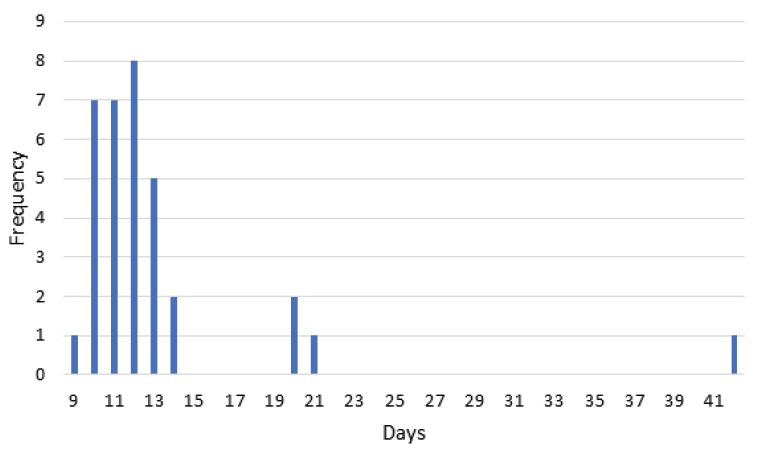
Figure 1. Frequency distribution of inter-clutch intervals in the common pigeon as observed in Chennai, India
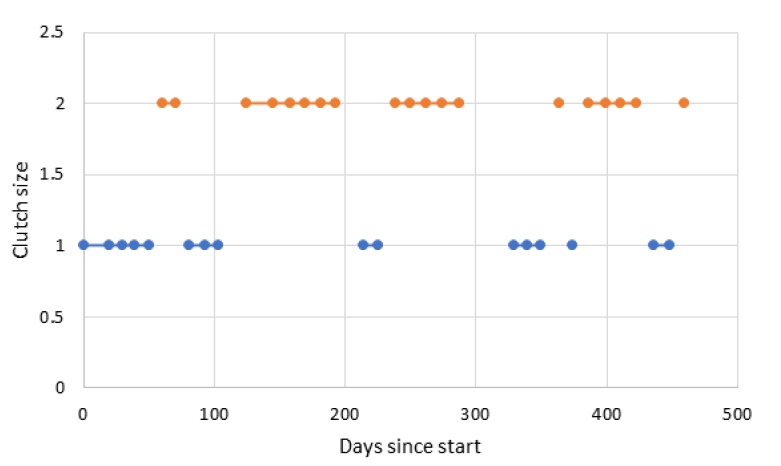
Figure 2. Variations in clutch size of the common pigeon during the entire laying period. Blue dots represent clutches of single eggs, and orange dots, represent clutches of two eggs.
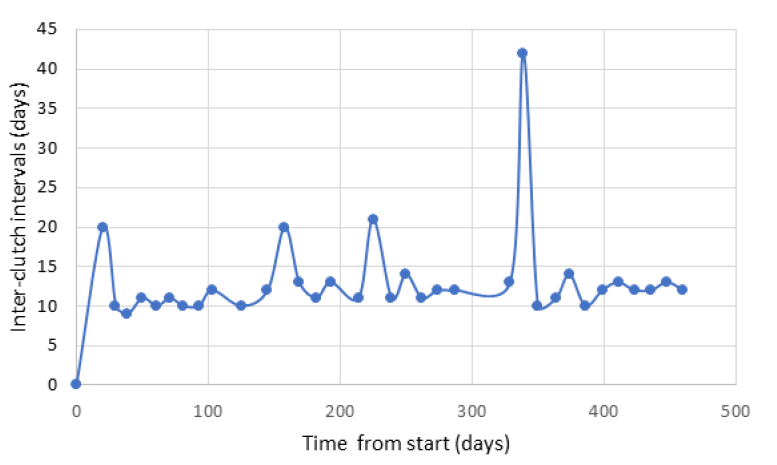
Figure 3. Inter-clutch intervals across time as observed in the common pigeon in Chennai, India.
recruit 36 pigeons locally. However, crows (Corvus spp.) take a toll on eggs and chicks. In one instance in Chennai, a rufous treepie (Dendrocitta vagabunda) preyed on two chicks in an exposed nest. Cats also predate on pigeons when they come down to feed.
There can be many other natural factors (including disease) that can potentially regulate the population size of the species, such as disease Pigeons are known to carry infectious diseases (Rani & Rajakumari, 2021).
Yet epidemics that wiped out local pigeon populations have not been widely reported either, although they are known in domestic pigeon-rearing (Kabir, 2019). Limits imposed by predators and infectious diseases, notwithstanding, lesser-known environmental factors seem to work in tandem, favorably, for pigeons. How common pigeon populations grow locally is therefore a question that needs more scientific investigation.
Food provisioning and abundance
Apparent overabundance of the common pigeon in urban landscapes has become a serious concern not just in India but world over (Haidar et al., 2017). In most Indian cities, its relative commonness and commensalism have together contributed to the species being increasingly seen as a public nuisance, menace and threat to human health. In cities like Mumbai, where it has become a socio-political concern, the public are even restrained from feeding them – thereby hindering a tradition that may be more than sixty years old (Ali & Ripley, 1969). Policies such as these can be due to the fact that some studies have attributed the seemingly large local abundance of common pigeons primarily to direct or indirect provisioning of food (e.g. Sutariya & Bhatt, 2025).
Common pigeons normally feed on a wide variety of grains, pulses, tubers, and green shoots (Ali & Ripley, 1969) and also anthropogenic sources like bread, cake, etc. (Roof, 2001). In Chennai, they readily eat cooked rice, idly, dosa, etc. However, unlike other predominantly grain-eating omnivorous birds of their size (example poultry birds), they do not spend much time feeding; they feed just twice a day (Ali & Ripley, 1969; Roof, 2001). They can go without food for days at a stretch as often observed in Chennai during floods. This is due to their low metabolism (McNab, 2000). Provisioned food may therefore not be the primary reason for their high abundance in urban landscapes.
Monogamy, fidelity and territory
The common pigeons are known for pair-bonding and monogamy. However, infidelity cannot be entirely ruled out. On December 15, 2017, a new female (F2) entered the balcony and subdued the old female (F1). As F2 kept chasing and bullying her, F1 left the building. F1 returned after two days on the 18th but was again attacked by F2 and the male (M1) as well. F1 was evidently weak and distressed that she had to be caught on the 19th evening so that she could be shifted to DMARRC the next day. However, as she was restless inside the basket, she was released on the 20th morning. She flew away but returned in the evening briefly for food. She disappeared thereafter.
F2 made the balcony her home for three months without laying eggs. On March 27, 2018, she appeared morbid. She died the next day. Moments later F1 returned, and after some ritualistic displays and cooing, she reunited with the male (M1) and took charge of the nest. End of November 2024 was the last time that F1 was seen. She had spent 9 years on the balcony. Her size, gait, and the confidence with which she loitered inside the apartment were definite pointers to her identity.
The more than 9-year-old M1 (identified by a dent in his cere, larger size and pompous gait) quickly found another mate (F3) in early December 2024. But she did not stay for long. Another young female (F4, identified by the absence of the inner toe on the right foot) joined him, and she started to lay the same month (December 2024). Eggs were removed and emptied, but the shell was placed in the nest. This was practiced mainly to prevent the female from producing frequent clutches, as removal of eggs can reduce the inter-clutch interval (Haidar et al., 2017). F4 sitting in the nest is also an incentive for M1 to defend the balcony from intruders. Intruding pairs attempting to take over the nest are a frequent occurrence, sometimes witnessed 3-4 times a day.
Fostering and brood parasitism
Three years before F1 disappeared, two chicks on the neighbor’s balcony were removed and had to be rehabilitated. The chicks were too young that they required hand-feeding. The screeching sounds that the chicks made while being fed attracted F1. She came and sat close every time the chicks were being fed. At first, it appeared as if she was trying to defend her territory. But as she was undeterred by gesturing or shouting, the chicks were placed beside her. She started feeding them without hesitation. Both parents (M1 & F1) fostered them until the chicks flew out. Is intraspecies fostering something unique? Or is it a trait shared by cliff-nesting birds such as kittiwakes? (De Waal, 2016).
Cross-fostering (interspecies fostering) is commonly adopted in homes, farms, and aviaries. It has been successfully used in species conservation too (Powell & Cuthbert, 1993) and among edible-nest swiftlets (Collacalia fuciphaga) in the caves of Andaman and Nicobar Islands (Rahmani, 2009). Brood parasitism, widely known in cuckoos, may just be a natural form of cross-fostering.
Intraspecies brood parasitism, also known as conspecific brood parasitism, has been observed in more than 200 species of birds (Stevens, 2013). It is known in grebes, waterfowl (ducks in particular; Cooper, 2022), grouse and allies, estrildid finches, swallows, starlings and weaverbirds (Lyon & Eadie, 2008). Sandell & Diemer (1999) have said that this is a strategy adopted by floating females in European starlings.
Conspecific brood parasitism was also observed in the balcony on at least three occasions. Were these floating females? They were never accompanied by males. Normally, what was observed is that whenever other pigeons tried to invade and take over the nest, they came in pairs. But floaters were always solitary.
Candidate for citizen science
Among India’s neighborhood birds, the common pigeon has the greatest potential of being a model organism for a wide range of citizen science projects. It is popular due to availability and hardiness, ease of handling (not a protected species), adaptability, and an established baseline. Since B. F. Skinner published his seminal research on behavioral psychology in the 1940s, there has been plenty of interest in the common pigeon as a model organism (Fernandes & Lattal, 2025).
The common pigeons have also been used as model organisms in urban ecology (Caproccia et al., 2018) and environmental science, especially in biomonitoring (Cizdziel et al., 2012). Other scientific investigations that have involved pigeons as the model organism are largely focused on population dynamics (e.g. Richardson & Caproccia, 2016) and as disease indicators (e.g. Rani & Rajakumari, 2021).
Science and adventure are not always compatible, although both can be rewarding in different ways. A number of well-intended field studies of birds in India have not gone beyond what Crooke (1981) described as ‘discovery phase and inventory stage’, because the adventure-science incompatibility is often overlooked. Discovery of species and exhaustive inventories, commonly showcased as ‘citizen science,’ have failed to influence decision-makers, as has become evident in the Great Nicobar Island (Daniels, 2024b).
In this paper, we have made an attempt to show how a common species of bird that we encounter in our everyday lives can provide useful information on how some animals adapt well to human-modified environments. We have also demonstrated how simple ‘book-keeping’ over a long period of time can prove to be useful in citizen science projects. Well-executed citizen science projects can help in dispelling myths about birds like the common pigeon and many other commensal and synanthropic species of animals.
Acknowledgement
The balcony experiment would not have been possible without the cooperation of Vinetha Daniels. The authors are indebted to her. We are also grateful to Prof N. V. Joshi for patiently reading various drafts of the manuscript and providing valuable inputs for improving it.
CONFLICT OF INTEREST
R J Ranjit Daniels is an academic editor at the Journal of Wildlife Science. However, he did not participate in the peer review process of this article except as an author. The authors declare no other competing interests.
DATA AVAILABILITY
Data will be made available on request by the first author R J Ranjit Daniels.
AUTHORS’ CONTRIBUTION
R J Ranjit Daniels: Concept, data analysis and drafting the manuscript.
Rosella Daniels: Collection of data and curation.
ETHICS STATEMENT
The common pigeon is not a protected species in India. No harm was inflicted on the pigeons in the course of the observations and egg-removal experiments.
Edited By
Amit Trivedi
Mizoram University, India
*CORRESPONDENCE
R. J. Ranjit Daniels
✉ ranjit.daniels@gmail.com
SPECIAL ISSUE
This paper is published in the Special Issue “Advances in Avian Biology”.
CITATION
Daniels, R. J. R. & Daniels, R. (2026). A bird in hand is worth two in the bush: Long-term observations on an accessible Common Pigeon’s nest, supplemented with anecdotes, offer insights for Citizen Science. Journal of Wildlife Science, Online Early Publication, 01-04. https://doi.org/10.63033/JWLS.VUYV5889
COPYRIGHT
© 2026 Daniels & Daniels. This is an open-access article, immediately and freely available to read, download, and share. The information contained in this article is distributed under the terms of the Creative Commons Attribution License (CC BY 4.0
 ), allowing for unrestricted use, distribution, and reproduction in any medium, provided the original work is properly cited in accordance with accepted academic practice. Copyright is retained by the author(s).
PUBLISHED BY
Wildlife Institute of India, Dehradun, 248 001 INDIA
PUBLISHER'S NOTE
The Publisher, Journal of Wildlife Science or Editors cannot be held responsible for any errors or consequences arising from the use of the information contained in this article. All claims expressed in this article are solely those of the author(s) and do not necessarily represent those of their affiliated organisations or those of the publisher, the editors and the reviewers. Any product that may be evaluated or used in this article or claim made by its manufacturer is not guaranteed or endorsed by the publisher.
Ali, S. & Ripley, S. D. (1969). Handbook of the Birds of India and Pakistan, together with those of Nepal, Sikkim, Bhutan and Ceylon. 3, Oxford University Press, New Delhi.
AnAge (2023). The Common Pigeon (Columba livia). AnAge: The animal Ageing and Longevity Database. Human Ageing Genomic Resources. https://genomics.senescience.info
Anonymous (2023). The Wildlife (Protection) Act, 1972 as amended by The Wildlife (Protection) Amendment Act, 2022. LexisNexis, New Delhi.
Bar, A. (2009). Calcium transport in strongly calcifying laying birds: mechanisms and regulations. Comparative Biochemistry and Physiology Part A: Molecular & Integrative Physiology, 152(4), 447-469. https://doi.org/10.1016/j.cbpa.2008.11.020
Caproccia, S., Boyle, C. & Darnell, T. (2018). Loved or loathed, feral pigeons as subjects in ecological and social research. Journal of Urban Ecology, 4(1). https://doi.org/10.1093/jue/juy024
Cizdziel, J. V., Dempsey, S. & Hallbrook, R. S. (2012). Preliminary evaluation of the use of homing pigeons as biomonitors of mercury in urban areas of the USA and China. Bulletin of Environmental Contamination and Toxicology, 90(3). https://doi.org/10.1007/s00128-012-0918-y
Cooper, E. (2022). Animal behavior and intraspecific brood parasitism. Research & Reviews: Journal of Veterinary Sciences, 6(S6). https://www.rroij.com/open-access/animal-behavior-and-intraspecific-brood-parasitism.php?aid=92702
Crooke, F. (1981). 200 years of ornithology in Canada. The Canadian field-naturalist, 95(1), 2-5. https://doi.org/10.5962/p.352290
Daniels, R. J. R. (2024a). Birds, People and the Urban Dilemma. Mongabay India, 4. https://india.mongabay.com
Daniels, R. J. R. (2024b). A Voice for the Great Nicobar Island. Current Science, 126(4), 424-425.
De Waal, F. (2016). Are we smart enough to know how smart animals are? W. W. Norton & Company, New York.
Fernandes, E. J. & Lattal, K. A. (2025). Pigeon in a box: Columba livia as subject in behavioral research. Perspectives in Behavioral Science, 48(2), 499-512. https://doi.org/10.1007/s40614-025-00454-4
Haidar, I., Alvarez, I. & Prevot, A. C. (2017). Mathematical modelling of an urban pigeon population subject to local management strategies. Mathematical Biosciences, 288, 71-83. https://doi.org/10.1016/j.mbs.2017.03.002
Kabir, M. A. (2019). Ten common causes of squab death during pigeon rearing. Journal of Dairy, Veterinary & Animal Research, 8(4). https://doi.org/10.15406/jdvar.2019.08.00262
Lorenz, K. (1961). King Solomon’s Ring (Translated by Marjorie K Wilson). Methuen, London.
Lyon, B. E. & Eadie, J. McA. (2008). Conspecific Brood Parasitism in Birds: A Life-History Perspective. Annual Review of Ecology, Evolution and Systematics, 39, 343-363. https://doi.org/10.1146/annurev.ecolsys.39.110707.173354
McNab, B. K. (2000). The influence of body mass, climate and distribution on the energetics of South Pacific pigeons. Comparative Biochemistry and Physiology A, 127(3), 309-329. https://doi.org/10.1016/S1095-6433(00)00268-3
Powell, A. N. & Cuthbert, F. (1993). Augmenting small populations of plovers: an assessment of cross-fostering and captive-rearing. Conservation Biology, 7(1), 160-168. https://doi.org/1046/j.1523-1739.1993.07010160
Rahmani, A. R. (2009). Ravi Sankaran’s ornithological contribution. Indian Birds, 5(4), 121-125.
Rani, P. B. R. & Rajakumari, D. V. S. (2021). Survey on prevalence of common diseases in pigeon (Columba livia) in Tuticorin district, Tamil Nadu, India. International Journal of Zoology and Biosciences, 6(4), 203-207. https://doi.org/10.55126/ijzab.2021.v06.i04.018
Richardson, C. & Caproccia, S. (2016). Population Dynamics of the Feral Pigeon in the Central Business District of Butte, Montana. In: Timm, R. M. & Baldwin, R. A. (eds). Proceedings of the 27th Vertebrate Pest Conference, University of California, Davis, pp.217-220. https://doi.org/10.5070/V427110524
Ridley, M. (2025). Birds, sex and beauty. 4th Estate, London.
Roof, J. (2001). ‘Columba livia’ (On-line), Animal Diversity Web. https://animaldiversity.org/accounts/Columba_livia/
Sandell, M. I. & Diemer, M. (1999). Intraspecific brood parasitism: a strategy for floating females within European starlings. Animal Behavior, 57, 197-202. https://doi.org/10.1006/anbe.1998.0936
Stevens, M. (2013). Bird brood parasitism. Current Biology, 23(20), 909-913. https://doi.org/10.1016/j.cub.2013.08.025
Sutariya, U. & Bhatt, N. (2025). Comparative study of feral pigeon abundances in relation to feeding impacts in urban and rural landscapes. Discover Animals, 2, 80. https://doi.org/10.1007/s44338-025-00134-2
Tinbergen, N. (1960). The Herring Gull’s World: A study of social behavior of birds. Basic Books, New York.

Edited By
Amit Trivedi
Mizoram University, India
*CORRESPONDENCE
R. J. Ranjit Daniels
✉ ranjit.daniels@gmail.com
SPECIAL ISSUE
This paper is published in the Special Issue “Advances in Avian Biology”.
CITATION
Daniels, R. J. R. & Daniels, R. (2026). A bird in hand is worth two in the bush: Long-term observations on an accessible Common Pigeon’s nest, supplemented with anecdotes, offer insights for Citizen Science. Journal of Wildlife Science, Online Early Publication, 01-04. https://doi.org/10.63033/JWLS.VUYV5889
COPYRIGHT
© 2026 Daniels & Daniels. This is an open-access article, immediately and freely available to read, download, and share. The information contained in this article is distributed under the terms of the Creative Commons Attribution License (CC BY 4.0), allowing for unrestricted use, distribution, and reproduction in any medium, provided the original work is properly cited in accordance with accepted academic practice. Copyright is retained by the author(s).
PUBLISHED BY
Wildlife Institute of India, Dehradun, 248 001 INDIA
PUBLISHER'S NOTE
The Publisher, Journal of Wildlife Science or Editors cannot be held responsible for any errors or consequences arising from the use of the information contained in this article. All claims expressed in this article are solely those of the author(s) and do not necessarily represent those of their affiliated organisations or those of the publisher, the editors and the reviewers. Any product that may be evaluated or used in this article or claim made by its manufacturer is not guaranteed or endorsed by the publisher.
Ali, S. & Ripley, S. D. (1969). Handbook of the Birds of India and Pakistan, together with those of Nepal, Sikkim, Bhutan and Ceylon. 3, Oxford University Press, New Delhi.
AnAge (2023). The Common Pigeon (Columba livia). AnAge: The animal Ageing and Longevity Database. Human Ageing Genomic Resources. https://genomics.senescience.info
Anonymous (2023). The Wildlife (Protection) Act, 1972 as amended by The Wildlife (Protection) Amendment Act, 2022. LexisNexis, New Delhi.
Bar, A. (2009). Calcium transport in strongly calcifying laying birds: mechanisms and regulations. Comparative Biochemistry and Physiology Part A: Molecular & Integrative Physiology, 152(4), 447-469. https://doi.org/10.1016/j.cbpa.2008.11.020
Caproccia, S., Boyle, C. & Darnell, T. (2018). Loved or loathed, feral pigeons as subjects in ecological and social research. Journal of Urban Ecology, 4(1). https://doi.org/10.1093/jue/juy024
Cizdziel, J. V., Dempsey, S. & Hallbrook, R. S. (2012). Preliminary evaluation of the use of homing pigeons as biomonitors of mercury in urban areas of the USA and China. Bulletin of Environmental Contamination and Toxicology, 90(3). https://doi.org/10.1007/s00128-012-0918-y
Cooper, E. (2022). Animal behavior and intraspecific brood parasitism. Research & Reviews: Journal of Veterinary Sciences, 6(S6). https://www.rroij.com/open-access/animal-behavior-and-intraspecific-brood-parasitism.php?aid=92702
Crooke, F. (1981). 200 years of ornithology in Canada. The Canadian field-naturalist, 95(1), 2-5. https://doi.org/10.5962/p.352290
Daniels, R. J. R. (2024a). Birds, People and the Urban Dilemma. Mongabay India, 4. https://india.mongabay.com
Daniels, R. J. R. (2024b). A Voice for the Great Nicobar Island. Current Science, 126(4), 424-425.
De Waal, F. (2016). Are we smart enough to know how smart animals are? W. W. Norton & Company, New York.
Fernandes, E. J. & Lattal, K. A. (2025). Pigeon in a box: Columba livia as subject in behavioral research. Perspectives in Behavioral Science, 48(2), 499-512. https://doi.org/10.1007/s40614-025-00454-4
Haidar, I., Alvarez, I. & Prevot, A. C. (2017). Mathematical modelling of an urban pigeon population subject to local management strategies. Mathematical Biosciences, 288, 71-83. https://doi.org/10.1016/j.mbs.2017.03.002
Kabir, M. A. (2019). Ten common causes of squab death during pigeon rearing. Journal of Dairy, Veterinary & Animal Research, 8(4). https://doi.org/10.15406/jdvar.2019.08.00262
Lorenz, K. (1961). King Solomon’s Ring (Translated by Marjorie K Wilson). Methuen, London.
Lyon, B. E. & Eadie, J. McA. (2008). Conspecific Brood Parasitism in Birds: A Life-History Perspective. Annual Review of Ecology, Evolution and Systematics, 39, 343-363. https://doi.org/10.1146/annurev.ecolsys.39.110707.173354
McNab, B. K. (2000). The influence of body mass, climate and distribution on the energetics of South Pacific pigeons. Comparative Biochemistry and Physiology A, 127(3), 309-329. https://doi.org/10.1016/S1095-6433(00)00268-3
Powell, A. N. & Cuthbert, F. (1993). Augmenting small populations of plovers: an assessment of cross-fostering and captive-rearing. Conservation Biology, 7(1), 160-168. https://doi.org/1046/j.1523-1739.1993.07010160
Rahmani, A. R. (2009). Ravi Sankaran’s ornithological contribution. Indian Birds, 5(4), 121-125.
Rani, P. B. R. & Rajakumari, D. V. S. (2021). Survey on prevalence of common diseases in pigeon (Columba livia) in Tuticorin district, Tamil Nadu, India. International Journal of Zoology and Biosciences, 6(4), 203-207. https://doi.org/10.55126/ijzab.2021.v06.i04.018
Richardson, C. & Caproccia, S. (2016). Population Dynamics of the Feral Pigeon in the Central Business District of Butte, Montana. In: Timm, R. M. & Baldwin, R. A. (eds). Proceedings of the 27th Vertebrate Pest Conference, University of California, Davis, pp.217-220. https://doi.org/10.5070/V427110524
Ridley, M. (2025). Birds, sex and beauty. 4th Estate, London.
Roof, J. (2001). ‘Columba livia’ (On-line), Animal Diversity Web. https://animaldiversity.org/accounts/Columba_livia/
Sandell, M. I. & Diemer, M. (1999). Intraspecific brood parasitism: a strategy for floating females within European starlings. Animal Behavior, 57, 197-202. https://doi.org/10.1006/anbe.1998.0936
Stevens, M. (2013). Bird brood parasitism. Current Biology, 23(20), 909-913. https://doi.org/10.1016/j.cub.2013.08.025
Sutariya, U. & Bhatt, N. (2025). Comparative study of feral pigeon abundances in relation to feeding impacts in urban and rural landscapes. Discover Animals, 2, 80. https://doi.org/10.1007/s44338-025-00134-2
Tinbergen, N. (1960). The Herring Gull’s World: A study of social behavior of birds. Basic Books, New York.


