TYPE: Natural History Note
Shahid Nawaz Khwaja Bhai Landge¹* , Alok Lamuel Gude²
¹The Blatter Herbarium (BLAT), St. Xavier's College (Empowered Autonomous Institute), Mumbai, 400001 India
²Department of Botany, St. Xavier's College (Empowered Autonomous Institute), Mumbai, 400001 India

The genus Eragrostiella Bor historically segregated from Eragrostis due to its solitary spike inflorescence bearing secund spikelets, contrasting with the panicle of the latter. Phylogenetically, Eragrostiella is considered sister to the Tripogonella clade (Peterson et al., 2016). Eragrostiella is characterised by its multiflowered spikelets and exaristate lemma, a feature that reliably distinguishes it from the closely related genera Tripogon Roem. & Schult. and Tripogonella P.M. Peterson & Romasch., both of which possess a distinctly aristate lemma. The genus consists of six species distributed across the old-world tropics and subtropics, with five species and two varieties known to occur in India (Lazarides, 1976).
Eragrostiella bifaria var. walkeri thrives in the dry, rocky habitats (characterised by sandstone and quartzite substrates) of Andhra Pradesh, South India. Despite inhabiting these xeric conditions, vivipary has not been documented in its wild populations. Gandikota hills, a geologically unique and botanically underexplored region, harbours unique grass flora in South India (Landge et al., 2026).
In its native habitats in Gandikota hills, Kadapa district of Andhra Pradesh, Eragrostiella bifaria var. walkeri exhibits notably robust growth forms, attaining a height of up to 90 cm (3 feet) (Figure 1). This impressive stature alone allows for easy distinction from its congeners such as, E. brachyphylla (Stapf) Bor, E. bifaria var. bifaria (Vahl) Bor and E. nardoides (Trin.) Bor. The inflorescence in var. walkeri is typically long and drooping, often measuring up to 40 cm in length. The leaves are evenly distributed on the culms; they are long, flat and drooping, and may reach up to 50 cm long. The lowest leaves clearly exceed the base of the inflorescence. Culms can be 2–4 nodded. The spikelets are generally whitish, occasionally displaying a purple tinge on the glumes, lemma apices, and submarginal sides. The spikelet floret count can be exceptionally high, often reaching 50 to 60 per spikelet.
The remarkable numerical superiority observed in the plant habit (height), inflorescence length, and spikelet floret number far exceeds the recorded extremes for any other taxa within the genus Eragrostiella. However, Lazarides (1976), viewing this taxon within the broader circumscription of E. bifaria, reduced its taxonomic rank to a variety. This treatment may be justified to some extent, as there is a paucity of qualitative characteristics currently available to support its segregation as a distinct species. To resolve this taxonomic uncertainty and confirm its appropriate rank, a molecular phylogenetic approach is strongly recommended.
In the present study, we report the occurrence of true vivipary in the inflorescence of Eragrostiella bifaria var. walkeri under controlled cultivated conditions. This observation is significant as it constitutes the first published record of true vivipary for the genus Eragrostiella and for the entire subtribe Tripogoninae. This finding warrants further investigation into the genetic potential and environmental triggers for vivipary within this taxonomically important group.
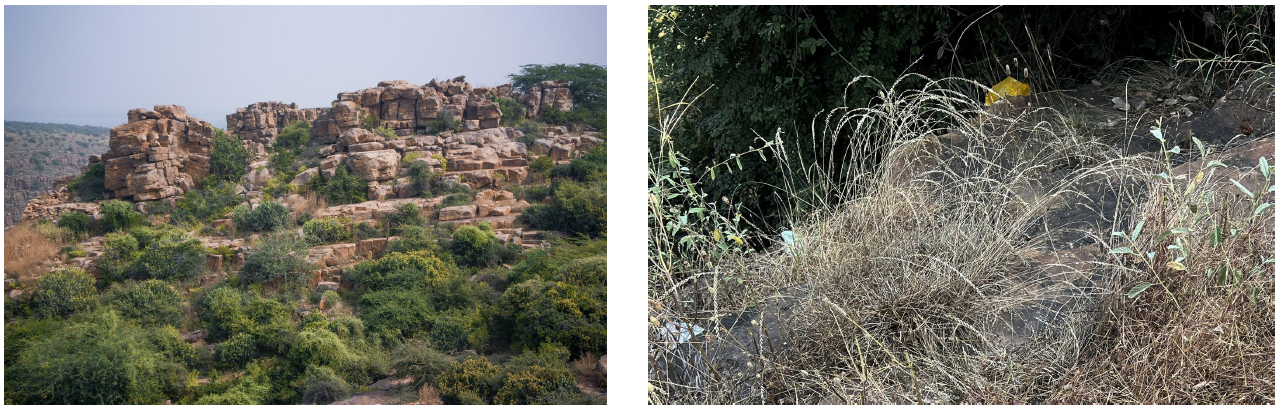
Figure 1. Habitats and habit of Eragrostiella bifaria var. walkeri in Gandikota hill, Kadapa [Cuddapah] district, Andhra Pradesh, India. (Captured on 21 December 2019 by Mr. Shahid Nawaz).
True vivipary is defined as the precocious germination of the embryo into small, separable plantlets while the developing structures remain attached to the mother plant (Goebel, 1905; Arber, 1965; Beetle, 1980; Vega & de Agrasar, 2006). These plantlets subsequently detach and fall to the ground; however, they often exhibit reduced reproductive potential, either remaining strictly vegetative or perishing. Vivipary is sometimes confused with vegetative proliferation (also termed pseudovivipary). Pseudovivipary is distinct because it involves asexual growth and the direct conversion of floral buds into vegetative plantlets, rather than the germination of a sexually produced embryo (Vega & de Agrasar, 2006).
In grasses, vivipary is considered an adaptation to severe climatic conditions, such as alpine, mountain, and arid regions (Tzelev, 1989). Vivipary has been documented across various grass genera, including Agrostis L., Poa L., Eleusine Gaertn., Sesleria Scop, Avena L., Bromus L., Festuca Tourn. ex L., Deschampsia P.Beauv., Panicum L., Phleum L., Setaria P.Beauv., and Zea L. The causal factors are complex, ranging from genetic influences (e.g., hybridization, polyploidy) to adverse environmental stressors (e.g., hormonal imbalance or fluctuation) (Beetle, 1980).
The grass Eragrostiella bifaria var. walkeri, an Indo-Ceylon disjunct taxon, is consistently observed thriving in dry, rocky areas (sandstone and quartzite) (Figure 1) within Andhra Pradesh, South India, confirming its remarkable desiccation tolerance and resurrection potential. In similar habitats, two more endemic grass taxa are found, viz., Parahyparrhenia bellariensis (Hack.) Clayton and Chrysopogon velutinus (Hook.f.) Bor, more details on them can be found in Landge & Shinde (2021, 2022, 2023).
An extremely desiccated tuft of the grass was collected from Gandikota Fort hill, Andhra Pradesh, on 21 December 2019, and subsequently planted under controlled cultivated conditions at the grass experimental set-up at St. Xavier’s College (Empowered Autonomous Institute), Mumbai, India. The first flowering appeared approximately six months later, in late June 2020, coinciding with the onset of the monsoon in India. Based on the characters such as robust habit, long inflorescence, four nodes on the culms, and leaf blades reaching the base of the inflorescence, the grass was identified using Bor (1960) and Lazarides (1976) as a match for Eragrostiella walkeri (now considered as E. bifaria var. walkeri).
In the same cultivated tuft, after the initial rigorous flowering subsided, accidental emergence of viviparous spikelets was observed in the inflorescence during the first week of October of the same year. The proliferated spikelet possessing a germinated caryopsis was studied under a stereo zoom microscope at Blatter Herbarium (BLAT) to understand its morphology and definitively confirm the occurrence of true vivipary, ruling out pseudovivipary.
Crucially, no instances of vivipary were recorded in natural populations in the wild, suggesting this phenomenon may be a stress-induced response triggered by the specific cultivated conditions (e.g., increased moisture availability) following severe desiccation.
The collected viviparous voucher specimen of Eragrostiella bifaria var. walkeri has been processed for herbarium preparation and deposited at the Blatter Herbarium (BLAT) for future study.
The viviparously proliferated spikelet was found situated below the middle of the spike (Figure 2). It was confirmed to possess a caryopsis, which rapidly germinated inside the floret. The viviparous spikelet measured up to 0.8 cm in length and consisted of well-developed sheaths, blades up to 25 mm, and a ciliate ligule. Notably, a small portion of a root, emerging from within the lower floret, was visible towards the rachis near the lower involucral glume (Figure 3).
Since the phenomenon of vivipary was not observed in the wild population of Eragrostiella bifaria var. walkeri, it prompts a consideration of the factors that triggered its emergence under controlled conditions. This rare event, which was not witnessed in any subsequent years after its first emergence, suggests a highly specific or acute environmental stimulus.
Perhaps the sudden change in environmental conditions, specifically the shift from the extremely desiccated wild state to the moisture-rich, cultivated environment, played a role. This change, particularly following the initial recovery and flowering, may have stimulated a survival mechanism in the species. Whether it is due to an acute, stress-induced survival instinct activated by the unusual habitat changes under cultivation is not known.
Morphological description, taxonomy and distribution of Eragrostiella bifaria var. walkeri
Eragrostiella bifaria var. walkeri (Stapf) Lazarides, Contr. Herb. Austral. 22: 7 (1976). – Eragrostis walkeri Stapf in Trim. Handb. Fl. Ceylon 298. (1900). – Eragrostiella walkeri (Stapf) Bor in Ind. Forest. 66: 270 (1940b). Type: SRI LANKA [CEYLON]. Walker s.n. [C.P. 60 pro parte on the label] (K000245121–lectotype, designated by Lazarides (1994).
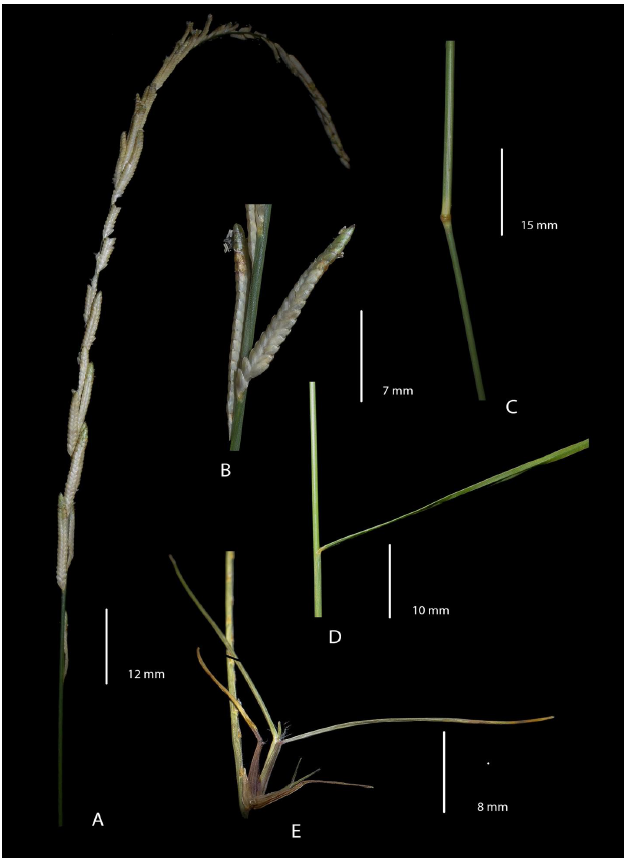
Figure 2. Morphology of Eragrostiella bifaria var. walkeri (Stapf) Lazarides with viviparous spikelet. A. Spicate inflorescence. B. Normal Spikelets. C. Node and geniculate culm. D. Leaf. E. Viviparous spikelet. (Captured on 5th October 2020 by Mr. Shahid Nawaz).
Robust, 30–90 cm high, densely tufted, geniculately ascending, glabrous, un-branched, perennial herb. Culms very slender, terete, bases studded with disintegrating fibrous sheaths, striated, glabrous, nodes 2–4, swollen and glabrous. Sheath shorter than the internode, scabrous, striated, terete, somewhat tightly clasping the culm, except near the mouth and little below, 6.0–8.0 cm in length. Ligule 0.8–2.0 mm long, ciliolate to ciliate. Blades sub-auriculate (thin, hyaline, membranous, glabrous extension of the margin of sheath), flat (becoming dry and convolute on maturity), striated, scaberulous and puberulous on intercostal spaces, linear long with attenuate to filiform apices 12–40 × 0.1–0.2 cm; basal leaves longer than their upper cauline counterparts, drooping, drying and somewhat curling at the tips on maturity; leaves reaching fairly above the base of the spike. Inflorescence a spike, up to 35 cm in length, remarkably curling and slightly drooping. Rachis very slender, serrulate on the edges. Spikelets sessile, distinctly white, multi-flowered (up to 50 florets), laterally compressed, linear long, 1.3 × 0.2 (–1.5) cm, biseriately secund, disposed alternately on a rhachis. Lower and the uppermost spikelets are smaller than those below and a little above the middle on the rhachis. Lower glume ovate adjacent to rhachis (adaxial), thin, hyaline, chartaceous, glabrous, 1-nerved, dorsally keeled, keel scabrous (somewhat pectinate in the lower two-third), apex sub-acute, slightly obtuse, 1.3 × 1.5 mm. Upper glume, sub-hyaline, fragile, chartaceous, 1-nerved, dorsally keeled, tip acute, slightly pectinate on the keel, linear-oblong 1.5 × 1.5 mm.
Floret: Lemma (lower two florets in the spikelets are barren) hyaline, membranous, glabrous, 3-nerved, margins broad, apex retuse or obtuse tinged with purple, broadly ovate, 2.5 × 2 mm; palea slightly shorter to its lemma, hyaline, obovate-spatulate, 2-keeled, ciliolate on the winged-keel, margin inflexed, broader at the base and tapering upwards, depressed between the keels, apex acute, broadly ovate. Stamens 3, anthers 0.8–1.1 mm in length. Lodicules turgid, in a pair at the base of the ovary, clavellate, slightly tridentate, ca. 0.3 mm. Ovary green, 0.25–0.3 mm in length, tipped with a tubercle protuberance (0.01 mm).
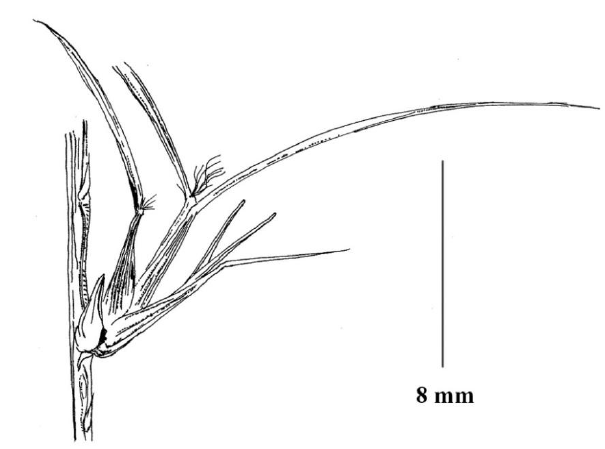
Figure 3. Illustration of the viviparous spikelet in Eragrostiella bifaria var. walkeri (Stapf) Lazarides. (Illustrated in October 2020 by Mr. Shahid Nawaz).
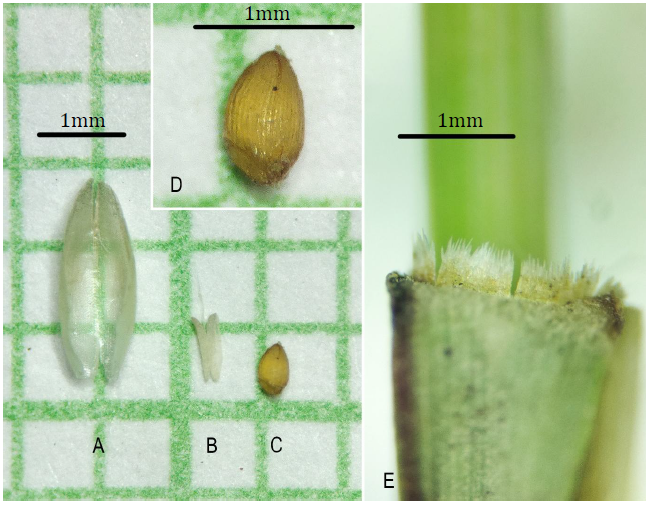
Figure 4. Lemma, stamen, caryopsis and ligule of Eragrostiella bifaria var. walkeri. A. Lemma. B. Anther. C. Caryopsis. D. Close-up of caryopsis. E. Ligule. Scale bar: 1 mm (A, B, C, D, and E). (Captured on 5th October 2020 by Mr. Shahid Nawaz).
Caryopsis, globose-ellipsoid, striate, finely reticulate, reddish brown, 0.7–0.8 mm, embryo laterally wedged, half of the seed.
Habitat & Distribution: In the dry, quartzite and sandstone rocky habitats, growing in meager soil accumulation through rocky crevices. This species is distributed in South India (Karnataka, Andhra Pradesh, Telangana and Tamil Nadu) and Sri Lanka. (Bor, 1940 & 1960; Lazarides, 1976; Kabeer & Nair 2009; Thoiba, 2018; Lakshminarasimhan et al., 2019).
Flowering and fruiting: June–January.
Taxonomic Notes: This particular taxon can be easily distinguished based on combinations of characters such as, the robust habit, wider tufts, culms 2-4 nodded, drooping inflorescences, higher number of florets per spikelet (up to 60 florets), whitish spikelets, lower leaf blades long, initially broad and wide open, and glaucous in appearance, reaching the base of the inflorescence and sometimes also exceeding it (Figures. 2-4).
Acknowledgement
The lead author (SNKBL) expresses his sincere gratitude to his family for their financial support during his research in South India. We also thank the management of St. Xavier’s College (Empowered Autonomous Institute), Mumbai, for providing the laboratory and infrastructure facilities necessary to conduct the experimental work.
CONFLICT OF INTEREST
The authors declare that they have no conflict of interest.
DATA AVAILABILITY
All the data available to authors have been provided in the paper.
AUTHOR CONTRIBUTIONS
SNKBL collected the plant specimens from the wild, designed the experimental work, captured the field and experimental photography, and prepared the original manu¬script draft. ALG reviewed the original draft and provided critical comments and valu¬able suggestions during manuscript preparation.
Edited By
Navendu Page
Thackeray Wildlife Foundation
*CORRESPONDENCE
Shahid Nawaz Khwaja Bhai Landge
✉ shahidnawaz.landge@xaviers.edu
CITATION
Landge, S. N. K. B. & Gude, A. L. (2026). First record of true vivipary in Eragrostiella bifaria var. walkeri (Poaceae: Chloridoideae, Tripogoninae) under cultivated conditions, and a brief note on its taxonomy. Journal of Wildlife Science, 3(2), 79-82. https://doi.org/10.63033/JWLS.OQBW9095
COPYRIGHT
© 2026 Langde & Gude. This is an open-access article, immediately and freely available to read, download, and share. The information contained in this article is distributed under the terms of the Creative Commons Attribution License (CC BY 4.0
 ), allowing for unrestricted use, distribution, and reproduction in any medium, provided the original work is properly cited in accordance with accepted academic practice. Copyright is retained by the author(s).
PUBLISHED BY
Wildlife Institute of India, Dehradun, 248 001 INDIA
PUBLISHER'S NOTE
The Publisher, Journal of Wildlife Science or Editors cannot be held responsible for any errors or consequences arising from the use of the information contained in this article. All claims expressed in this article are solely those of the author(s) and do not necessarily represent those of their affiliated organisations or those of the publisher, the editors and the reviewers. Any product that may be evaluated or used in this article or claim made by its manufacturer is not guaranteed or endorsed by the publisher.
Arber, A. (1965). The Gramineae: A Study of Cereal, Bamboo, and Grass. J. Cramer-Weinheim, New York.
Beetle, A. A. (1980). Vivipary, proliferation, and phyllody in grasses. Journal of Range Management, 33(4), 256–261. https://doi.org/10.2307/3898068
Bor, N. L. (1940). Three new genera of Indian Grasses. Indian Forester, 66. 267–72.
Bor, N. L. (1960). The grasses of Burma, Ceylon, India & Pakistan. Pergamon Press, London.
Goebel, K. (1905). Organography of Plants, Especially of the Archegoniatae and Spermophyta, Part II. Clarendon Press, Oxford.
Kabeer, A. K. A. & Nair, V. J. (2009). Grasses of Tamil Nadu. Botanical Survey of India Publication, Kolkata. pp.131.
Lakshminarasimhan, P., Dash, S. S., Singh, P., Singh, N. P., Vasudeva, R. M. K. & Rao, P. S. N. 2019. Flora of Karnataka (Monocotyledons). Vol. 3. Botanical Survey of India Publication, Kolkata. pp.645.
Landge, S. N. & Shinde, R. D. (2021). Rediscovery of Parahyparrhenia bellariensis (Poaceae: Andropogoneae): a presumed extinct grass from Andhra Pradesh, India. Phytotaxa, 497 (2), 147–156. https://doi.org/10.11646/phytotaxa.497.2.7
Landge, S. N. & Shinde, R. D. (2022). A taxonomic revision of the genus Parahyparrhenia (Poaceae: Andropogoneae) in India and review of African and Thai species. Phytotaxa, 541 (3), 247–260. https://doi.org/10.11646/phytotaxa.541.3.4
Landge, S. N. & Shinde, R. D. (2023). On the identity and distribution of Chrysopogon velutinus (Poaceae: Andropogoneae) and its taxonomic comparison with allied species in India. Phytotaxa, 612 (1), 046–056. https://doi.org/10.11646/phytotaxa.612.1.3
Landge, S. N., Chandran, M., Gude, A. L. & Shinde, R. D. (2026). Tripogon fibrosissimus (Poaceae: Chloridoideae: Tripogoninae): a new species from the Grand Canyon of India. Phytotaxa, 739 (2), 213–226. https://doi.org/10.11646/phytotaxa.739.2.5
Lazarides, M. (1976). The genus Eragrostiella Bor (Poaceae, Eragrostideae). Contributions from the Herbarium Australiense 22, 1–7. https://doi.org/10.1071/HA76011
Lazarides, M. (1994). Eragrostiella Bor. Eragrostis Wolf, Leptochloa P. Beauv., Tripogon Roem. & Schult. In: Dassanayake, M. D., Fosberg, F. R. & Clayton, W. D. (eds.). A revised handbook to the flora of Ceylon. Vol. 8. Amerind Publishing Co. Pvt. Ltd., New Delhi, pp.199–229.
Peterson, P. M., Romaschenko, K. & Herrera, A. Y. (2016). A molecular phylogeny and classification of the Cynodonteae (Poaceae: Chloridoideae) with four new genera: Orthacanthus, Triplasiella, Tripogonella, and Zaqiqah; three new subtribes: Dactylocteniinae, Orininae, and Zaqiqahinae; and a subgeneric classification of Distichlis. Taxon, 65 (6), 1263–1287. https://doi.org/10.12705/656.4
Thoiba, K. (2018). Taxonomic studies on Eragrostidineae (Poaceae: Chloridoideae: Eragrostideae) in Peninsular India. PhD Thesis, University of Calicut.
Tzvelev, N. N. (1989). The system of grasses (Poaceae) and their evolution. Botanical Review, 55 (3), 141–204. https://doi.org/10.1007/BF02858328
Vega, A. S. & De Agrasar, Z. E. R. (2006). Vivipary and pseudovivipary in the Poaceae, including the first record of pseudovivipary in Digitaria (Panicoideae: Paniceae). South African Journal of Botany, 72 (4), 559–564. https://doi.org/10.1016/j.sajb.2006.03.012

Edited By
Navendu Page
Thackeray Wildlife Foundation
*CORRESPONDENCE
Shahid Nawaz Khwaja Bhai Landge
✉ shahidnawaz.landge@xaviers.edu
CITATION
Landge, S. N. K. B. & Gude, A. L. (2026). First record of true vivipary in Eragrostiella bifaria var. walkeri (Poaceae: Chloridoideae, Tripogoninae) under cultivated conditions, and a brief note on its taxonomy. Journal of Wildlife Science, 3(2), 79-82. https://doi.org/10.63033/JWLS.OQBW9095
COPYRIGHT
© 2026 Langde & Gude. This is an open-access article, immediately and freely available to read, download, and share. The information contained in this article is distributed under the terms of the Creative Commons Attribution License (CC BY 4.0), allowing for unrestricted use, distribution, and reproduction in any medium, provided the original work is properly cited in accordance with accepted academic practice. Copyright is retained by the author(s).
PUBLISHED BY
Wildlife Institute of India, Dehradun, 248 001 INDIA
PUBLISHER'S NOTE
The Publisher, Journal of Wildlife Science or Editors cannot be held responsible for any errors or consequences arising from the use of the information contained in this article. All claims expressed in this article are solely those of the author(s) and do not necessarily represent those of their affiliated organisations or those of the publisher, the editors and the reviewers. Any product that may be evaluated or used in this article or claim made by its manufacturer is not guaranteed or endorsed by the publisher.
Arber, A. (1965). The Gramineae: A Study of Cereal, Bamboo, and Grass. J. Cramer-Weinheim, New York.
Beetle, A. A. (1980). Vivipary, proliferation, and phyllody in grasses. Journal of Range Management, 33(4), 256–261. https://doi.org/10.2307/3898068
Bor, N. L. (1940). Three new genera of Indian Grasses. Indian Forester, 66. 267–72.
Bor, N. L. (1960). The grasses of Burma, Ceylon, India & Pakistan. Pergamon Press, London.
Goebel, K. (1905). Organography of Plants, Especially of the Archegoniatae and Spermophyta, Part II. Clarendon Press, Oxford.
Kabeer, A. K. A. & Nair, V. J. (2009). Grasses of Tamil Nadu. Botanical Survey of India Publication, Kolkata. pp.131.
Lakshminarasimhan, P., Dash, S. S., Singh, P., Singh, N. P., Vasudeva, R. M. K. & Rao, P. S. N. 2019. Flora of Karnataka (Monocotyledons). Vol. 3. Botanical Survey of India Publication, Kolkata. pp.645.
Landge, S. N. & Shinde, R. D. (2021). Rediscovery of Parahyparrhenia bellariensis (Poaceae: Andropogoneae): a presumed extinct grass from Andhra Pradesh, India. Phytotaxa, 497 (2), 147–156. https://doi.org/10.11646/phytotaxa.497.2.7
Landge, S. N. & Shinde, R. D. (2022). A taxonomic revision of the genus Parahyparrhenia (Poaceae: Andropogoneae) in India and review of African and Thai species. Phytotaxa, 541 (3), 247–260. https://doi.org/10.11646/phytotaxa.541.3.4
Landge, S. N. & Shinde, R. D. (2023). On the identity and distribution of Chrysopogon velutinus (Poaceae: Andropogoneae) and its taxonomic comparison with allied species in India. Phytotaxa, 612 (1), 046–056. https://doi.org/10.11646/phytotaxa.612.1.3
Landge, S. N., Chandran, M., Gude, A. L. & Shinde, R. D. (2026). Tripogon fibrosissimus (Poaceae: Chloridoideae: Tripogoninae): a new species from the Grand Canyon of India. Phytotaxa, 739 (2), 213–226. https://doi.org/10.11646/phytotaxa.739.2.5
Lazarides, M. (1976). The genus Eragrostiella Bor (Poaceae, Eragrostideae). Contributions from the Herbarium Australiense 22, 1–7. https://doi.org/10.1071/HA76011
Lazarides, M. (1994). Eragrostiella Bor. Eragrostis Wolf, Leptochloa P. Beauv., Tripogon Roem. & Schult. In: Dassanayake, M. D., Fosberg, F. R. & Clayton, W. D. (eds.). A revised handbook to the flora of Ceylon. Vol. 8. Amerind Publishing Co. Pvt. Ltd., New Delhi, pp.199–229.
Peterson, P. M., Romaschenko, K. & Herrera, A. Y. (2016). A molecular phylogeny and classification of the Cynodonteae (Poaceae: Chloridoideae) with four new genera: Orthacanthus, Triplasiella, Tripogonella, and Zaqiqah; three new subtribes: Dactylocteniinae, Orininae, and Zaqiqahinae; and a subgeneric classification of Distichlis. Taxon, 65 (6), 1263–1287. https://doi.org/10.12705/656.4
Thoiba, K. (2018). Taxonomic studies on Eragrostidineae (Poaceae: Chloridoideae: Eragrostideae) in Peninsular India. PhD Thesis, University of Calicut.
Tzvelev, N. N. (1989). The system of grasses (Poaceae) and their evolution. Botanical Review, 55 (3), 141–204. https://doi.org/10.1007/BF02858328
Vega, A. S. & De Agrasar, Z. E. R. (2006). Vivipary and pseudovivipary in the Poaceae, including the first record of pseudovivipary in Digitaria (Panicoideae: Paniceae). South African Journal of Botany, 72 (4), 559–564. https://doi.org/10.1016/j.sajb.2006.03.012


