TYPE: Natural History Note
Shrey Dandriyal¹* , Nitesh Goswami¹, Piyush Sharma², Ashutosh Singh Rana²
¹Wildlife Institute of India, Dehradun, Uttarakhand, India, 248001
²Gurukul Kangri (Deemed to be University), Haridwar, Uttarakhand, India, 249404

The Small Indian Mongoose (Urva auropunctata) is an opportunistic omnivore, native to the Middle East and the Indian sub-continent, with its distribution spanning between Iraq and Myanmar, including Iran, Pakistan, Northern India, Nepal, and Bangladesh (Gilchrist et al. 2009, as cited in Louppe et al. 2020). It was introduced to multiple areas throughout the globe between the late 19th and early 20th century such as the Caribbean in 1870-1872, Hawaii in 1882, Fiji in 1883, the South American continent and various islands of the Mascarenes in 1900, and in a few Japanese and Croatian islands in 1910 (Louppe et al. 2020). These introductions were mainly done to achieve biological control to reduce the population of rats in sugar cane plantations (Berentsen et al. 2018) and to control the population of dangerous snakes (IUCN GISD 2024). The introduction of mongoose has caused drastic effects on the native biodiversity in the introduced areas, causing the decline and extinction of native mammals, birds, reptiles and amphibians (IUCN GISD 2024).
The taxonomic history of the Small Indian Mongoose, now identified as Urva auropunctata, has undergone significant revision to distinguish it from closely related species. While historically classified as Herpestes auropunctatus and was long considered conspecific with the Javan Mongoose (Urva javanica) under the name Herpestes javanicus (Veron et al. 2007, as cited in Louppe et al. 2020; Veron & Jennings 2017). However, molecular phylogenetic studies have established that both these taxa are different species (Patou et al. 2009; Veron & Jennings 2017), though older literature often mentions both of them as a single species under the name H. javanicus. In this paper, we have used the name U. auropunctata to align with contemporary classifications.
The Small Indian Mongoose is an opportunistic omnivore with a diverse diet that includes insects, snakes, rodents, birds, fruits, tubers and berries, and may occasionally scavenge (Feldhamer et al. 1999; Gilchrist et al. 2009). In agricultural landscapes, the species plays a significant role in controlling pest populations (Mahmood & Nadeem 2011), while in Sialkot district, animals comprised 58% of the diet with plants making up 8%, and insects were consumed more heavily during summer (Mahmood & Adil 2017).
In a study of the Potohar plateau in north-western Pakistan, it was discovered that an omnivorous diet was the most common, consisting of mammals (66% by volume), with the mongoose adapting to coexist with human habitation (Mahmood & Nadeem 2011). A closer examination of U. auropunctata diet revealed seasonal dietary plasticity in the state of Gujarat, India, in which the primary insect diet in summers changed to 64.6% plant matter and 35.6% insects during the winters (Dabholkar & Devkar 2020). Such food flexibility is probably a contributing factor to the survival of the mongoose in a variety of habitats and environments. In this paper, we present an opportunistic observation of frugivory by the species, U. auropunctata, feeding on cultivated mango (Mangifera indica) fruit in a peri-urban agricultural setting, in Uttarakhand, and thus contribute to natural-history information of the species in its native habitat on the Indian subcontinent.
Observation details
On 19th July 2024, the authors observed two Small Indian Mongooses feeding on a fallen mango fruit in an agriculture field adjacent to mango orchards near Dehradun, Uttarakhand, India (30.289322° N, 78.025837° E) at 07:38h in the morning (Figure 1). The site is a peri-urban agricultural landscape with mixed cultivation including mango trees, interspersed with patches of grass and shrub cover. One of the two animals instantly withdrew into a high grass cover when it noticed the presence of the observer. The second mongoose kept feeding on the naked pulp of a fallen mango fruit on the ground. The mango seemed to have been opened somewhere previously, probably by a bird, and the inner pulp was soft. The mongoose fed upon this bare pulp and ate the soft material of the fruit without trying to move or to manipulate the fruit. The feeding behavior was also found to be concentrated and intentional as the animal stayed at the fruit throughout the observation. The immediate location did not have any other animals or people during the observation. The mongoose stopped feeding and left the fruit after about 34 seconds of feeding. The images were photographed through video recording (Figure 2).
Our observation documents the opportunistic consumption of a fallen mango fruit by Urva auropunctata in a peri-urban agricultural area during the peak mango season in northern India. The short feeding time (about 34 seconds) and the fact that the mongoose consumed a fruit that seemed to have been opened by another animal indicate incidental feeding on a ready food source and not frugivorous feeding. The fact that there were two individuals with, different reactions to human presence, suggests individual differences in behavior or adaptation to anthropogenic disruptions.
The consumption of mango aligns with documented dietary flexibility of this species as an opportunistic predator from other parts of its native range, where seasonal shifts in diet composition have been recorded (Dabholkar & Devkar 2020; Mahmood & Adil 2017). We observed in July, when the mangoes are in abundance as fallen fruits in the agricultural fields around Dehradun, which is a seasonal food source that mongooses seem to take advantage of and exploit opportunistically. The extent to which this type of fruit consumption is a small supplement or a larger seasonal food item in the mango-growing areas would have to be systematically studied by the use of techniques like fecal analysis during and out of the fruiting season.
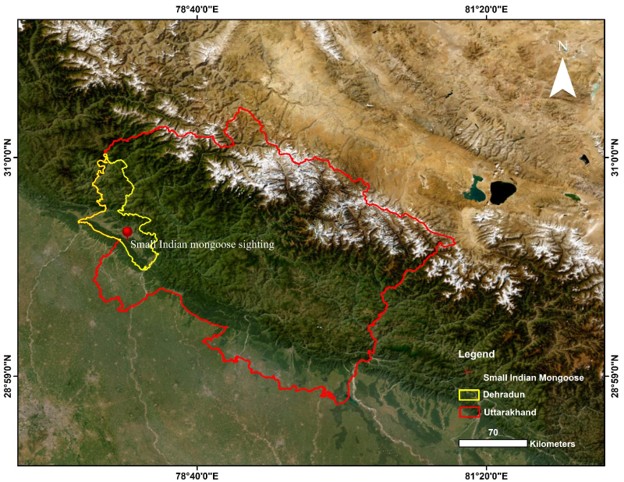
Figure 1. Geographic location of the site of observation
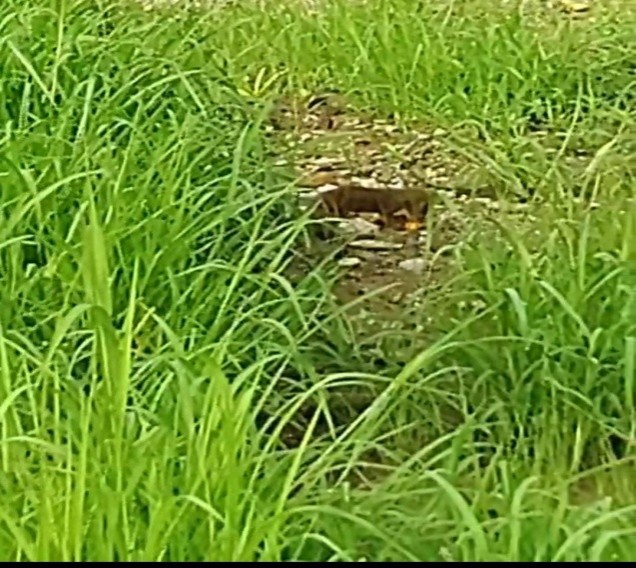
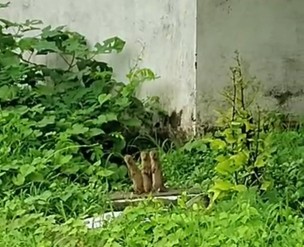
Figure 2. Opportunistic frugivory by Urva auropunctata in Uttarakhand, India. The image displays a single individual consuming the pulp of a fallen mango (Mangifera indica) on 19th July 2024, 07:38 h. Note the previous damage to the fruit skin, likely caused by an avian species, which facilitated access. (To watch the full video, click here)
Observation of mongooses feeding on mangoes suggests potential dietary plasticity and highlights their ability to exploit opportunistic food resources. In human-modified landscapes, i.e., areas with waste dumps, drainage channels, and fruit-bearing trees, these animals effectively exploit available resources. The location close to a high-traffic road like NH-72, especially during the high season of mango, helps in facilitating opportunistic frugivory. The observation occurred in a farm field near the mango orchards, which is a reflection of the species’ recorded capacity to be able to inhabit human-altered environments (Baldwin et al. 1952, as cited in Louppe et al. 2020).
In such landscapes, mongooses may come across both their natural food sources and anthropogenic food sources like cultivated fruits. The partial opening of the mango by another animal, likely an avian frugivore, may facilitate access for ground-foraging mongooses that might not otherwise break intact mango skin. This observation suggests that mongooses may be more likely to scavenge fruits that have already been opened by other animals rather than actively seeking and opening intact fallen fruits. Further observations are needed to test this.
It should be noted that the above interpretations are based on a single anecdotal observation of 34 seconds and therefore remain speculative.
Although there is a substantial amount of research on U. auropunctata in the regions where it has become an invasive species, ecological observations in the native range are relatively few (Dabholkar & Devkar 2020). Such short natural history notes add to the background information on resource utilization and behavioral ecology of the species in its native range. Further studies that use camera traps in agricultural environments and a series of dietary studies in various seasons and areas would assist in understanding the scope and importance of fruit feeding in the range of the species, especially in regions where there is extensive farming of mango and other fruit crops.
Acknowledgement
We sincerely thank Dr. Harshvardhan Singh Rathore, Gargi Roy Chaudhary, and Rajat Singh Rana for their kind encouragement in documenting this observation, and the Wildlife Institute of India for their Institutional support.
CONFLICT OF INTEREST
The authors declare no competing interests.
DATA AVAILABILITY
The data that support the findings of this study are available from the corresponding author upon reasonable request.
AUTHORS’ CONTRIBUTION
Shrey Dandriyal conceived the observation, conducted the field observation, collected the data, prepared the figures, wrote the original manuscript, and revised the manuscript. Nitesh Goswami reviewed and edited the manuscript. Piyush Sharma contributed to manuscript writing and reference compilation and verification. Ashutosh Singh Rana contributed to manuscript writing and prepared the study-area map.
ETHICAL APPROVAL
This was an opportunistic, non-invasive observation with no handling, capture, or disturbance of animals. The observation was conducted at a distance that did not alter the natural behavior of the animals. No permits were required for this observational study.
Edited By
Vidyadhar Atkore
Salim Ali Centre for Ornithology and Natural History, Coimbatore, Tamil Nadu.
*CORRESPONDENCE
Shrey Dandriyal
✉ shreydandriyal@gmail.com
CITATION
Dandriyal, S., Goswami, N., Sharma, P., Rana, A. S. (2026). Opportunistic Frugivory of Small Indian Mongoose (Urva auropunctata) in an Agricultural Field, Uttarakhand, India. Journal of Wildlife Science, 3(2), 83-86. https://doi.org/10.63033/JWLS.CRVE5590
COPYRIGHT
© 2026 Dandriyal, Goswami, Sharma, Rana. This is an open-access article, immediately and freely available to read, download, and share. The information contained in this article is distributed under the terms of the Creative Commons Attribution License (CC BY 4.0
 ), allowing for unrestricted use, distribution, and reproduction in any medium, provided the original work is properly cited in accordance with accepted academic practice. Copyright is retained by the author(s).
PUBLISHED BY
Wildlife Institute of India, Dehradun, 248 001 INDIA
PUBLISHER'S NOTE
The Publisher, Journal of Wildlife Science or Editors cannot be held responsible for any errors or consequences arising from the use of the information contained in this article. All claims expressed in this article are solely those of the author(s) and do not necessarily represent those of their affiliated organisations or those of the publisher, the editors and the reviewers. Any product that may be evaluated or used in this article or claim made by its manufacturer is not guaranteed or endorsed by the publisher.
Baldwin, P. H., Schwartz, C. W. & Schwartz, E. R. (1952). Life History and Economic Status of the Mongoose in Hawaii. Journal of Mammalogy, 33(3), 335–356. https://doi.org/10.2307/1375771
Berentsen, A. R., Pitt, W. C., & Sugihara, R. T. (2018). Ecology of the Small Indian Mongoose (Herpestes auropunctatus) in North America. In: W. C. Pitt, J. C. Beasley, & G. W. Witmer (eds.), Ecology and Management of Terrestrial Vertebrate Invasive Species in the United States. CRC Press, pp.17-42. https://doi.org/10.1201/9781315157078-12
Dabholkar, Y. & Devkar, R. V. (2020). Diurnal activity and diet of Small Indian Mongoose Urva auropunctata on the outskirts of Vadodara, Gujarat, India. Small Carnivore Conservation, 58, e58002.
Feldhamer, G. A., Drickamer, L. C., Vessey, S. H. & Merritt, J. F. (1999). Mammalogy: Adaptation, Diversity, and Ecology. The McGraw-Hill, Boston, USA. pp.511–543.
Gilchrist, J., Jennings, A. P., Veron, G. & Cavallini, P. (2009). Family Herpestidae (mongooses). In: Wilson, D. E. & Mittermeier, R. A. (eds.), Handbook of the Mammals of the World. Volume 1: Carnivores. Lynx Edicions, Barcelona, Spain, pp.262–328.
Global Invasive Species Database (2024). Species profile: Herpestes javanicus. http://www.iucngisd.org/gisd/speciesname/Herpestes+javanicus (Accessed on 3 January 2026)
Louppe, V., Leroy, B., Herrel, A. & Veron, G. (2020). The globally invasive small Indian mongoose Urva auropunctata is likely to spread with climate change. Scientific Reports, 10, 7461. https://doi.org/10.1038/s41598-020-64502-6
Mahmood, T. & Adil, A. (2017). Diet composition of small Indian mongoose (Herpestes javanicus) varies seasonally in its native range. Animal Biology, 67(1), 69–80. https://doi.org/10.1163/15707563-00002516
Mahmood, T. & Nadeem, M. S. (2011). Population estimates, habitat preference and the diet of Small Indian Mongoose (Herpestes javanicus) in Potohar Plateau, Pakistan. Pakistan Journal of Zoology, 43(1), 103–111.
Patou, M.-L., McLenachan, P. A., Morley, C. G., Couloux, A., Jennings, A. P., & Veron, G. (2009). Molecular phylogeny of the Herpestidae (Mammalia, Carnivora) with a special emphasis on the Asian Herpestes. Molecular Phylogenetics and Evolution, 53(1), 69-80. https://doi.org/10.1016/j.ympev.2009.05.038
Veron, G. & Jennings, A. P. (2017). Javan mongoose or small Indian mongoose—who is where? Mammalian Biology, 87, 62–70. https://doi.org/10.1016/j.mambio.2017.05.006
Veron, G., Patou, M. L., Pothet, G., Simberloff, D. & Jennings, A. P. (2007). Systematic status and biogeography of the Javan and small Indian mongooses (Herpestidae, Carnivora). Zoologica Scripta, 36(1), 1–10. https://doi.org/10.1111/j.1463-6409.2006.00261.x

Edited By
Vidyadhar Atkore
Salim Ali Centre for Ornithology and Natural History, Coimbatore, Tamil Nadu.
*CORRESPONDENCE
Shrey Dandriyal
✉ shreydandriyal@gmail.com
CITATION
Dandriyal, S., Goswami, N., Sharma, P., Rana, A. S. (2026). Opportunistic Frugivory of Small Indian Mongoose (Urva auropunctata) in an Agricultural Field, Uttarakhand, India. Journal of Wildlife Science, 3(2), 83-86. https://doi.org/10.63033/JWLS.CRVE5590
COPYRIGHT
© 2026 Dandriyal, Goswami, Sharma, Rana. This is an open-access article, immediately and freely available to read, download, and share. The information contained in this article is distributed under the terms of the Creative Commons Attribution License (CC BY 4.0), allowing for unrestricted use, distribution, and reproduction in any medium, provided the original work is properly cited in accordance with accepted academic practice. Copyright is retained by the author(s).
PUBLISHED BY
Wildlife Institute of India, Dehradun, 248 001 INDIA
PUBLISHER'S NOTE
The Publisher, Journal of Wildlife Science or Editors cannot be held responsible for any errors or consequences arising from the use of the information contained in this article. All claims expressed in this article are solely those of the author(s) and do not necessarily represent those of their affiliated organisations or those of the publisher, the editors and the reviewers. Any product that may be evaluated or used in this article or claim made by its manufacturer is not guaranteed or endorsed by the publisher.
Baldwin, P. H., Schwartz, C. W. & Schwartz, E. R. (1952). Life History and Economic Status of the Mongoose in Hawaii. Journal of Mammalogy, 33(3), 335–356. https://doi.org/10.2307/1375771
Berentsen, A. R., Pitt, W. C., & Sugihara, R. T. (2018). Ecology of the Small Indian Mongoose (Herpestes auropunctatus) in North America. In: W. C. Pitt, J. C. Beasley, & G. W. Witmer (eds.), Ecology and Management of Terrestrial Vertebrate Invasive Species in the United States. CRC Press, pp.17-42. https://doi.org/10.1201/9781315157078-12
Dabholkar, Y. & Devkar, R. V. (2020). Diurnal activity and diet of Small Indian Mongoose Urva auropunctata on the outskirts of Vadodara, Gujarat, India. Small Carnivore Conservation, 58, e58002.
Feldhamer, G. A., Drickamer, L. C., Vessey, S. H. & Merritt, J. F. (1999). Mammalogy: Adaptation, Diversity, and Ecology. The McGraw-Hill, Boston, USA. pp.511–543.
Gilchrist, J., Jennings, A. P., Veron, G. & Cavallini, P. (2009). Family Herpestidae (mongooses). In: Wilson, D. E. & Mittermeier, R. A. (eds.), Handbook of the Mammals of the World. Volume 1: Carnivores. Lynx Edicions, Barcelona, Spain, pp.262–328.
Global Invasive Species Database (2024). Species profile: Herpestes javanicus. http://www.iucngisd.org/gisd/speciesname/Herpestes+javanicus (Accessed on 3 January 2026)
Louppe, V., Leroy, B., Herrel, A. & Veron, G. (2020). The globally invasive small Indian mongoose Urva auropunctata is likely to spread with climate change. Scientific Reports, 10, 7461. https://doi.org/10.1038/s41598-020-64502-6
Mahmood, T. & Adil, A. (2017). Diet composition of small Indian mongoose (Herpestes javanicus) varies seasonally in its native range. Animal Biology, 67(1), 69–80. https://doi.org/10.1163/15707563-00002516
Mahmood, T. & Nadeem, M. S. (2011). Population estimates, habitat preference and the diet of Small Indian Mongoose (Herpestes javanicus) in Potohar Plateau, Pakistan. Pakistan Journal of Zoology, 43(1), 103–111.
Patou, M.-L., McLenachan, P. A., Morley, C. G., Couloux, A., Jennings, A. P., & Veron, G. (2009). Molecular phylogeny of the Herpestidae (Mammalia, Carnivora) with a special emphasis on the Asian Herpestes. Molecular Phylogenetics and Evolution, 53(1), 69-80. https://doi.org/10.1016/j.ympev.2009.05.038
Veron, G. & Jennings, A. P. (2017). Javan mongoose or small Indian mongoose—who is where? Mammalian Biology, 87, 62–70. https://doi.org/10.1016/j.mambio.2017.05.006
Veron, G., Patou, M. L., Pothet, G., Simberloff, D. & Jennings, A. P. (2007). Systematic status and biogeography of the Javan and small Indian mongooses (Herpestidae, Carnivora). Zoologica Scripta, 36(1), 1–10. https://doi.org/10.1111/j.1463-6409.2006.00261.x


