TYPE: Research Article
Rumana Maheen¹,²* , Udayan Borthakur¹, Govindan Veeraswami Gopi²,³*
¹Wildlife Genetics Laboratory, Aaranyak, 12 Kanaklata Path, Survey, Beltola, 781028, Assam, India.
²Forest Research Institute (Deemed to be University), Kaulagarh Road, Dehradun, 248195, Uttarakhand, India.
³Wildlife Institute of India, Post Box #18, Chandrabani, Dehradun, 248001, Uttarakhand, India.

Introduction
The genus Macaca belongs to the tribe Papionini within the subfamily Cercopithecinae (Old World monkeys) (Fa, 1989). It diverged within Old World monkeys approximately 7 to 8 million years ago (Fan et al., 2024) and today represents one of the most widely distributed genera of non-human primates (Abegg, 2002). Fossil evidence indicates that macaques were historically distributed across Eurasia during the Plio-Pleistocene (Roos & Zinner, 2015). Members of this genus exhibit relatively high evolutionary rates compared to other primates (Elango et al., 2009), notable ecological plasticity (Roos & Zinner, 2015), and a complex evolutionary history shaped by ancient hybridisation events and incomplete lineage sorting (Zhang et al., 2023). Depending on taxonomic treatment, approximately 23 extant species are currently recognised and are organised into several species groups reflecting their evolutionary relationships (Liedigk et al., 2014).
Among these, the sinica species group represents a polytypic lineage of macaques (Roos & Zinner, 2015). This group exhibits a fragmented distribution across the Himalaya and South Asia and has been the subject of considerable taxonomic debate due to incongruence between morphological variation and genetic relationships (Khanal et al., 2024). Northeast India represents a hotspot of macaque diversity, harbouring several species including the Assamese macaque (Macaca assamensis), rhesus macaque (Macaca mulatta), stump-tailed macaque (Macaca arctoides), northern pig-tailed macaque (Macaca leonina), Arunachal macaque (Macaca munzala), and the white-cheeked macaque (Macaca leucogenys). The latter two species were described only in recent decades (Sinha et al., 2005), and their taxonomic validity has been questioned due to the absence of clear morphological, ecological or geographic barriers (Choudhury, 2022). Both M. munzala and M. leucogenys belong to the sinica species group and, together with M. assamensis, form a taxonomically challenging complex characterised by overlapping morphological traits and poorly defined distributional boundaries (Biswas et al., 2011; Choudhury, 2022).
The Assamese macaque was originally described from ‘Assam’ by McClelland in 1840 and although the exact collection site remains uncertain, the type locality of the nominate subspecies (M. a. assamensis) is generally believed to denote the region south of the Brahmaputra River in eastern Assam and adjoining eastern Arunachal Pradesh (Choudhury, 2022). Subsequent discoveries of closely related taxa within the same broad landscape have complicated interpretations of intraspecific variation and species boundaries. Choudhury (2022) hypothesised that M. munzala and M. leucogenys are subspecies within an assamensis-munzala-leucogenys complex, split by the vicariant effects of the Brahmaputra River system. However, this hypothesis remains untested using genome-wide markers and requires comprehensive validation. Within M. assamensis, two subspecies are generally recognised — M. a. assamensis and M. a. pelops — broadly separated by the Brahmaputra River, although regions near eastern Arunachal Pradesh and Assam may represent zones of contact where lineage boundaries remain unresolved (Roos, 2018; Khanal et al., 2023). Despite its wide distribution, the Assamese macaque remains comparatively underrepresented in the scientific literature (Choudhury, 2022), particularly in regions bordering Assam and eastern Arunachal Pradesh. The south bank of the Lohit River lies within this transition zone, where understanding mitochondrial lineage structure is critical for resolving geographic boundaries within the sinica complex.
Molecular markers can resolve evolutionary lineages at the subspecies, species and higher taxonomic levels. However, the choice of marker is often dictated by the life history, behaviour, conservation questions asked and practical constraints of the study (Caparroz et al., 2009; Jiang et al., 2016). The most commonly used markers are mitochondrial and nuclear. Nuclear markers are increasingly favoured for resolving broad species-level relationships and intricate genomic events such as historical introgression (Tosi et al., 2000, 2003; Kuderna et al., 2023). Since mitochondrial DNA (mtDNA) reflects only maternal evolutionary history, it may not represent true species-level relationships in taxa heavily influenced by incomplete lineage sorting or hybridisation (Xing et al., 2025). However, mitochondrial markers are uniquely capable of capturing detailed maternal phylogeographic structures (Melnick & Hoelzer, 1992). This geographic sensitivity makes mtDNA suitable for assessing taxonomic relationships within the complex sinica group, where maternal lineages often cluster sharply due to female philopatry. Furthermore, mtDNA sequences were crucial in validating M. munzala and M. leucogenys as distinct taxonomic units (Chakraborty et al., 2007; Fan et al., 2017). These documented relationships offer a reliable divergence benchmark against which the genetic distances and phylogenetic placement of any new population can be objectively evaluated.
In this study, sampling was conducted in the wild and non-invasive samples were collected. Consequently, short mtDNA fragments of partial cytochrome b (Cyt b) and D-loop totalling less than 1 kb of sequence data were strategically selected to account for poor DNA yield and high degradation typical of non-invasive faecal samples collected in the field (Taberlet et al., 1999; Chu et al., 2006). The eastern Himalayan region, where multiple members of the assamensis–munzala-leucogenys complex occur in proximity, represents a critical landscape for testing concordance between current taxonomy and mitochondrial lineages. Because this region lies at the intersection of multiple biogeographic barriers and recently diverged lineages, it provides a natural framework for examining how geographic isolation, lineage sorting and historical dispersal shape mitochondrial diversity within the sinica macaque complex.
This study aims to determine the mitochondrial lineage identity of macaque populations sampled from the south bank of the Lohit River in India and to assess their phylogenetic placement relative to eastern and western Assamese macaque lineages and sympatric macaque species, including M. munzala, M. leucogenys, and M. mulatta, using mtDNA sequence data. The study also examines the genetic diversity and divergence history of the Lohit population to understand the effects of localised lineage diversification.
Methodology
We carried out ad libitum field surveys along the south bank of the Lohit River in Lohit district of Arunachal Pradesh from September 2021 to March 2022 and collected 25 faecal samples. Lohit district is named after the Lohit River, which traverses it. The district comprises a heterogeneous landscape of river valleys, hills and mountains supports a wide range of flora and fauna.
Sampling was distributed across four sites. Wakro (n = 5) is a town in Lohit district near which Kamlang Wildlife Sanctuary (KWLS; n = 6) is located. Both areas are characterised by dense vegetation and rugged terrain. Parsuramkund (n = 6) is a well-known temple area, nestled in dense vegetation, where macaques may benefit from positive human interactions. Lastly, Anchal Reserve Forest (ARF; n = 8), situated close to Tezu town, is composed of tracts of vegetation shaped by the Lohit River. Samples were collected at elevations ranging from 187 m to 471 m. To prevent duplicate sampling, faecal samples were collected at a minimum distance of 2 m, and Global Positioning System (GPS) coordinates were recorded for each collection site (Figure 1).
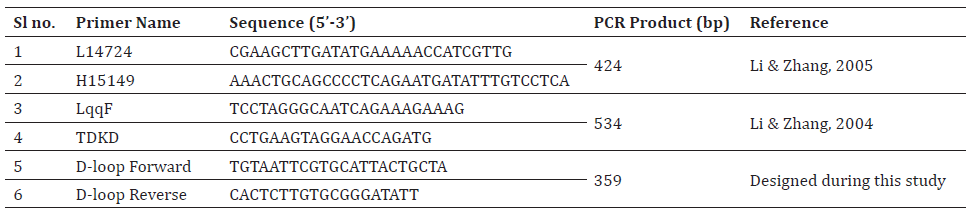
Non-invasive samples were collected in zip-lock bags and later preserved in leak-proof plastic containers containing absolute ethanol. Samples were stored at −20°C until DNA extraction. DNA was extracted from faecal samples using the QIAmp DNA Stool Mini Kit (QIAGEN, Germany) following the standard kit protocol, with a final elution volume of 80 μl. Extractions were carried out in an area isolated for high-quality DNA work, using aerosol-barrier tips and negative controls to prevent cross-contamination. For species identification and to assess the phylogenetic status of samples under investigation, partial fragments of mtDNA, viz., cytochrome b (Cyt b; Li & Zhang, 2005) and the D-loop, were sequenced. The Cyt b primers amplified a 424 bp fragment. Two primer pairs were used for the D-loop due to poor faecal DNA quality. The first primer pair amplifies a 534 bp segment of the D-loop (Li & Zhang, 2004); the second, designed in this study, amplifies a shorter 359 bp segment of the same region and was used in samples where the first did not amplify (Table 1).
All polymerase chain reactions (PCR) were performed in a 10 μl reaction volume using the QIAGEN Multiplex PCR Kit (QIAGEN, Germany) with a reagent concentration of 0.2 μM of each primer and 2 μl of template DNA. PCR conditions for the primers were as follows: an initial denaturation at 95°C for 15 min, followed by 35-40 cycles of denaturation at 94°C for 30 sec, annealing temperature of 51°C (Cyt b) (Li & Zhang, 2005), 55°C (D-loop; Li & Zhang, 2004) and 56°C (D-loop; this study) for 30 sec and elongation at 72°C for 30 sec, followed by a final extension at 72°C for 30 min.
All the PCR products were run on a 1.5% (w/v) agarose gel and visualised by ethidium bromide staining on a UV transilluminator. The targeted PCR products were purified from excised pieces of gel using QIAEX® II Gel Extraction Kit (QIAGEN, Germany) following the manufacturer’s instructions. Purified PCR products were labelled using the BigDye™ Terminator Cycle Sequencing Kit and sequenced in both forward and reverse
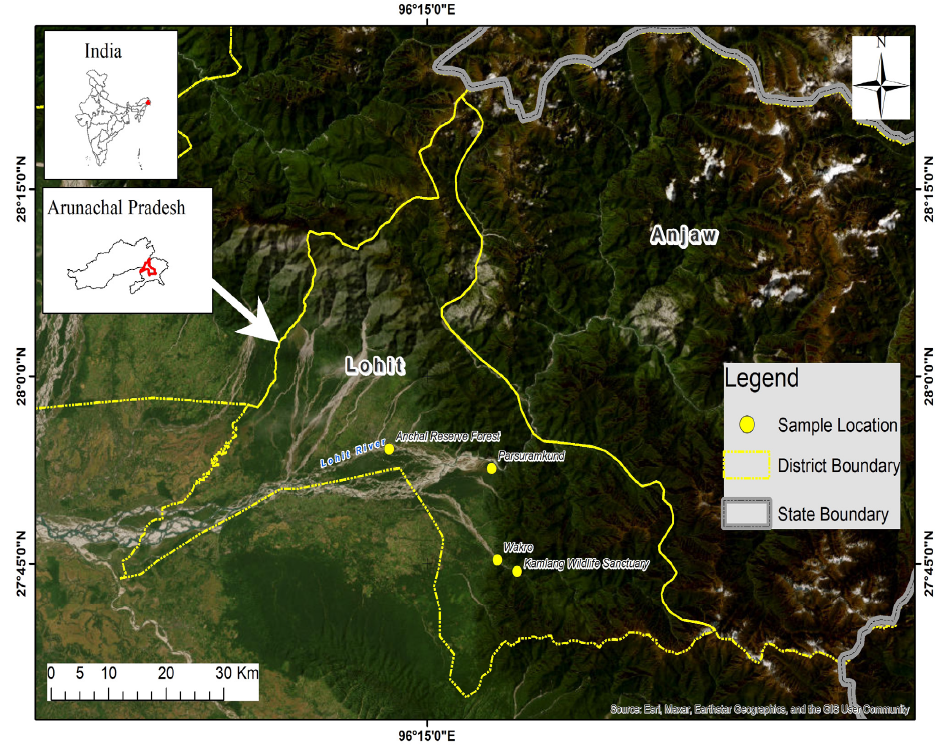
Figure 1. The sampling locations of Macaca assamensis assamensis in Lohit district, Arunachal Pradesh, India.
Table 1. List of the PCR primers used to study the phylogenies of macaques in Lohit district, Arunachal Pradesh, India.
directions on an ABI 3100 Genetic Analyzer. Forward and reverse sequences were aligned using the contig assembly program of BioEdit (Hall, 1999) to derive a single consensus sequence. Each consensus sequence was manually screened and edited.
Sequence homology was determined using the Basic Local Alignment Search Tool (BLAST) (Altschul et al., 1990) on the National Center for Biotechnology Information (NCBI) website (https://blast.ncbi.nlm.nih.gov/). Multiple sequence alignment of DNA sequences was performed with ClustalW (http://www.ebi.ac.uk/cgi-bin/clustalW) software package (version 1.81) (Thompson et al., 1994). Homologous sequences of Assamese macaque across the known geographic locations, viz., Nepal, Vietnam, Myanmar and China were utilised in population analysis (Table S1 in Supplementary material). Reference sequences include sequences from Chakraborty et al. (2007) and Fan et al. (2017) to allow for comparative analyses. Corresponding sequences of other macaque species were also utilised in the construction of the phylogeny. Barbary macaque (Macaca sylvanus) sequences were used as the outgroup in the maximum likelihood (ML) and Bayesian inference (BI) reconstructions, whereas hamadryas baboon (Papio hamadryas) sequences were utilised as the outgroup for divergence time estimation. All reference sequences were trimmed to maintain consistency in all analyses performed. To follow the classification system proposed by Choudhury (2022), we separated the Assamese macaque sequences with respect to their geographical origins north and southeast of the Brahmaputra (Table 2). Reference sequences north of the Brahmaputra include sequences generated by Khanal et al. (2021, 2024). All other reference sequences are from southeast of the Brahmaputra, viz., Myanmar, Vietnam and China.
Genetic diversity
Consensus datasets of Cyt b and D-loop sequences were generated by combining individual sequences. Genetic diversity indices, including the number of polymorphic sites (S), number of haplotypes (H), haplotype diversity (Hd), variance of haplotype diversity (“Var” Hd), and nucleotide diversity (π), were calculated for the sampled Lohit population (n=16) using DnaSP v6 (Rozas et al., 2017). Further, we used the minimum spanning network (MSN) method implemented in PopART (Leigh & Bryant, 2015) to build a haplotype network which graphically represents the relationship of each sample from different geographical locations. In addition to the concatenated Cyt b and D-loop MSN, separate Cyt b-only and D-loop-only MSNs were generated to evaluate marker-specific haplotype structure. We then calculated average genetic divergence between and within the studied macaque species based on Kimura two-parameter (K2P; Kimura, 1980) distances in MEGA v.11 (Tamura et al., 2021).
Phylogenetic analyses
The sequence files obtained were viewed and edited manually in BioEdit (Hall, 1999). Prior to phylogenetic analyses, the optimal model of sequence evolution was determined using ModelFinder (Kalyaanamoorthy et al., 2017) under the Bayesian Information Criterion (BIC), as implemented in the W-IQ-TREE web server (Trifinopoulos et al., 2016).
ML analysis was performed in RAxML GUI (Edler et al., 2021) using the GTR+G+I model of nucleotide sequence evolution with 500 bootstrap replicates to obtain the best ML tree and branch support values.
We used MrBayes 3.2.2 (Ronquist et al., 2012) to perform the BI analysis using the GTR+G+I model. Two parallel runs, with four chains each, were run for 6 million generations sampling every 1000 generations. Convergence between the two runs was determined based on the standard deviation of split frequencies. Tracer v1.6 (Rambaut et al., 2014) was used to assess stationarity; an effective sample size (ESS) > 200 for each parameter was used as the cut-off for run length. The first 25% of trees were discarded as burn-in.
Divergence time estimation
For divergence time estimation, we used BEAST v2.7.3 (Bouckaert et al., 2019). The input file was prepared using BEAUti v2.7 (Bouckaert et al., 2019). The best-fit nucleotide substitution models for each partition were selected using ModelFinder (Kalyaanamoorthy et al., 2017) under the Bayesian Information Criterion (BIC) in W-IQ-TREE (Trifinopoulos et al., 2016). For Cyt b the best fit model was TIM3+F+I+G4 while for D-loop was TPM2u+F+G4. The clock model was set to an uncorrelated lognormal relaxed clock. The analyses were run for 200 million generations sampling every 5000 generations. Tracer was used to determine convergence, and the resulting tree was visualised with FigTree v.1.4.3 (Rambaut, 2014). Lognormal priors were used to constrain divergence estimates with the Papio–Macaca split set to 8 million years ago (mya), with an offset of 0, and a standard deviation of 0.25 (Fan et al., 2017). The M. sylvanus node was calibrated with a 5.5 mya prior (Tosi et al., 2003). Nodal constraints were set for the most recent common ancestor (MRCA) of the sinica group (1.7 mya), fascicularis group (2.5 mya) and silenus group (3.7 mya; Fan et al., 2017). All nodal constraints used lognormal priors.
Demographic history
Tajima’s D (Tajima, 1989) and Fu’s Fs (Fu, 1997) neutrality tests were performed for the sampled population to infer its demographic history using DnaSP v6 (Rozas et al., 2017). Isolation by distance (IBD) was evaluated by testing the correlation between pairwise genetic (FST) and geographic distances (km) via a Mantel test (Pearson method, 9,999 permutations) in the vegan package in R (Oksanen et al., 2001; R Core Team, 2024), and visualized by fitting an ordinary least squares (OLS) linear regression (lm function) with 95% confidence intervals in ggplot2 (Wickham, 2016).
Results
DNA extraction and sequences generated
Out of the 25 samples collected, two samples were omitted due to poor DNA quality and one was removed from analysis due to poor data quality. From the remaining 22 samples, 16 were identified as M. a. assamensis and 6 as M. mulatta. For all 16 M. a. assamensis samples, 424 bp Cyt b and 340 bp D-loop sequences were generated successfully (GenBank accession numbers in Table S2, Supplementary material). Since two different D-loop primer pairs were used, concatenated population analyses utilised a shortened 340 bp D-loop sequence common to all samples, whereas divergence analyses used a longer 518 bp alignment from representative sequences.
Genetic diversity
Concatenated Cyt b and D-loop sequences (764 bp) of the M. a. assamensis samples were used in the MSN, ML and BI analyses. For MSN analyses, sequences were trimmed to a uniform length of 742 bp (Cyt b 402 bp + D-loop 340 bp). The 16 Lohit sequences comprised 11 haplotypes (S = 27; π = 0. 00987 ± 0. 00234; Hd = 0. 908 ± 0. 063; Table 3), with moderate nucleotide diversity and high haplotype diversity. The haplotype network showed a partially radial arrangement, with multiple internal branches, and lacked strong geographic clustering within Lohit district (Figure 2). The Cyt b-only MSN showed a more pronounced star-like radiating pattern amongst Lohit and southeast of the Brahmaputra M. a. assamensis reference samples (Figure S1, Supplementary material). No such pattern was observed in the D-loop-only MSN (Figure S2, Supplementary material). No haplotypes were shared among the four sampled locations within Lohit district.
To evaluate intra- and inter-specific evolutionary relationships, we calculated the average K2P genetic distances between the M. a. assamensis samples from Lohit and reference sequences from other macaque populations (Table S3, Supplementary material). The lowest genetic distances were observed with M. a. assamensis populations from Yunnan, China (0.073) and Myanmar (0.075), followed closely by the Tibetan macaque Macaca thibetana (0.083). Relatively high genetic distances were observed with M. a. pelops reference sequences from Nepal (M_ass_NPAM and M_ass_Nepal) at 0.133, as well as with M. a. pelops populations from Jilong, China (0.134). Among sinica group, the highest genetic distances were observed between the Lohit population of M. a. assamensis and M. munzala from Shannan (China), Tawang and West Kameng (India), at 0.136, 0.133 and 0.143, respectively.
Phylogenetic analysis
The ML (Figure 3) and BI (Figure 4) trees showed similar overall topologies. In both trees, the Lohit haplotypes formed a monophyletic sister clade to a subset of M. a. assamensis reference haplotypes from southeast of the Brahmaputra (Lohit samples highlighted in purple and M. a. assamensis southeast of the Brahmaputra in yellow). In contrast, the reference sequences of the western Assamese macaque (M. a. pelops) from north of the Brahmaputra formed a sister clade with M. munzala reference sequences, with bootstrap support of 0.94 (ML) and a posterior probability of 1.0 (BI; M. a. pelops highlighted in light blue and M. munzala in salmon). ML and BI tree topology for other macaque species is consistent with other studies (Chakraborty et al., 2007; Fan et al., 2017).
Divergence time estimation
Divergence times (Figure 5) were estimated from a partitioned dataset of Cyt b (424 bp) and a longer D-loop alignment (518 bp) for representative sequences. The resulting topology was consistent with the BI tree, with macaque species segregating into the accepted species groups. The proto-sinica clade diverged
Table 2. Description of Macaca assamensis subspecies with their respective geographic locations.

Table 3. Genetic diversity indices and neutrality tests for the Macaca assamensis assamensis population (n = 16) from Lohit district, Arunachal Pradesh, India. S: polymorphic sites, π: nucleotide diversity, H: number of haplotypes, Hd: haplotype diversity, VarHd: variance of haplotype diversity. Tajima’s D and Fu’s Fs not significant (P > 0.10).

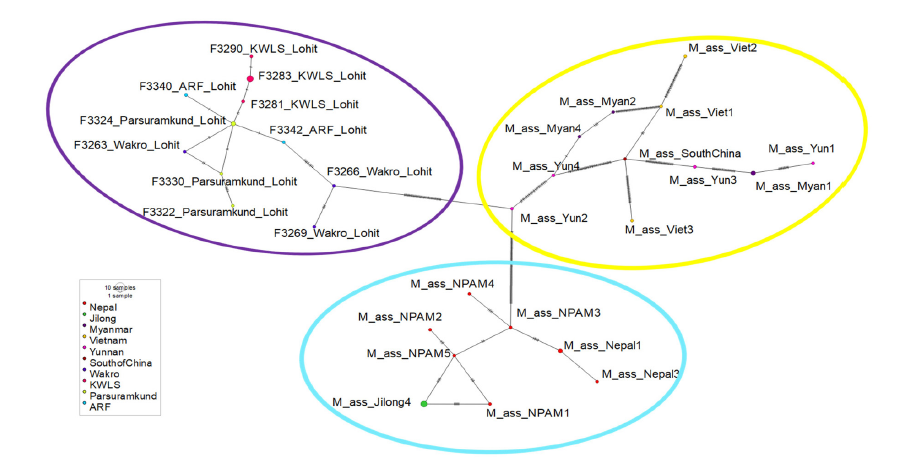
Figure 2. Minimum spanning network (742 bp concatenated Cyt b and D-loop) of Macaca assamensis samples from the Lohit, north and southeast of the Brahmaputra. The network illustrates relationships among Lohit samples and global reference sequences. Coloured circles represent sampled haplotypes (coloured by locality according to the inset legend) and hash marks along the connecting lines indicate mutational steps. Circle sizes are proportional to observed haplotype frequency. Coloured ellipses delineate broad regional groupings: light blue indicates populations north of the Brahmaputra River, yellow highlights reference lineages southeast of the Brahmaputra, and purple groups local samples from Lohit district.
~3.14 mya (95% highest posterior density [HPD]: 2.13–5.0 mya). The MRCA of the ‘proto-munzala-leucogenys-radiata’ lineage was dated to ~2.3 mya (95% HPD: 1.45–3.75 mya). The northern populations of the Assamese macaque (M_ass_Nepal, M_ass_NPAM and M_ass_Jilong) and M. munzala populations (Tawang, West Kameng and Shannan, China) diverged ~1.37 mya (95% HPD: 0.63–2.56 mya).
Within the eastern clade, the Lohit population (M_ass_Lohit) tentatively clustered as a sister lineage to M. a. assamensis from Myanmar and Yunnan, China, although nodal support for this specific grouping was weak (PP = 0.38). Collectively, this eastern M. a. assamensis–M. thibetana assemblage shared a most recent common ancestor dated to ~0.85 mya (95% HPD: 0.43–1.63 mya; PP = 1.0).
Demographic history
The neutrality test of Tajima’s D was not significant (D = -0.689, P > 0.10). Fu’s Fs was also negative and non-significant (Fs = −1.648, P > 0.10). Isolation by distance was tested within the Lohit samples using pairwise genetic distances (FST) and geographic distances in kilometres (Figure 6). The analysis revealed a weak, non-significant negative relationship between pairwise genetic distance and geographic distance (r = -0.07543, P = 0.56). Linear regression confirmed that geographic separation accounted for virtually none of the observed genetic variance within the study landscape (R2 = 0.0057).
Discussion
The Lohit River system lies within the south-bank tributaries of the Brahmaputra River and forms part of a critical biogeographic transition zone between the Himalayan and Indo-Burmese regions (Trivedi et al., 2024). This landscape is therefore important for evaluating the geographically hypothesised subspecies classification of M. assamensis with respect to the mitochondrial lineage. The type locality of the nominate subspecies M. a. assamensis is placed south of the Brahmaputra River (Choudhury, 2022). Conversely, the type locality for M. a. pelops is Nepal (Boonratana et al., 2020), a population considered morphologically distinct from Assamese macaque populations in India and Bhutan (Ghimire & Chalise, 2021).
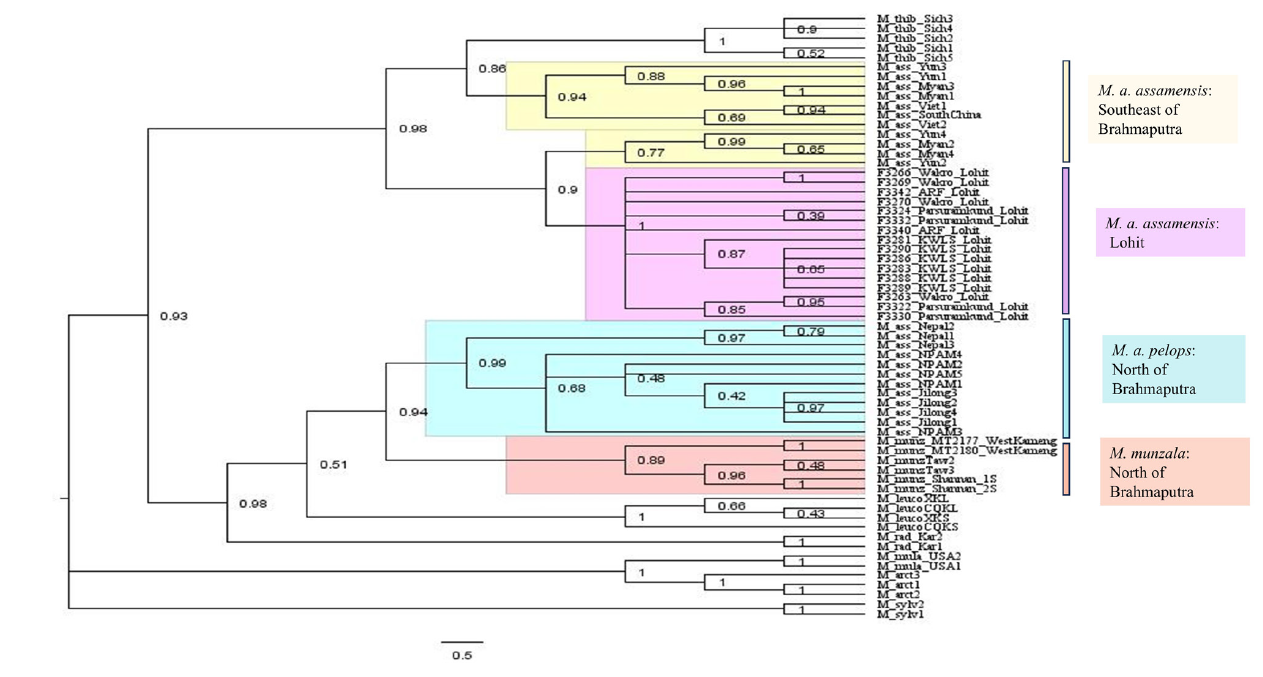
Figure 3. Maximum likelihood (ML) tree of Macaca assamensis assamensis samples from Lohit with homologous sequences of other macaque species, with Barbary macaque (Macaca sylvanus) as the outgroup. Bootstrap support values are shown at the nodes.
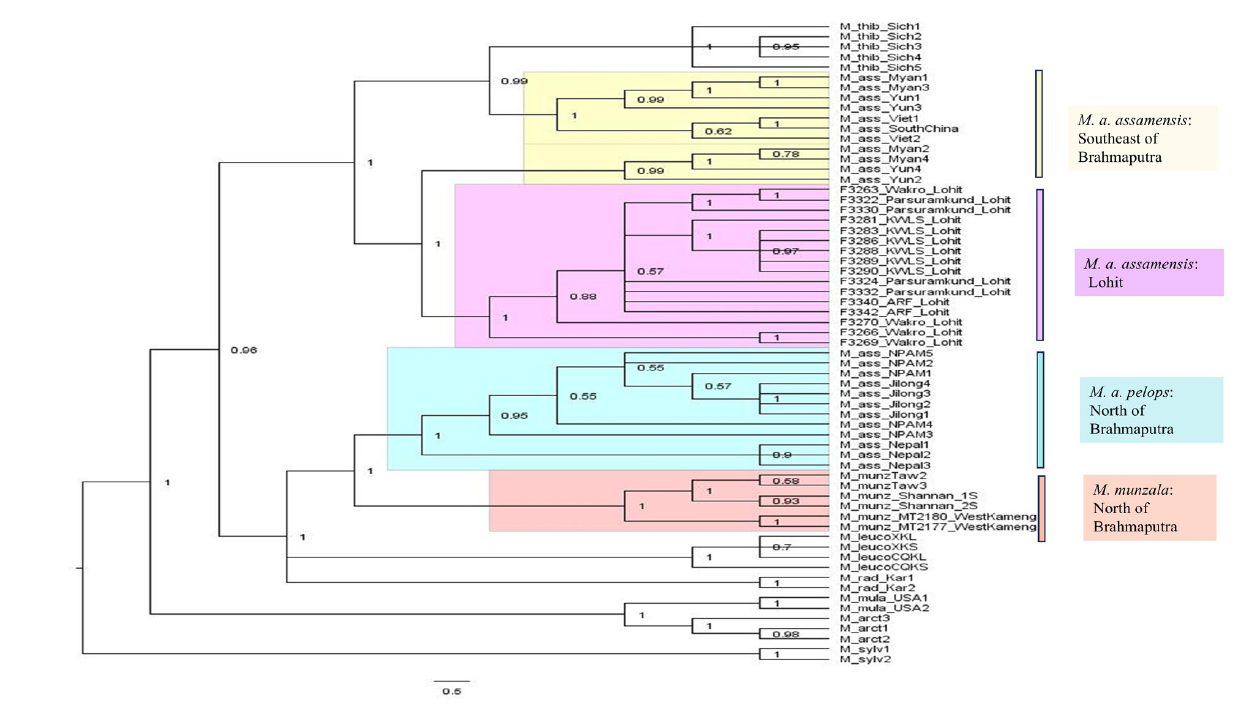
Figure 4. Bayesian inference (BI) tree of Macaca assamensis assamensis samples from Lohit and homologous sequences of other macaque species, with M. sylvanus as the outgroup. Node values represent posterior probability support.
Thus, investigating the eastern Himalayan range is important for understanding the species assemblage with respect to mitochondrial lineage and assessing whether geographically assigned subspecies designations align with mitochondrial lineages.
The M. a. assamensis population sampled in Lohit district showed high haplotype diversity (Hd = 0.908) and moderate nucleotide diversity (π = 0.00987), indicating the presence of multiple haplotypes within the sampled landscape. Because mitochondrial markers were used, these values reflect historical maternal demographic processes, such as the possible absence of a recent bottleneck, rather than adaptive potential. Evaluating their adaptive potential (Osada, 2015; Roos et al., 2025) would require evidence from nuclear genomic and ecological data.
However, the MSN lacked clear geographical structure, and no haplotypes were shared among the sampled localities. This spatial pattern could be a reflection of localised population fragmentation, though it may also be influenced by a relatively short evolutionary history, founder effects, or behavioural traits such as female philopatry and male-biased dispersal (Wang et al., 2019).
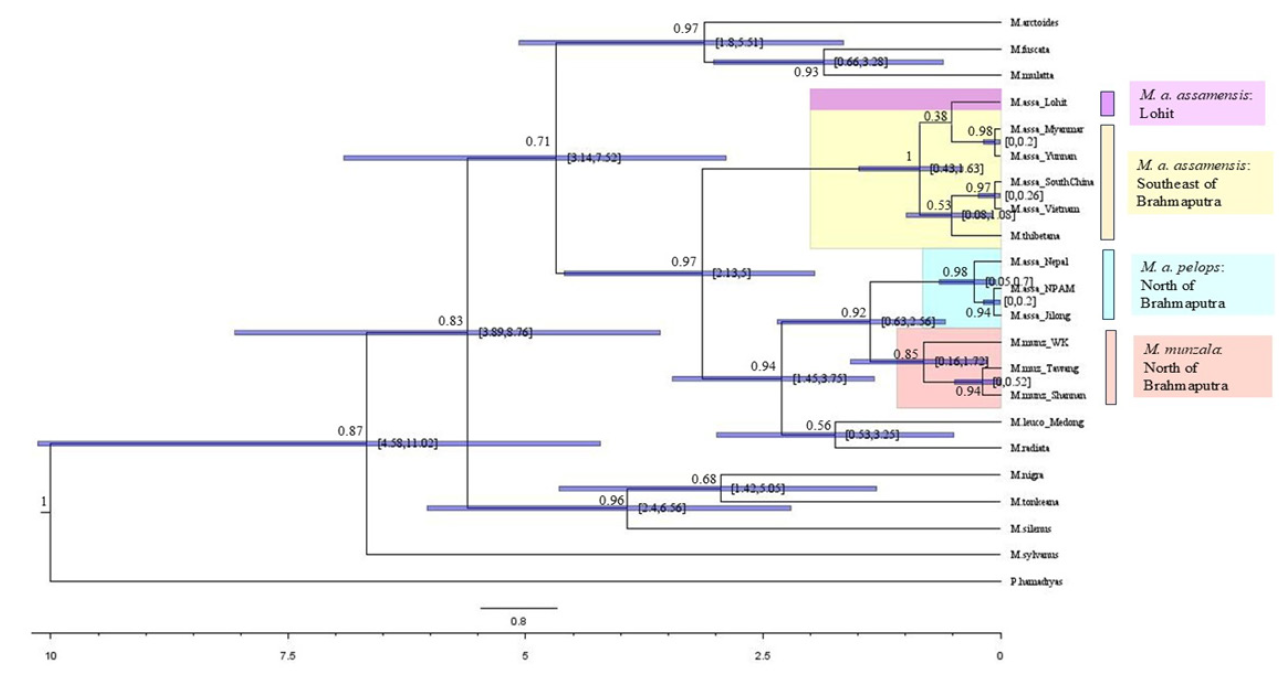
Figure 5. Divergence time tree of Macaca assamensis assamensis and homologous sequences of other macaque species, based on partitioned Cyt b (424 bp) and D-loop (518 bp) data. Blue bars indicate 95% highest posterior density (HPD) intervals, with values in bracket at each node. The time scale is in million years ago (mya). Values above or below the nodes represent posterior values.
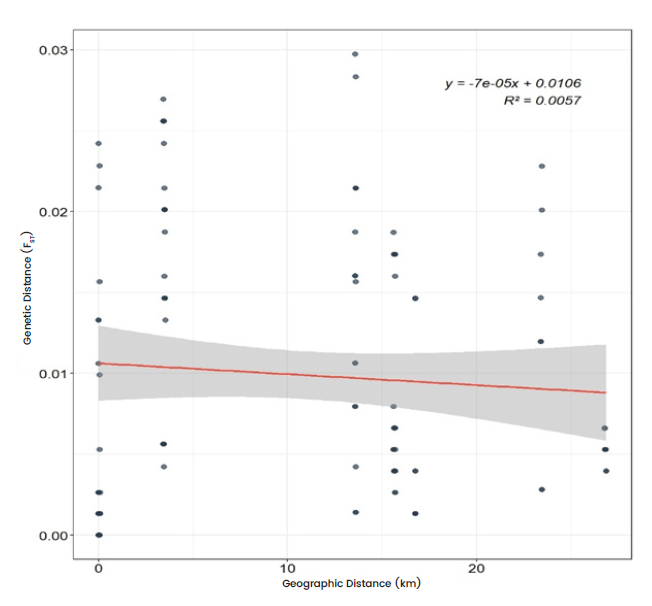
Figure 6. Mantel test scatterplot of pairwise genetic distance (Y-axis) against geographic distance (X-axis) for Macaca assamensis assamensis samples from Lohit.
The Cyt b-only MSN showed a more radiating arrangement among Lohit and southeast of the Brahmaputra haplotypes, consistent with shared maternal affinity. Additionally, contemporary anthropogenic factors and habitat degradation may play a role in restricting maternal gene flow by confining groups to localised forest fragments (Wang et al., 2019).
Genetic distances (K2P) indicated that the maternal lineage of the Lohit population clusters closest to southern and eastern populations of M. a. assamensis from China, Myanmar, and Vietnam, while exhibiting greater divergence from M. a. pelops populations sampled north of the Brahmaputra. This maternal stratification highlights the potential role of major river systems, specifically the Brahmaputra and its key tributaries such as the Lohit, as potential historical geographic boundaries that influenced the distribution of sinica group lineages. The evolutionary history of Sino-Himalayan macaques has been shaped by Pleistocene vicariance, dispersal, and colonisation events. These historical dynamics likely contributed to the observed geographical structuring, where populations north of the river system may have experienced incomplete lineage sorting or localised historical gene flow, potentially explaining the low sequence divergence observed among M. a. pelops, M. munzala, and M. leucogenys. This hypothesis needs rigorous testing as a potential factor in the observed segregation.
Tajima’s D was negative (D =-0.689 P>0.10), indicating a slight and non-significant excess of low-frequency polymorphisms relative to neutral expectations. The non-significant Tajima’s D value also does not support recent demographic expansion or purifying selection (Hasan et al., 2014). Similarly, Fu’s Fs was a negative but non-significant value (Fs =−1.648, P>0.10), providing limited support for population growth. The Mantel test revealed a non-significant negative correlation between genetic and geographic distances (r = -0.07543, P = 0.56), indicating no evidence of isolation by distance among sampled individuals. While the observed diversity values are consistent with the retention of multiple maternal lineages, demographic conclusions regarding population stability or historical fluctuations remain tentative because neutrality tests were non-significant and sample size was limited.
In the phylogenetic analysis, both the ML and BI trees displayed similar topology, with the maternal lineages of M. a. assamensis sampled from Lohit clustering neatly with reference sequences from global populations southeast of the Brahmaputra, providing support for the hypothesised subspecies boundary. ML and BI trees both show M. a. pelops (Nepal [M_ass_NPAM; Khanal et al., 2021], eastern Nepal [M_ass_Nepal; Khanal et al., 2024] and Jilong, China [M_ass_Jilong; Khanal et al., 2024]) forming a sister clade with M. munzala reference sequences with good bootstrap support (0.94) and a posterior probability of 1.0. This is congruent with the deep genetic distance observed between M. a. pelops north of the Brahmaputra with respect to Lohit and southeast populations of M. a. assamensis.
Primates are known to exhibit heterogeneity in substitution rate and Old World monkeys (Cercopithecidae) display elevated substitution rates relative to hominids, as described by Moorjani et al. (2016). Our divergence time estimates therefore have wide HPD intervals. In this study, the estimated proto-sinica divergence timeline (~3.14 mya) is consistent with other studies (Fan et al., 2017; Ghosh et al., 2022), which also span the Pliocene epoch (~5.33 to 2.58 mya). Khanal et al. (2024) dated the most recent common ancestor of the sinica group to approximately 2.61 mya (95% HPD: 2.23–3.09 mya). Such differences are expected and could be attributed to the different genetic markers utilised in the studies. Our sampled population from Lohit, together with common ancestors of Myanmar and Yunnan populations of M. a. assamensis, diverged at ~0.85 mya during the Pleistocene. The Pleistocene epoch is characterised by oscillating glacial cycles, and these events heralded the diversification, fragmentation and subsequent colonisation of the sinica macaque group across this landscape (Chakraborty et al., 2007; Khanal et al., 2024). This area bordering Assam and eastern Arunachal Pradesh marks the intersection of the two subspecies of Assamese macaque and sits at the ecological junction of South Asia and the Tibetan Plateau.
Contemporary studies highlight the importance of Paleogene South Asian tropical forests as the cradle of diversification for mammalian fauna, followed by subsequent colonisation of mammalian diversity up into the Pliocene (Feijó et al., 2022). Thus, the divergence seen amongst sinica species members coincides with major Pliocene and Pleistocene events, which, in combination with conducive environments, provided few barriers to continued divergence and subsequent colonisation of newly opened habitats in this landscape (Chakraborty et al., 2007).
In this study, the maternal lineage of the Assamese macaque (M. a. assamensis) sampled in Lohit district aligned with global populations of the Assamese macaque southeast of the Brahmaputra River, whereas northern populations (M. a. pelops) formed a sister clade with M. munzala reference samples. Topography and riverine networks appear to correspond with the contemporary distribution of these maternal lineages, particularly within the sinica group. Because geographic features like rivers and mountain ranges frequently coincide with primate population divisions (Helenbrook & Valdez, 2025), our mitochondrial data are consistent with the geographical boundaries historically used to describe the subspecies of M. assamensis.
The influence of geographical and ecological barriers and of climatic oscillations has been documented in many primate species and could be a factor in the spatial structure of the assamensis-munzala-leucogenys species complex (Martins-Junior et al., 2022; Löwenberg-Neto, 2024). Given the relatively recent divergence and limited morphological differentiation among members of the sinica group, particularly M. munzala, M. leucogenys, and M. assamensis, their evolutionary relationships may reflect a complex pattern of lineage diversification rather than clearly delineated species boundaries. Phylogenetic studies have demonstrated overlapping genetic affinities among Himalayan populations, suggesting that incomplete lineage sorting and historical gene flow may contribute to the ambiguous morphological distinctiveness observed among these taxa. Such patterns are consistent with scenarios proposed for recently diverged lineages, where morphological congruence and partial reproductive isolation can obscure taxonomic resolution (Fišer et al., 2018). Rather than implying definitive species limits, the current evidence points toward a structured lineage complex shaped by geographic and climatic processes across the eastern Himalaya.
While these maternal mitochondrial lineages are revealing, we recognise that mtDNA captures only a single, maternally inherited locus and is inadequate for resolving complex population-level dynamics such as male-mediated gene flow, introgression patterns, or hybridisation. Given the possibility of incomplete speciation or ongoing reticulate evolution among Sino-Himalayan macaque species (Fan et al., 2017), an integrative approach with extensive sampling effort across all the major tributaries of the Brahmaputra is required to fully characterise nuclear gene flow and confirm subspecies identities.
Conclusion
This study provides mitochondrial evidence that the sampled Lohit population belongs to the M. a. assamensis maternal lineage and is genetically closer to reference populations southeast of the Brahmaputra than to northern M. a. pelops reference sequences. In contrast, M. a. pelops forms a sister clade with M. munzala north of the Brahmaputra, underscoring a complex evolutionary history shaped by past geographic isolation and climatic oscillations.
The overlapping mitochondrial relationships observed within the sinica clade highlight the need for a comprehensive molecular study with standardised, multi-locus sampling to resolve remaining taxonomic ambiguities and clarify the local evolutionary processes operating within this group. To address these uncertainties, future studies should integrate genomic, ecological, geological, and morphometric data to better define evolutionary and ecologically significant conservation units.
The clear delineation of evolutionary units is a basic requirement for effective conservation planning and for establishing localised priority management zones. At present, M. assamensis, M. munzala, and M. leucogenys are protected under Schedule I of the Wildlife (Protection) Amendment Act, 2022, and listed in CITES Appendix II. Identifying and establishing landscapes of ecological and evolutionary importance remains vital for understanding how geography and climatic oscillations influence diversification among these closely related primates.
TO DOWNLOAD SUPPLEMENTARY MATERIAL, CLICK HERE.
Acknowledgement
The authors are thankful to the Forest Department of Arunachal Pradesh for necessary facilities and the Office of the Principal Chief Conservator of Forest and Wildlife for necessary permission. We thank our field companions Pranob Gogoi, Bishal, Kamleshwar Das, and Khuwenso Tamai, who made the effort easy and fun. We thank the Wildlife Genetics Laboratory, Aaranyak, for facilitating all molecular work in their laboratory. We also thank Mrs. Madhumita Borthakur, Geospatial Division, Aaranyak, for preparing the map.
CONFLICT OF INTEREST
Dr. Gopi G.V. is an academic editor at the Journal of Wildlife Science. However, he did not participate in the peer review of this article except as an author. The authors declare no other conflicts of interest.
DATA AVAILABILITY
The data is available from corresponding author on request.
AUTHORS’ CONTRIBUTION
All authors contributed to the study design. Data collection and analysis were per-formed by RM. The first draft of the manuscript was written by RM. UB and GGV suggested the necessary modifications to the first draft of the manuscript. All authors read and approved the final manuscript.
Edited By
Vishnupriya Kolipakam
Wildlife Institute of India, Dehradun.
*CORRESPONDENCE
Rumana Maheen
✉ maheenrumana2017@gmail.com
Govindan Veeraswami Gopi
✉ gopigv@wii.gov.in
CITATION
Maheen, R., Borthakur, U. & Gopi, G. V. (2026). Mitochondrial lineage diversity within the Assamese macaque complex: Evidence from the Lohit River population in India. Journal of Wildlife Science, Online Early Publication, 01-10. https://doi.org/10.63033/JWLS.ABGB3941
COPYRIGHT
© 2026 Maheen, Borthakur & Gopi. This is an open-access article, immediately and freely available to read, download, and share. The information contained in this article is distributed under the terms of the Creative Commons Attribution License (CC BY 4.0
 ), allowing for unrestricted use, distribution, and reproduction in any medium, provided the original work is properly cited in accordance with accepted academic practice. Copyright is retained by the author(s).
PUBLISHED BY
Wildlife Institute of India, Dehradun, 248 001 INDIA
PUBLISHER'S NOTE
The Publisher, Journal of Wildlife Science or Editors cannot be held responsible for any errors or consequences arising from the use of the information contained in this article. All claims expressed in this article are solely those of the author(s) and do not necessarily represent those of their affiliated organisations or those of the publisher, the editors and the reviewers. Any product that may be evaluated or used in this article or claim made by its manufacturer is not guaranteed or endorsed by the publisher.
Abegg, C. (2002). Macaque evolution and dispersal in insular south-east Asia. Biological Journal of the Linnean Society, 75(4), 555–576. https://doi.org/10.1046/j.1095-8312.2002.00045.x
Altschul, S. F., Gish, W., Miller, W., Myers, E. W. & Lipman, D. J. (1990). Basic local alignment search tool. Journal of Molecular Biology, 215(3), 403–410. https://doi.org/10.1016/S0022-2836(05)80360-2
Bandelt, H. J., Forster, P. & Röhl, A. (1999). Median-joining networks for inferring intraspecific phylogenies. Molecular Biology and Evolution, 16(1), 37–48. https://doi.org/10.1093/oxfordjournals.molbev.a026036
Biswas, J., Borah, D. K., Das, A., Das, J., Bhattacharjee, P. C., Mohnot, S. M. & Horwich, R. H. (2011). The enigmatic Arunachal macaque: its biogeography, biology and taxonomy in northeastern India. American Journal of Primatology, 73(5), 458–473. https://doi.org/10.1002/ajp.20924
Boonratana, R., Chalise, M., Htun, S. & Timmins, R. J. (2020). Macaca assamensis. The IUCN Red List of Threatened Species 2020: e.T12549A17950189.(Accessed on 10 January 2024)
Bouckaert, R., Vaughan, T. G., Barido-Sottani, J., Duchêne, S., Fourment, M., Gavryushkina, A., Helet, J., Jones, G., Kühnert, D. et al. (2019) BEAST 2.5: An advanced software platform for Bayesian evolutionary analysis. PLoS Computational Biology 15(4): e1006650. https://doi.org/10.1371/journal.pcbi.1006650
Caparroz, R., Miyaki, C. Y. & Baker, A. J. (2009). Contrasting Phylogeographic Patterns in Mitochondrial DNA and Microsatellites: Evidence of Female Philopatry and Male-Biased Gene Flow Among Regional Populations of the Blue-and-Yellow Macaw (Psittaciformes: Ara ararauna) in Brazil. The Auk, 126(2), 359–370. https://doi.org/10.1525/auk.2009.07183
Chakraborty, D., Ramakrishnan, U., Panor, J., Mishra, C. & Sinha, A. (2007). Phylogenetic relationships and morphometric affinities of the Arunachal macaque Macaca munzala, a newly described primate from Arunachal Pradesh, northeastern India. Molecular Phylogenetics and Evolution, 44(2), 838–849. https://doi.org/10.1016/j.ympev.2007.04.007
Choudhury, A. (2022). A review of the Assamese macaque Macaca assamensis complex and its geographical variation. Primate Conservation, 36, 203–231.
Chu, J. J.-H., Lin, Y. Y.-S. & Wu, H. H.-Y. (2006). Applicability of non-invasive sampling in population genetic study of Taiwanese macaques (Macaca cyclopis). Taiwania, 51(4), 258–265. https://doi.org/10.6165/tai.2006.51(4).258
Edler, D., Klein, J., Antonelli, A. & Silvestro, D. (2021). raxmlGUI 2.0: A graphical interface and toolkit for phylogenetic analyses using RAxML. Methods in Ecology and Evolution, 12(2), 373–377. https://doi.org/10.1111/2041-210X.13512
Elango, N., Lee, J., Peng, Z., Loh, Y. H. E. & Yi, S. V. (2009). Evolutionary rate variation in Old World monkeys. Biology Letters, 5(3), 405–408. https://doi.org/10.1098/rsbl.2008.0712
Fa, J. E. (1989). The genus Macaca: a review of taxonomy and evolution. Mammal Review, 19(2), 45–81. https://doi.org/10.1111/j.1365-2907.1989.tb00401.x
Fan, P., Liu, Y., Zhang, Z., Zhao, C., Li, C., Liu, W., Liu, Z. & Li, M. (2017). Phylogenetic position of the white-cheeked macaque (Macaca leucogenys), a newly described primate from southeastern Tibet. Molecular Phylogenetics and Evolution, 107, 80–89. https://doi.org/10.1016/j.ympev.2016.10.012
Fan, Z., Zhang, R., Zhou, A., Hey, J., Song, Y., Osada, N., Hamada, Y., Yue, B., Xing, J. & Li, J. (2024). Genomic Evidence for the Complex Evolutionary History of Macaques (Genus Macaca). Journal of Molecular Evolution, 92(3), 286–299. https://doi.org/10.1007/s00239-024-10166-z
Feijó, A., Ge, D., Wen, Z., Cheng, J., Xia, L., Patterson, B. D. & Yang, Q. (2022). Mammalian diversification bursts and biotic turnovers are synchronous with Cenozoic geoclimatic events in Asia. Proceedings of the National Academy of Sciences, 119(49), e2207845119. https://doi.org/10.1073/pnas.2207845119
Fišer, C., Robinson, C. T. & Malard, F. (2018). Cryptic species as a window into the paradigm shift of the species concept. Molecular Ecology, 27(3), 613–635. https://doi.org/10.1111/mec.14486
Fu, Y. X. (1997). Statistical Tests of Neutrality of Mutations Against Population Growth, Hitchhiking and Background Selection. Genetics, 147(2), 915–925. https://doi.org/10.1093/genetics/147.2.915
Ghimire, K. & Chalise, M. K. (2021). Activity pattern and habitat association of Assamese macaques Macaca assamensis McClelland, 1840 in Shivapuri Nagarjun National Park, Nepal. Nepalese Journal of Zoology, 5(2), 51–61. https://doi.org/10.3126/njz.v5i2.42032
Ghosh, A., Thakur, M., Singh, S. K., Dutta, R., Sharma, L. K., Chandra, K. & Banerjee, D. (2022). The Sela macaque (Macaca selai) is a distinct phylogenetic species that evolved from the Arunachal macaque following allopatric speciation. Molecular Phylogenetics and Evolution, 174, 107513. https://doi.org/10.1016/j.ympev.2022.107513
Hall, T. A. (1999). BioEdit: a user-friendly biological sequence alignment editor and analysis program for Windows 95/98/NT. Nucleic Acids Symposium Series, 41, 95–98.
Hasan, M. K., Feeroz, M. M., Jones‐Engel, L., Engel, G. A., Kanthaswamy, S. & Smith, D. G. (2014). Diversity and molecular phylogeny of mitochondrial DNA of rhesus macaques (Macaca mulatta) in Bangladesh. American Journal of Primatology, 76(11), 1094–1104. https://doi.org/10.1002/ajp.22296
Helenbrook, W. D. & Valdez, J. (2025). Role of Rivers as Geographical Barriers in Shaping Molecular Divergence of Neotropical Primates. Biotropica, 57(3), e70028. https://doi.org/10.1111/btp.70028
Jiang, J., Yu, J., Li, J., Li, P., Fan, Z., Niu, L., Deng, J., Yue, B. & Li, J. (2016). Mitochondrial genome and nuclear markers provide new insight into the evolutionary history of macaques. PLoS One, 11(5), e0154665. https://doi.org/10.1371/journal.pone.0154665
Kalyaanamoorthy, S., Minh, B. Q., Wong, T. K. F., von Haeseler, A. & Jermiin, L. S. (2017). ModelFinder: fast model selection for accurate phylogenetic estimates. Nature Methods, 14(6), 587–589. https://doi.org/10.1038/nmeth.4285
Khanal, L., Chalise, M. K., Fan, P. F., Kyes, R. C. & Jiang, X. L. (2021). Multilocus phylogeny suggests a distinct species status for the Nepal population of Assam macaques (Macaca assamensis): implications for evolution and conservation. Zoological Research, 42(1), 3–13. https://doi.org/10.24272/j.issn.2095-8137.2020.279
Khanal, L., Li, X., Subba, A., Ulak, S., Kyes, R. C. & Jiang, X. L. (2024). Phylogeography of the Sinica Group of Macaques in the Himalayas: Taxonomic and Evolutionary Implications. Biology, 13(10), 795. https://doi.org/10.3390/biology13100795
Khanal, L., Upadhyaya, L. P., Pandey, N., Chand, D. B., Karki, M., Chalise, M. K. & Kyes, R. C. (2023). Projected distribution of the westernmost subpopulation of Assamese macaques (Macaca assamensis pelops) under climate change: Conservation implications of a threatened population. Frontiers in Conservation Science, 4, 1235595. https://doi.org/10.3389/fcosc.2023.1235595
Kimura, M. (1980). A simple method for estimating evolutionary rates of base substitutions through comparative studies of nucleotide sequences. Journal of Molecular Evolution, 16(2), 111–120. https://doi.org/10.1007/BF01731581
Kuderna, L. F., Gao, H., Janiak, M. C., Kuhlwilm, M., Orkin, J. D., Bataillon, T., Manu, S., Valenzuela, A., Bergman, J., et al. (2023). A global catalog of whole-genome diversity from 233 primate species. Science, 380(6648), 906–913. https://doi.org/10.1126/science.abn7829
Leigh, J. W. & Bryant, D. (2015). POPART: full-feature software for haplotype network construction. Methods in Ecology & Evolution, 6(9), p.1110. https://doi.org/10.1111/2041-210X.12410
Li, Q. Q. & Zhang, Y. P. (2005). Phylogenetic Relationships of the Macaques (Cercopithecidae: Macaca), Inferred from Mitochondrial DNA Sequences. Biochemical Genetics, 43(7), 375–386. https://doi.org/10.1007/s10528-005-6777-z
Li, Q. Q. & Zhang, Y. P. (2004). A molecular phylogeny of Macaca based on mitochondrial control region sequences. Zoological Research, 25(5), 385–390. https://www.zoores.ac.cn/article/id/939
Liedigk, R., Roos, C., Brameier, M. & Zinner, D. (2014). Mitogenomics of the Old World monkey tribe Papionini. BMC Evolutionary Biology, 14(1), 176. https://doi.org/10.1186/s12862-014-0176-1
Löwenberg-Neto, P. (2024). Validating the timing of New World monkey dispersal routes by lineage dispersal modeling and description of the Amazonian eastward route. Journal of Mammalian Evolution, 31(2), 14. https://doi.org/10.1007/s10914-024-09714-7
Martins-Junior, A. M., Sampaio, I., Silva, A., Boubli, J., Hrbek, T., Farias, I., Ruiz-Garcia, M. & Schneider, H. (2022). Out of the shadows: Multilocus systematics and biogeography of night monkeys suggest a Central Amazonian origin and a very recent widespread southeastward expansion in South America. Molecular Phylogenetics and Evolution, 170, 107426. https://doi.org/10.1016/j.ympev.2022.107426
Melnick, D. J. & Hoelzer, G. A. (1992). Differences in male and female macaque dispersal lead to contrasting distributions of nuclear and mitochondrial DNA variation. International Journal of Primatology, 13(4), 379–393. https://doi.org/10.1007/BF02547824
Moorjani, P., Amorim, C. E. G., Arndt, P. F. & Przeworski, M. (2016). Variation in the molecular clock of primates. Proceedings of the National Academy of Sciences (PNAS), 113(38), 10607–10612. https://doi.org/10.1073/pnas.1600374113
Oksanen, J., Simpson, G. L., Blanchet, F. G., Kindt, R., Legendre, P., Minchin, P. R., O'Hara, R. B., Solymos, P., Stevens, M. H. H., et al. (2001). Vegan: community ecology package. https://doi.org/10.32614/CRAN.package.vegan
Osada, N. (2015). Genetic diversity in humans and non-human primates and its evolutionary consequences. Genes & Genetic Systems, 90(3), 133–145. https://doi.org/10.1266/ggs.90.133
R Core Team (2026). R: A Language and Environment for Statistical Computing. R Foundation for Statistical Computing, Vienna, Austria. https://www.R-project.org/
Rambaut, A. (2014). FigTree. Tree figure drawing tool, version 1.4.3. https://tree.bio.ed.ac.uk/software/figtree/ (Accessed on 20 November 2021)
Rambaut, A., Suchard, M. A., Xie, D. & Drummond, A. J. (2014). BEAST software-Bayesian evolutionary analysis sampling trees. Tracer, V1.6. http://tree.bio.ed.ac.uk/software/tracer/ (Accessed on 19 March 2019).
Ronquist, F., Teslenko, M., Van Der Mark, P., Ayres, D. L., Darling, A., Höhna, S., Larget, B., Liu, L., Suchard, M. A. & Huelsenbeck, J. P. (2012). MrBayes 3.2: Efficient Bayesian Phylogenetic Inference and Model Choice Across a Large Model Space. Systematic Biology, 61(3), 539–542. https://doi.org/10.1093/sysbio/sys029
Roos, C. (2018). Complete mitochondrial genome of a Toque Macaque (Macaca sinica). Mitochondrial DNA Part B, 3(1), 182-183. https://doi.org/10.1080/23802359.2018.1437834
Roos, C., Seshadri, L., Zhang, L., Harris, R.A., Raveendran, M., Cuadros Espinoza, S.H., Kuderna, L.F., Manu, S., Umapathy, G. et al. (2025). Genomic basis of non-human-primate diversity and adaptation. Nature Reviews Biodiversity, 1(6), 353-370. https://doi.org/10.1038/s44358-025-00039-8
Roos, C. & Zinner, D. (2015). Diversity and Evolutionary History of Macaques with Special Focus on Macaca mulatta and Macaca fascicularis. In: Bluemel, J., Korte, S. & Weinbauer, G. F. (eds.), The nonhuman primate in nonclinical drug development and safety assessment. Academic Press. 3–16. https://doi.org/10.1016/B978-0-12-417144-2.00001-9
Rozas, J., Ferrer-Mata, A., Sánchez-DelBarrio, J. C., Guirao-Rico, S., Librado, P., Ramos-Onsins, S. E. & Sánchez-Gracia, A. (2017). DnaSP 6: DNA Sequence Polymorphism Analysis of Large Data Sets. Molecular Biology and Evolution, 34(12), 3299–3302. https://doi.org/10.1093/molbev/msx248
Sinha, A., Datta, A., Madhusudan, M. D. & Mishra, C. (2005). Macaca munzala: A New Species from Western Arunachal Pradesh, Northeastern India. International Journal of Primatology, 26, 977–989. https://doi.org/10.1007/s10764-005-5333-3
Taberlet, P., Waits, L. P. & Luikart, G. (1999). Noninvasive genetic sampling: look before you leap. Trends in Ecology & Evolution, 14(8), 323–327. https://doi.org/10.1016/S0169-5347(99)01637-7
Tajima, F. (1989). Statistical method for testing the neutral mutation hypothesis by DNA polymorphism. Genetics, 123(3), 585–595. https://doi.org/10.1093/genetics/123.3.585
Tamura, K., Stecher, G. & Kumar, S. (2021). MEGA11: Molecular Evolutionary Genetics Analysis Version 11. Molecular Biology and Evolution, 38(7), 3022–3027. https://doi.org/10.1093/molbev/msab120
Thompson, J. D., Higgins, D. G. & Gibson, T. J. (1994). CLUSTAL W: improving the sensitivity of progressive multiple sequence alignment through sequence weighting, position-specific gap penalties and weight matrix choice. Nucleic Acids Research, 22(22), 4673–4680. https://doi.org/10.1093/nar/22.22.4673
Tosi, A. J., Morales, J. C. & Melnick, D. J. (2000). Comparison of Y Chromosome and mtDNA Phylogenies Leads to Unique Inferences of Macaque Evolutionary History. Molecular Phylogenetics and Evolution, 17(2), 133–144. https://doi.org/10.1006/mpev.2000.0834
Tosi, A. J., Morales, J. C. & Melnick, D. J. (2003). Paternal, maternal, and biparental molecular markers provide unique windows onto the evolutionary history of macaque monkeys. Evolution, 57(6), 1419–1435. https://doi.org/10.1111/j.0014-3820.2003.tb00349.x
Trifinopoulos, J., Nguyen, L. T., von Haeseler, A. & Minh, B. Q. (2016). W-IQ-TREE: a fast online phylogenetic tool for maximum likelihood analysis. Nucleic Acids Research, 44(W1), W232–W235. https://doi.org/10.1093/nar/gkw256
Trivedi, M., Arekar, K., Manu, S., Kuderna, L., Rogers, J., Kyle, F., Marques-Bonet, T. & Umapathy, G. (2024). Historical demography and species distribution models shed light on speciation in primates of northeast India. Authorea preprint. https://doi.org/10.22541/au.171924466.62844196/v1
Wang, W., Zheng, Y., Zhao, J. & Yao, M. (2019). Low genetic diversity in a critically endangered primate: shallow evolutionary history or recent population bottleneck? BMC Evolutionary Biology, 19(1), 134. https://doi.org/10.1186/s12862-019-1451-y
Wright, S. (1943). Isolation by distance. Genetics, 28(2), 114–138. https://doi.org/10.1093/genetics/28.2.114
Xing, B., Lin, L. & Wu, Q. (2025). Application of mitochondrial genomes to species identification and evolution. Electronic Journal of Biotechnology, 76, 39–48. https://doi.org/10.1016/j.ejbt.2025.04.001
Zhang, B. L., Chen, W., Wang, Z., Pang, W., Luo, M. T., Wang, S., Shao, Y., He, W. Q., Deng, Y., et al. (2023). Comparative genomics reveals the hybrid origin of a macaque group. Science Advances, 9(22), eadd3580. https://doi.org/10.1126/sciadv.add3580

Edited By
Vishnupriya Kolipakam
Wildlife Institute of India, Dehradun.
*CORRESPONDENCE
Rumana Maheen
✉ maheenrumana2017@gmail.com
Govindan Veeraswami Gopi
✉ gopigv@wii.gov.in
CITATION
Maheen, R., Borthakur, U. & Gopi, G. V. (2026). Mitochondrial lineage diversity within the Assamese macaque complex: Evidence from the Lohit River population in India. Journal of Wildlife Science, Online Early Publication, 01-10. https://doi.org/10.63033/JWLS.ABGB3941
COPYRIGHT
© 2026 Maheen, Borthakur & Gopi. This is an open-access article, immediately and freely available to read, download, and share. The information contained in this article is distributed under the terms of the Creative Commons Attribution License (CC BY 4.0), allowing for unrestricted use, distribution, and reproduction in any medium, provided the original work is properly cited in accordance with accepted academic practice. Copyright is retained by the author(s).
PUBLISHED BY
Wildlife Institute of India, Dehradun, 248 001 INDIA
PUBLISHER'S NOTE
The Publisher, Journal of Wildlife Science or Editors cannot be held responsible for any errors or consequences arising from the use of the information contained in this article. All claims expressed in this article are solely those of the author(s) and do not necessarily represent those of their affiliated organisations or those of the publisher, the editors and the reviewers. Any product that may be evaluated or used in this article or claim made by its manufacturer is not guaranteed or endorsed by the publisher.
Abegg, C. (2002). Macaque evolution and dispersal in insular south-east Asia. Biological Journal of the Linnean Society, 75(4), 555–576. https://doi.org/10.1046/j.1095-8312.2002.00045.x
Altschul, S. F., Gish, W., Miller, W., Myers, E. W. & Lipman, D. J. (1990). Basic local alignment search tool. Journal of Molecular Biology, 215(3), 403–410. https://doi.org/10.1016/S0022-2836(05)80360-2
Bandelt, H. J., Forster, P. & Röhl, A. (1999). Median-joining networks for inferring intraspecific phylogenies. Molecular Biology and Evolution, 16(1), 37–48. https://doi.org/10.1093/oxfordjournals.molbev.a026036
Biswas, J., Borah, D. K., Das, A., Das, J., Bhattacharjee, P. C., Mohnot, S. M. & Horwich, R. H. (2011). The enigmatic Arunachal macaque: its biogeography, biology and taxonomy in northeastern India. American Journal of Primatology, 73(5), 458–473. https://doi.org/10.1002/ajp.20924
Boonratana, R., Chalise, M., Htun, S. & Timmins, R. J. (2020). Macaca assamensis. The IUCN Red List of Threatened Species 2020: e.T12549A17950189.(Accessed on 10 January 2024)
Bouckaert, R., Vaughan, T. G., Barido-Sottani, J., Duchêne, S., Fourment, M., Gavryushkina, A., Helet, J., Jones, G., Kühnert, D. et al. (2019) BEAST 2.5: An advanced software platform for Bayesian evolutionary analysis. PLoS Computational Biology 15(4): e1006650. https://doi.org/10.1371/journal.pcbi.1006650
Caparroz, R., Miyaki, C. Y. & Baker, A. J. (2009). Contrasting Phylogeographic Patterns in Mitochondrial DNA and Microsatellites: Evidence of Female Philopatry and Male-Biased Gene Flow Among Regional Populations of the Blue-and-Yellow Macaw (Psittaciformes: Ara ararauna) in Brazil. The Auk, 126(2), 359–370. https://doi.org/10.1525/auk.2009.07183
Chakraborty, D., Ramakrishnan, U., Panor, J., Mishra, C. & Sinha, A. (2007). Phylogenetic relationships and morphometric affinities of the Arunachal macaque Macaca munzala, a newly described primate from Arunachal Pradesh, northeastern India. Molecular Phylogenetics and Evolution, 44(2), 838–849. https://doi.org/10.1016/j.ympev.2007.04.007
Choudhury, A. (2022). A review of the Assamese macaque Macaca assamensis complex and its geographical variation. Primate Conservation, 36, 203–231.
Chu, J. J.-H., Lin, Y. Y.-S. & Wu, H. H.-Y. (2006). Applicability of non-invasive sampling in population genetic study of Taiwanese macaques (Macaca cyclopis). Taiwania, 51(4), 258–265. https://doi.org/10.6165/tai.2006.51(4).258
Edler, D., Klein, J., Antonelli, A. & Silvestro, D. (2021). raxmlGUI 2.0: A graphical interface and toolkit for phylogenetic analyses using RAxML. Methods in Ecology and Evolution, 12(2), 373–377. https://doi.org/10.1111/2041-210X.13512
Elango, N., Lee, J., Peng, Z., Loh, Y. H. E. & Yi, S. V. (2009). Evolutionary rate variation in Old World monkeys. Biology Letters, 5(3), 405–408. https://doi.org/10.1098/rsbl.2008.0712
Fa, J. E. (1989). The genus Macaca: a review of taxonomy and evolution. Mammal Review, 19(2), 45–81. https://doi.org/10.1111/j.1365-2907.1989.tb00401.x
Fan, P., Liu, Y., Zhang, Z., Zhao, C., Li, C., Liu, W., Liu, Z. & Li, M. (2017). Phylogenetic position of the white-cheeked macaque (Macaca leucogenys), a newly described primate from southeastern Tibet. Molecular Phylogenetics and Evolution, 107, 80–89. https://doi.org/10.1016/j.ympev.2016.10.012
Fan, Z., Zhang, R., Zhou, A., Hey, J., Song, Y., Osada, N., Hamada, Y., Yue, B., Xing, J. & Li, J. (2024). Genomic Evidence for the Complex Evolutionary History of Macaques (Genus Macaca). Journal of Molecular Evolution, 92(3), 286–299. https://doi.org/10.1007/s00239-024-10166-z
Feijó, A., Ge, D., Wen, Z., Cheng, J., Xia, L., Patterson, B. D. & Yang, Q. (2022). Mammalian diversification bursts and biotic turnovers are synchronous with Cenozoic geoclimatic events in Asia. Proceedings of the National Academy of Sciences, 119(49), e2207845119. https://doi.org/10.1073/pnas.2207845119
Fišer, C., Robinson, C. T. & Malard, F. (2018). Cryptic species as a window into the paradigm shift of the species concept. Molecular Ecology, 27(3), 613–635. https://doi.org/10.1111/mec.14486
Fu, Y. X. (1997). Statistical Tests of Neutrality of Mutations Against Population Growth, Hitchhiking and Background Selection. Genetics, 147(2), 915–925. https://doi.org/10.1093/genetics/147.2.915
Ghimire, K. & Chalise, M. K. (2021). Activity pattern and habitat association of Assamese macaques Macaca assamensis McClelland, 1840 in Shivapuri Nagarjun National Park, Nepal. Nepalese Journal of Zoology, 5(2), 51–61. https://doi.org/10.3126/njz.v5i2.42032
Ghosh, A., Thakur, M., Singh, S. K., Dutta, R., Sharma, L. K., Chandra, K. & Banerjee, D. (2022). The Sela macaque (Macaca selai) is a distinct phylogenetic species that evolved from the Arunachal macaque following allopatric speciation. Molecular Phylogenetics and Evolution, 174, 107513. https://doi.org/10.1016/j.ympev.2022.107513
Hall, T. A. (1999). BioEdit: a user-friendly biological sequence alignment editor and analysis program for Windows 95/98/NT. Nucleic Acids Symposium Series, 41, 95–98.
Hasan, M. K., Feeroz, M. M., Jones‐Engel, L., Engel, G. A., Kanthaswamy, S. & Smith, D. G. (2014). Diversity and molecular phylogeny of mitochondrial DNA of rhesus macaques (Macaca mulatta) in Bangladesh. American Journal of Primatology, 76(11), 1094–1104. https://doi.org/10.1002/ajp.22296
Helenbrook, W. D. & Valdez, J. (2025). Role of Rivers as Geographical Barriers in Shaping Molecular Divergence of Neotropical Primates. Biotropica, 57(3), e70028. https://doi.org/10.1111/btp.70028
Jiang, J., Yu, J., Li, J., Li, P., Fan, Z., Niu, L., Deng, J., Yue, B. & Li, J. (2016). Mitochondrial genome and nuclear markers provide new insight into the evolutionary history of macaques. PLoS One, 11(5), e0154665. https://doi.org/10.1371/journal.pone.0154665
Kalyaanamoorthy, S., Minh, B. Q., Wong, T. K. F., von Haeseler, A. & Jermiin, L. S. (2017). ModelFinder: fast model selection for accurate phylogenetic estimates. Nature Methods, 14(6), 587–589. https://doi.org/10.1038/nmeth.4285
Khanal, L., Chalise, M. K., Fan, P. F., Kyes, R. C. & Jiang, X. L. (2021). Multilocus phylogeny suggests a distinct species status for the Nepal population of Assam macaques (Macaca assamensis): implications for evolution and conservation. Zoological Research, 42(1), 3–13. https://doi.org/10.24272/j.issn.2095-8137.2020.279
Khanal, L., Li, X., Subba, A., Ulak, S., Kyes, R. C. & Jiang, X. L. (2024). Phylogeography of the Sinica Group of Macaques in the Himalayas: Taxonomic and Evolutionary Implications. Biology, 13(10), 795. https://doi.org/10.3390/biology13100795
Khanal, L., Upadhyaya, L. P., Pandey, N., Chand, D. B., Karki, M., Chalise, M. K. & Kyes, R. C. (2023). Projected distribution of the westernmost subpopulation of Assamese macaques (Macaca assamensis pelops) under climate change: Conservation implications of a threatened population. Frontiers in Conservation Science, 4, 1235595. https://doi.org/10.3389/fcosc.2023.1235595
Kimura, M. (1980). A simple method for estimating evolutionary rates of base substitutions through comparative studies of nucleotide sequences. Journal of Molecular Evolution, 16(2), 111–120. https://doi.org/10.1007/BF01731581
Kuderna, L. F., Gao, H., Janiak, M. C., Kuhlwilm, M., Orkin, J. D., Bataillon, T., Manu, S., Valenzuela, A., Bergman, J., et al. (2023). A global catalog of whole-genome diversity from 233 primate species. Science, 380(6648), 906–913. https://doi.org/10.1126/science.abn7829
Leigh, J. W. & Bryant, D. (2015). POPART: full-feature software for haplotype network construction. Methods in Ecology & Evolution, 6(9), p.1110. https://doi.org/10.1111/2041-210X.12410
Li, Q. Q. & Zhang, Y. P. (2005). Phylogenetic Relationships of the Macaques (Cercopithecidae: Macaca), Inferred from Mitochondrial DNA Sequences. Biochemical Genetics, 43(7), 375–386. https://doi.org/10.1007/s10528-005-6777-z
Li, Q. Q. & Zhang, Y. P. (2004). A molecular phylogeny of Macaca based on mitochondrial control region sequences. Zoological Research, 25(5), 385–390. https://www.zoores.ac.cn/article/id/939
Liedigk, R., Roos, C., Brameier, M. & Zinner, D. (2014). Mitogenomics of the Old World monkey tribe Papionini. BMC Evolutionary Biology, 14(1), 176. https://doi.org/10.1186/s12862-014-0176-1
Löwenberg-Neto, P. (2024). Validating the timing of New World monkey dispersal routes by lineage dispersal modeling and description of the Amazonian eastward route. Journal of Mammalian Evolution, 31(2), 14. https://doi.org/10.1007/s10914-024-09714-7
Martins-Junior, A. M., Sampaio, I., Silva, A., Boubli, J., Hrbek, T., Farias, I., Ruiz-Garcia, M. & Schneider, H. (2022). Out of the shadows: Multilocus systematics and biogeography of night monkeys suggest a Central Amazonian origin and a very recent widespread southeastward expansion in South America. Molecular Phylogenetics and Evolution, 170, 107426. https://doi.org/10.1016/j.ympev.2022.107426
Melnick, D. J. & Hoelzer, G. A. (1992). Differences in male and female macaque dispersal lead to contrasting distributions of nuclear and mitochondrial DNA variation. International Journal of Primatology, 13(4), 379–393. https://doi.org/10.1007/BF02547824
Moorjani, P., Amorim, C. E. G., Arndt, P. F. & Przeworski, M. (2016). Variation in the molecular clock of primates. Proceedings of the National Academy of Sciences (PNAS), 113(38), 10607–10612. https://doi.org/10.1073/pnas.1600374113
Oksanen, J., Simpson, G. L., Blanchet, F. G., Kindt, R., Legendre, P., Minchin, P. R., O'Hara, R. B., Solymos, P., Stevens, M. H. H., et al. (2001). Vegan: community ecology package. https://doi.org/10.32614/CRAN.package.vegan
Osada, N. (2015). Genetic diversity in humans and non-human primates and its evolutionary consequences. Genes & Genetic Systems, 90(3), 133–145. https://doi.org/10.1266/ggs.90.133
R Core Team (2026). R: A Language and Environment for Statistical Computing. R Foundation for Statistical Computing, Vienna, Austria. https://www.R-project.org/
Rambaut, A. (2014). FigTree. Tree figure drawing tool, version 1.4.3. https://tree.bio.ed.ac.uk/software/figtree/ (Accessed on 20 November 2021)
Rambaut, A., Suchard, M. A., Xie, D. & Drummond, A. J. (2014). BEAST software-Bayesian evolutionary analysis sampling trees. Tracer, V1.6. http://tree.bio.ed.ac.uk/software/tracer/ (Accessed on 19 March 2019).
Ronquist, F., Teslenko, M., Van Der Mark, P., Ayres, D. L., Darling, A., Höhna, S., Larget, B., Liu, L., Suchard, M. A. & Huelsenbeck, J. P. (2012). MrBayes 3.2: Efficient Bayesian Phylogenetic Inference and Model Choice Across a Large Model Space. Systematic Biology, 61(3), 539–542. https://doi.org/10.1093/sysbio/sys029
Roos, C. (2018). Complete mitochondrial genome of a Toque Macaque (Macaca sinica). Mitochondrial DNA Part B, 3(1), 182-183. https://doi.org/10.1080/23802359.2018.1437834
Roos, C., Seshadri, L., Zhang, L., Harris, R.A., Raveendran, M., Cuadros Espinoza, S.H., Kuderna, L.F., Manu, S., Umapathy, G. et al. (2025). Genomic basis of non-human-primate diversity and adaptation. Nature Reviews Biodiversity, 1(6), 353-370. https://doi.org/10.1038/s44358-025-00039-8
Roos, C. & Zinner, D. (2015). Diversity and Evolutionary History of Macaques with Special Focus on Macaca mulatta and Macaca fascicularis. In: Bluemel, J., Korte, S. & Weinbauer, G. F. (eds.), The nonhuman primate in nonclinical drug development and safety assessment. Academic Press. 3–16. https://doi.org/10.1016/B978-0-12-417144-2.00001-9
Rozas, J., Ferrer-Mata, A., Sánchez-DelBarrio, J. C., Guirao-Rico, S., Librado, P., Ramos-Onsins, S. E. & Sánchez-Gracia, A. (2017). DnaSP 6: DNA Sequence Polymorphism Analysis of Large Data Sets. Molecular Biology and Evolution, 34(12), 3299–3302. https://doi.org/10.1093/molbev/msx248
Sinha, A., Datta, A., Madhusudan, M. D. & Mishra, C. (2005). Macaca munzala: A New Species from Western Arunachal Pradesh, Northeastern India. International Journal of Primatology, 26, 977–989. https://doi.org/10.1007/s10764-005-5333-3
Taberlet, P., Waits, L. P. & Luikart, G. (1999). Noninvasive genetic sampling: look before you leap. Trends in Ecology & Evolution, 14(8), 323–327. https://doi.org/10.1016/S0169-5347(99)01637-7
Tajima, F. (1989). Statistical method for testing the neutral mutation hypothesis by DNA polymorphism. Genetics, 123(3), 585–595. https://doi.org/10.1093/genetics/123.3.585
Tamura, K., Stecher, G. & Kumar, S. (2021). MEGA11: Molecular Evolutionary Genetics Analysis Version 11. Molecular Biology and Evolution, 38(7), 3022–3027. https://doi.org/10.1093/molbev/msab120
Thompson, J. D., Higgins, D. G. & Gibson, T. J. (1994). CLUSTAL W: improving the sensitivity of progressive multiple sequence alignment through sequence weighting, position-specific gap penalties and weight matrix choice. Nucleic Acids Research, 22(22), 4673–4680. https://doi.org/10.1093/nar/22.22.4673
Tosi, A. J., Morales, J. C. & Melnick, D. J. (2000). Comparison of Y Chromosome and mtDNA Phylogenies Leads to Unique Inferences of Macaque Evolutionary History. Molecular Phylogenetics and Evolution, 17(2), 133–144. https://doi.org/10.1006/mpev.2000.0834
Tosi, A. J., Morales, J. C. & Melnick, D. J. (2003). Paternal, maternal, and biparental molecular markers provide unique windows onto the evolutionary history of macaque monkeys. Evolution, 57(6), 1419–1435. https://doi.org/10.1111/j.0014-3820.2003.tb00349.x
Trifinopoulos, J., Nguyen, L. T., von Haeseler, A. & Minh, B. Q. (2016). W-IQ-TREE: a fast online phylogenetic tool for maximum likelihood analysis. Nucleic Acids Research, 44(W1), W232–W235. https://doi.org/10.1093/nar/gkw256
Trivedi, M., Arekar, K., Manu, S., Kuderna, L., Rogers, J., Kyle, F., Marques-Bonet, T. & Umapathy, G. (2024). Historical demography and species distribution models shed light on speciation in primates of northeast India. Authorea preprint. https://doi.org/10.22541/au.171924466.62844196/v1
Wang, W., Zheng, Y., Zhao, J. & Yao, M. (2019). Low genetic diversity in a critically endangered primate: shallow evolutionary history or recent population bottleneck? BMC Evolutionary Biology, 19(1), 134. https://doi.org/10.1186/s12862-019-1451-y
Wright, S. (1943). Isolation by distance. Genetics, 28(2), 114–138. https://doi.org/10.1093/genetics/28.2.114
Xing, B., Lin, L. & Wu, Q. (2025). Application of mitochondrial genomes to species identification and evolution. Electronic Journal of Biotechnology, 76, 39–48. https://doi.org/10.1016/j.ejbt.2025.04.001
Zhang, B. L., Chen, W., Wang, Z., Pang, W., Luo, M. T., Wang, S., Shao, Y., He, W. Q., Deng, Y., et al. (2023). Comparative genomics reveals the hybrid origin of a macaque group. Science Advances, 9(22), eadd3580. https://doi.org/10.1126/sciadv.add3580


